Results by title
198 books match the query 'Educational Policy & Reform' and 13 start with e
Early Childhood in the Anglosphere
Systemic Failings and Transformative PossibilitiesPeter Moss and Linda Mitchell
University College London, 2024
Written by two leading experts in early childhood education, Early Childhood in the Anglosphere offers a unique comparison of early childhood education and care services and parenting leave across seven high-income Anglophone countries. Peter Moss and Linda Mitchell explore what these systems have in common, including the dominance of childcare services, widespread privatization and marketization, and weak parenting leave. They highlight the substantial failings of these systems and the causes and consequences of these failings. But this book is ultimately about hope, about how these failings might be made good through major changes. In other words, it is about transformation: Why transformation is both necessary and possible at this particular time? What transformation might look like? And how it might happen? Part of that transformation concerns the need for new policies and structures. Furthermore, it is about how the Anglosphere thinks about early childhood.
The authors call for a turn away from speaking of early childhood services as “childcare,” conceptualizing it in terms of business and marketized commodities. Instead, they should be envisaged as a public good with universal access for children, supported by well-paid, individual entitlements to parenting leave. Using examples from the Anglosphere and beyond, the book argues that a transformation of thinking, policies, and structures is desirable and doable.
Early Start
Preschool Politics in the United StatesAndrew Karch
University of Michigan Press, 2014
In the United States, preschool education is characterized by the dominance of a variegated private sector and patchy, uncoordinated oversight of the public sector. Tracing the history of the American debate over preschool education, Andrew Karch argues that the current state of decentralization and fragmentation is the consequence of a chain of reactions and counterreactions to policy decisions dating from the late 1960s and early 1970s, when preschool advocates did not achieve their vision for a comprehensive national program but did manage to foster initiatives at both the state and national levels. Over time, beneficiaries of these initiatives and officials with jurisdiction over preschool education have become ardent defenders of the status quo. Today, advocates of greater government involvement must take on a diverse and entrenched set of constituencies resistant to policy change.
In his close analysis of the politics of preschool education, Karch demonstrates how to apply the concepts of policy feedback, critical junctures, and venue shopping to the study of social policy.
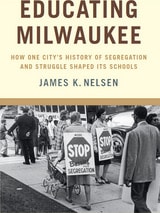
Educating Milwaukee
How One City’s History of Segregation and Struggle Shaped Its SchoolsJames K. Nelsen
Wisconsin Historical Society Press, 2015
"Milwaukee's story is unique in that its struggle for integration and quality education has been so closely tied to [school] choice." --from the Introduction
"Educating Milwaukee: How One City's History of Segregation and Struggle Shaped Its Schools" traces the origins of the modern school choice movement, which is growing in strength throughout the United States. Author James K. Nelsen follows Milwaukee's tumultuous education history through three eras--"no choice," "forced choice," and "school choice." Nelsen details the whole story of Milwaukee's choice movement through to modern times when Milwaukee families have more schooling options than ever--charter schools, open enrollment, state-funded vouchers, neighborhood schools--and yet Milwaukee's impoverished African American students still struggle to succeed and stay in school. "Educating Milwaukee" chronicles how competing visions of equity and excellence have played out in one city's schools in the modern era, offering both a cautionary tale and a "choice" example.
Education Policy in Developing Countries
Edited by Paul Glewwe
University of Chicago Press, 2013
Surveying many aspects of education—from administrative structures to the availability of health care to parent and student incentives—the contributors synthesize an impressive diversity of data, paying special attention to the gross imbalances in educational achievement that still exist between developed and developing countries. They draw out clear implications for governmental policy at a variety of levels, conscious of economic realities such as budget constraints, and point to crucial areas where future research is needed. Offering a wealth of insights into one of the best investments a nation can make, Education Policy in Developing Countries is an essential contribution to this most urgent field.
Education for Democracy
Renewing the Wisconsin IdeaEdited by Chad Alan Goldberg
University of Wisconsin Press, 2020
Using the Wisconsin Idea as a lens, Education for Democracy argues that public higher education institutions remain a bastion of collaborative problem solving. Examinations of partnerships between the state university and people of the state highlight many crucial and lasting contributions to issues of broad public concern such as conservation, LGBTQ+ rights, and poverty alleviation. The contributors restore the value of state universities and humanities education as a public good, contending that they deserve renewed and robust support.
Emerging Issues and Trends in Education
Theodore S. Ransaw
Michigan State University Press, 2017
Engaging Place, Engaging Practices
Urban History and Campus-Community PartnershipsEdited by Robin F. Bachin and Amy L. Howard
Temple University Press, 2023
Colleges and universities in urban centers have often leveraged their locales to appeal to students while also taking a more active role in addressing local challenges. They embrace civic engagement, support service-learning, tailor courses to local needs, and even provide university-community collaborations such as lab schools and innovation hubs. Engaging Place, Engaging Practices highlights the significant role the academy, in general, and urban history, in particular, can play in fostering these critical connections.
The editors and contributors to this volume address topics ranging from historical injustices and affordable housing and land use to climate change planning and the emergence of digital humanities. These case studies reveal the intricate components of a city’s history and how they provide context and promote a sense of cultural belonging.
This timely book appreciates and emphasizes the critical role universities must play as intentional—and humble—partners in addressing the past, present, and future challenges facing cities through democratic community engagement.
Envisioning the Faculty for the Twenty-First Century
Moving to a Mission-Oriented and Learner-Centered ModelKezar, Adrianna
Rutgers University Press, 2016

Equity Engines
The Overlooked Colleges Delivering on Higher Education’s PromiseBecca Spindel Bassett
University of Chicago Press, 0
Shares novel insights into American colleges and universities that deliberately support the success of their first-generation, low-income students.
In American higher education, universities that prioritize inclusivity and equity over exclusivity and prestige are penalized rather than rewarded, both in terms of status and resources. Consequently, very few colleges and universities both enroll large shares of low-income students and graduate them at high rates. This is terrible news, both for the first-generation, low-income students with big aspirations and for a democratic society that relies on an educated citizenry and a representative government to function.
In Equity Engines, Becca Spindel Bassett shines a light on a small group of colleges that are quietly achieving the improbable. These “equity engines” open their doors widely to low-income students and graduate them at remarkably high rates. Immersing herself in two distinct institutions, a small private liberal arts university and a large regional public university, Bassett offers a window into the unseen mindsets and policies that drive universities toward equitable outcomes. By culturally and structurally centering first-generation, low-income students and challenging the superiority of exclusive, research-oriented cultures, the faculty, staff, and administrators of both institutions achieve extraordinary results.
Combining ethnography with sociological analysis, Equity Engines presents a detailed and nuanced depiction of the people and practices that power equity engines, the pressures that challenge their operation, and how we can transform American higher education to promote a more democratic and equitable society.
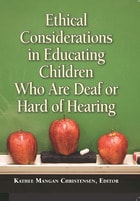
Ethical Considerations in Educating Children Who Are Deaf or Hard of Hearing
Kathee Mangan Christensen
Gallaudet University Press, 2011
The education of deaf or hard of hearing children has become as complex as the varying needs of each individual child. Teachers face classrooms filled with students who are culturally Deaf, hard of hearing, or post-lingually deaf; they might use American Sign Language, cochlear implants, hearing aids/FM systems, speech, Signed English, sign-supported speech, contact signing, nonverbal communication, or some combination of methods. Educators who decide what tools are best for these children are making far-reaching ethical decisions in each case. This collection features ten chapters that work as constructive conversations to make the diverse needs of these deaf students the primary focus.
The initial essays establish fundamental points of ethical decision-making and emphasize that every situation should be examined not with regard for what is “right or wrong,” but for what is “useful.” Absolute objectivity is unattainable due to social influences, while “common knowledge” is ruled out in favor of “common awareness.” Other chapters deal with the reality of interpreting through the professional’s eyes, of how they are assessed, participate, and are valued in the total educational process, including mainstream environments. The various settings of education for deaf children are profiled, from residential schools to life in three cultures for deaf Latino students, to self-contained high school programs. Ethical Considerations in Educating Deaf Children Who Are Deaf or Hard of Hearing offers an invaluable set of guidelines for administrators and educators of children with hearing loss in virtually every environment in a postmodern world.

European Higher Education, Social Responsibility, and the Local Democratic Mission
Sjur Bergan
Temple University Press, 2025
Bergan outlines the political and institutional complexity of European universities. He explains how history, cultural traditions, and national identities impact education across Europe. He also describes the roles of the Council of Europe and U.S. higher education in the development of a transatlantic cooperation on the democratic mission of higher education. Other chapters explore education programs for developing and maintaining democracy and human rights, pragmatic and creative ways that European universities are working with their local communities, and the development of education opportunities for refugees.
Ultimately, Bergan’s book explores not only the local democratic mission of higher education as it has developed in Europe, but also how it could continue to develop, and why it is important it does so.
In the series Higher Education, Place, and Social Responsibility.

Excellence for All
How a New Breed of Reformers Is Transforming America's Public SchoolsJack Schneider
Vanderbilt University Press, 2011
"Excellence for all" might, at first glance, appear to be nothing more than a rhetorical flourish. Who, after all, would oppose the idea of a great education for every student? Yet it is hardly a throwaway phrase. Rather, it represents a surprising fusion of educational policy approaches that had been in tense opposition throughout the twentieth centurythose on the right favoring social efficiency, and those on the left supporting social justice.
This book seeks to understand why the "excellence for all" vision took hold at the time it did, unpacks the particular beliefs and assumptions embedded in it, and details the often informal coalition building that produced this period of consensus. Examining the nation's largest urban school districts (Los Angeles, Chicago, and New York), the author details three major reform efforts in chapters titled "The Right Space: The Small Schools Movement"; "The Right Teachers: Teach for America"; and "The Right Curriculum: Expanding Advanced Placement."
Expelling Public Schools
How Antiracist Politics Enable School Privatization in NewarkJohn Arena
University of Minnesota Press, 2023
Exploring the role of identitarian politics in the privatization of Newark’s public school system
In Expelling Public Schools, John Arena explores the more than two-decade struggle to privatize public schools in Newark, New Jersey—a conflict that is raging in cities across the country—from the vantage point of elites advancing the pro-privatization agenda and their grassroots challengers.
Analyzing the unsuccessful effort of Cory Booker—Newark’s leading pro-privatization activist and mayor—to generate popular support for the agenda, and Booker’s rival and ultimate successor Ras Baraka’s eventual galvanization of the charter movement, Arena argues that Baraka’s black radical politics cloaked a revanchist agenda of privatization.
Expelling Public Schools reveals the political rise of Booker and Baraka, their one-time rivalry and subsequent alliance, and what this particular case study illuminates about contemporary post–civil rights Black politics. Ultimately, Expelling Public Schools is a critique of Black urban regime politics and the way in which antiracist messaging obscures real class divisions, interests, and ideological diversity.