81 books match the query 'Educational equalization' and 5 start with e
cover of Education and Equality

Education and Equality

Danielle Allen

University of Chicago Press, 2016

American education as we know it today—guaranteed by the state to serve every child in the country—is still less than a hundred years old. It’s no wonder we haven’t agreed yet as to exactly what role education should play in our society. In these Tanner Lectures, Danielle Allen brings us much closer, examining the ideological impasse between vocational and humanistic approaches that has plagued educational discourse, offering a compelling proposal to finally resolve the dispute. 
           
Allen argues that education plays a crucial role in the cultivation of political and social equality and economic fairness, but that we have lost sight of exactly what that role is and should be. Drawing on thinkers such as John Rawls and Hannah Arendt, she sketches out a humanistic baseline that re-links education to equality, showing how doing so can help us reframe policy questions. From there, she turns to civic education, showing that we must reorient education’s trajectory toward readying students for lives as democratic citizens. Deepened by commentaries from leading thinkers Tommie Shelby, Marcelo Suárez-Orozco, Michael Rebell, and Quiara Alegría Hudes that touch on issues ranging from globalization to law to linguistic empowerment, this book offers a critical clarification of just how important education is to democratic life, as well as a stirring defense of the humanities. 
[more]
cover of Education, Justice, and Democracy

Education, Justice, and Democracy

Edited by Danielle Allen and Rob Reich

University of Chicago Press, 2013
Education is a contested topic, and not just politically. For years scholars have approached it from two different points of view: one empirical, focused on explanations for student and school success and failure, and the other philosophical, focused on education’s value and purpose within the larger society. Rarely have these separate approaches been brought into the same conversation. Education, Justice, and Democracy does just that, offering an intensive discussion by highly respected scholars across empirical and philosophical disciplines.
 
The contributors explore how the institutions and practices of education can support democracy, by creating the conditions for equal citizenship and egalitarian empowerment, and how they can advance justice, by securing social mobility and cultivating the talents and interests of every individual. Then the authors evaluate constraints on achieving the goals of democracy and justice in the educational arena and identify strategies that we can employ to work through or around those constraints. More than a thorough compendium on a timely and contested topic, Education, Justice, and Democracy exhibits an entirely new, more deeply composed way of thinking about education as a whole and its importance to a good society.
[more]
cover of Emerging Issues and Trends in Education

Emerging Issues and Trends in Education

Theodore S. Ransaw

Michigan State University Press, 2017
As classrooms across the globe become increasingly more diverse, it is imperative that educators understand how to meet the needs of students with varying demographic backgrounds. Emerging Issues and Trends in Education presents case studies from academics who have all at one point been teachers in K–12 classrooms, addressing topics such as STEM as well as global issues related to race, gender education, education policy, and parental engagement. The contributors take an international approach, including research about Nigerian, Chinese, Native American, and Mexican American classrooms. With a focus on multidisciplinary perspectives, Emerging Issues and Trends in Education is reflective of the need to embrace different ways of looking at problems to improve education for all students.
[more]
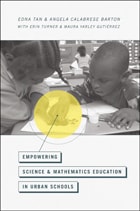
cover of Empowering Science and Mathematics Education in Urban Schools

Empowering Science and Mathematics Education in Urban Schools

Edna Tan and Angela Calabrese Barton with Erin Turner and Maura Varley Gutiérrez

University of Chicago Press, 2012
Math and science hold powerful places in contemporary society, setting the foundations for entry into some of the most robust and highest-paying industries. However, effective math and science education is not equally available to all students, with some of the poorest students—those who would benefit most—going egregiously underserved. This ongoing problem with education highlights one of the core causes of the widening class gap.
 
While this educational inequality can be attributed to a number of economic and political causes, in Empowering Science and Mathematics Education in Urban Communities, Angela Calabrese Barton and Edna Tan demonstrate that it is augmented by a consistent failure to integrate student history, culture, and social needs into the core curriculum. They argue that teachers and schools should create hybrid third spaces—neither classroom nor home—in which underserved students can merge their personal worlds with those of math and science. A host of examples buttress this argument: schools where these spaces have been instituted now provide students not only an immediate motivation to engage the subjects most critical to their future livelihoods but also the broader math and science literacy necessary for robust societal engagement. A unique look at a frustratingly understudied subject, Empowering Science and Mathematics Education pushes beyond the idea of teaching for social justice and into larger questions of how and why students participate in math and science. 
[more]
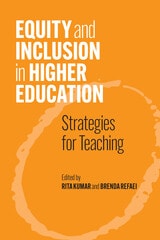
cover of Equity and Inclusion in Higher Education: Strategies for Teaching

Equity and Inclusion in Higher Education

Strategies for Teaching

Edited by Rita Kumar and Brenda Refaei

University of Minnesota Press, 2020

Americans’ perception of college students does not correlate with the reality of the rich diversity seen on university campuses. Over 60% of Americans believe the average age of a college student is 20 years old but, in fact, it’s 26.4 years old. Demographics in the classroom are shifting and instructors bear a responsibility to adjust their teaching style and curriculum to be inclusive for all students.

Equity and Inclusion for Higher Education Strategies for Teaching, edited by Rita Kumar and Brenda Refaei, details the necessity for an inclusive curriculum with examples of discipline-specific activities and modules. The intersectionality of race, age, socioeconomic status, and ability all embody the diversity college instructors encounter in their classrooms. Through the chapters in this book, the contributors make apparent the "hidden curriculum," which is taught implicitly instead of explicitly. The editors focus on learner-centered environments and accessibility of classroom materials for traditionally marginalized students; a critical part of the labor needed to create an inclusive curriculum.

This text provides instructors with resources to create equity-based learning environments. It challenges instructors to see beyond Eurocentric curriculums and expand their pedagogy to include intercultural competence. The contributors challenge the student/instructor dichotomy and embrace collaboration between the two to construct a curriculum that fits all students' needs. The resources and examples in this book demonstrate the importance of inclusion and equity in the classroom. A companion community page provides examples and tools from the editors and contributing authors, which allows for readers to add materials from their own classrooms. This book and collaborative toolkit allow instructors to begin intentional practice of an inclusive curriculum and implement changes to promote respect for diversity.

[more]