Results by title
60 books match the query 'Energy' and 11 start with e
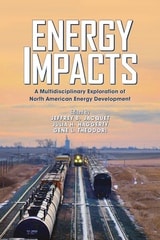
Energy Impacts
A Multidisciplinary Exploration of North American Energy DevelopmentJeffrey B. Jacquet
University Press of Colorado, 2020
Twelve chapters from respected scholars in a variety of disciplines present new ways to consider and analyze energy impact research. Focused on varied energy topics, geographies, and disciplines, each chapter includes a policy brief that summarizes the work and provides “key takeaways” to apply the findings to policy and public discourse.
Meaningful public engagement is critical in limiting the negative implications of energy development, and understanding the social influences on and of energy systems is a cornerstone of addressing the climate crisis. As such, Energy Impacts is a significant work for students, scholars, and professionals working in sociology, education, geography, environmental studies, and public health.
This material is based upon work supported by the National Science Foundation under Grant No. 1528422. Publication is also supported, in part, by Montana State University.
Contributors:
Ali Adil, Lisa Bailey-Davis, Nancy Bowen-Elizey, Morey Burnham, Weston Eaton, Heather Feldhaus, Felix Fernando, Emily Grubert, C. Clare Hinrichs, John Hintz, Richard Hirsh, Season Hoard, Tamara Laninga, Eric Larson, Achla Marathe, Natalie Martinkus, Seven Mattes, Ronald Meyers, Patrick Miller, Ethan Minier, Myra Moss, Jacob Mowery, Thomas Murphy, Sevda Ozturk Sari, John Parkins, Christopher Podeschi, Nathan Ratledge, Sanne Rijkhoff, Kelli Roemer, Todd Schenk, Anju Seth, Kate Sherren, Jisoo Sim, Marc Stern, Jessica Ulrich-Schad, Cameron Whitley, Laura Zachary
Energy and Structure
A Theory of Social PowerBy Richard Newbold Adams
University of Texas Press, 1975
All social structures are essentially power structures dependent on energy. The concept of power and the role of energy in social organization are crucial and timely concerns, especially in light of the current apprehension about future energy resources. In Energy and Structure, Richard N. Adams argues that social power affects humanity's approach to ecological, economic, and political problems, directing people to seek solutions that are often deceptively shortsighted.
Adams, an anthropologist, proposes that social power is directly derived from control over energy processes. He identifies how power and mentalistic structures constitute fundamental determinants that shape the lives of people at all stages of cultural development, forcing them to accept alternatives often far removed from their desires. His central thesis is that the amount of power in any system varies with the amount of control exercised over the environment and that increasing power and control lead to increasing centralization of decision-making, social marginalization, and environmental despoliation. Thus the more highly developed societies, by virtue of their greater controls, are responsible for the greater ultimate subordination and destruction of human potential, as humanity combines technological advances with a growing inability to exercise good judgment with respect to our own survival.
Energy and Structure begins with an examination of the basic theory of social power—what it is and how it works. Adams defines and differentiates between the concepts of power and control, authority and legitimacy, power domains and levels. He then examines the underlying metatheory of energetic and mentalistic structures and provides an analytic model of the evolution of power, from the primitive band to modern nations. He predicts the emergence of supranational blocs and discusses other future possibilities. Throughout, his theoretical points are solidly supported by examples drawn from a wide range of cultures.
Energy in the Nordic World
Mogens Rüdiger and Anna Åberg
University of Wisconsin Press, 2023
Norway and Sweden are among the biggest consumers of energy per capita, yet the Nordic nations also lead the world in clean power production and have ambitious goals of decarbonizing their energy systems by 2050. Denmark, Norway, Sweden, Finland, and Iceland vary drastically in geography and the availability of natural resources, but each consistently generates electricity from renewable sources at multiple times the average rate of other high-income countries.
Mogens Rüdiger and Anna Åberg present a concise and timely history of energy production, trade, and consumption in Norden, starting with a review of the regional energy mix—from wind, solar, tide and wave, geothermal, biomass, nuclear, coal, and gas sources. Brief chapters describe the diversity of Nordic energy markets, assess how far the green transition has come, and explore what comes next as global crises, domestic politics, and technological developments present novel challenges and opportunities. Energy infrastructures and economic activities, Rüdiger and Åberg argue, serve as unique cultural focal points in the region. The coauthors summarize the national policy frameworks for the sector as well as the key energy and economic indicators used in infrastructure planning, regulation, and the opening of the electricity and gas markets to free competition.
Energy in the Nordic World is the essential primer to the power markets at the heart of Europe’s energy transition.
Energy
Resources, technologies and the environmentChristian Ngô
The Institution of Engineering and Technology, 2010

Energy
The Life of John J. McKetta Jr.By Elisabeth Sharp McKetta, Foreword by William H. Cunningham
University of Texas Press, 2017
Energy recounts the life of Dr. John J. McKetta Jr., a first-generation Ukrainian American coal miner who worked his way up from the mines to become the world’s foremost energy expert, a university dean, an encyclopedia editor, and one of the most widely known and respected professors in his field. To honor his one hundredth birthday in 2015, thousands of his former students raised more than $25 million to celebrate his contributions to their lives and to chemical engineering at the University of Texas at Austin, which rechristened his home department the John J. McKetta Jr. Department of Chemical Engineering.
In this biography, granddaughter Elisabeth Sharp McKetta retraces Dr. McKetta’s path to becoming the godfather of modern chemical engineering. She describes how he dedicated his life to supporting students throughout their careers, becoming legendary for phoning scores of them on their birthdays every year, while also showing Americans how to produce and use energy efficiently. John J. McKetta Jr.’s fascinating story has been the subject of hundreds of articles and interviews, and now Energy is the first full-length book about his remarkable life.
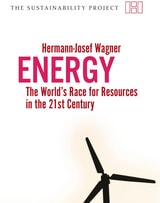
Energy
The Worlds Race for Resources in the 21st CenturyHermann-Josef Wagner
Haus Publishing, 2009
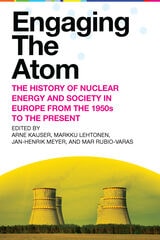
Engaging the Atom
The History of Nuclear Energy and Society in Europe from the 1950s to the PresentArne Kaijser
West Virginia University Press, 2021
With the aim of overcoming the disciplinary and national fragmentation that characterizes much research on nuclear energy, Engaging the Atom brings together specialists from a variety of fields to analyze comparative case studies across Europe and the United States. It explores evolving relationships between society and the nuclear sector from the origins of civilian nuclear power until the present, asking why nuclear energy has been more contentious in some countries than in others and why some countries have never gone nuclear, or have decided to phase out nuclear, while their neighbors have committed to the so-called nuclear renaissance. Contributors examine the challenges facing the nuclear sector in the context of aging reactor fleets, pressing climate urgency, and increasing competition from renewable energy sources.
Written by leading academics in their respective disciplines, the nine chapters of Engaging the Atom place the evolution of nuclear energy within a broader set of national and international configurations, including its role within policies and markets.
Environmental and Energy Policy and the Economy
Volume 1Edited by Matthew J. Kotchen, James H. Stock, and Catherine D. Wolfram
University of Chicago Press Journals, 2020
Environmental and Energy Policy and the Economy
Volume 2Edited by Matthew J. Kotchen, James H. Stock, and Catherine D. Wolfram
University of Chicago Press Journals, 2020
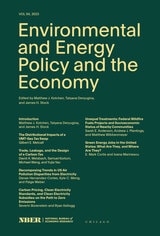
Environmental and Energy Policy and the Economy
Volume 4Edited by Matthew J. Kotchen, Tatyana Deryugina, and James H. Stock
University of Chicago Press Journals, 2023
Environmental and Energy Policy and the Economy focuses on the effective and efficient management of environmental and energy challenges. Research papers offer new evidence on the intended and unintended consequences, the market and nonmarket effects, and the incentive and distributional impacts of policy initiatives and market developments.
This volume presents six new papers on environmental and energy economics and policy. Gilbert Metcalf examines the distributional impacts of substituting a vehicle miles-traveled tax for the existing federal excise tax in the United States. David Weisbach, Samuel Kortum, Michael Wang, and Yujia Yao consider solutions to the leakage problem of climate policy with differential tax policies on the supply and demand for fossil fuels and on domestic production and consumption. Danae Hernandez-Cortes, Kyle Meng, and Paige Weber quantify and decompose recent trends in air pollution disparities in the US electricity sector. Severin Borenstein and Ryan Kellogg provide a comparative analysis of different incentive-based mechanisms to reduce emissions in the electricity sector on a path to zero emissions. Sarah Anderson, Andrew Plantinga, and Matthew Wibbenmeyer document distributional differences in the allocation of US wildfire prevention projects. Finally, Mark Curtis and Ioana Marinescu provide new evidence on the quality and quantity of emerging “green” jobs in the United States.
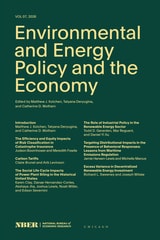
Environmental and Energy Policy and the Economy
Volume 7Edited by Matthew J. Kotchen, Tatyana Deryugina, and Catherine D. Wolfram
University of Chicago Press Journals, 2026
Rigorous, careful, and nonpartisan research with a high policy impact on environmental and energy economics.
Environmental and Energy Policy and the Economy focuses on the effective and efficient management of environmental and energy challenges. Research papers offer new evidence on the intended and unintended consequences, the market and nonmarket effects, and the incentive and distributional impacts of policy initiatives and market developments.
This volume presents six new papers on environmental and energy economics and policy. Judson Boomhower and Meredith Fowlie illustrate the distributional consequences of improving risk pricing efficiency in wildfire insurance markets. Claire Brunel and Arik Levinson develop a conceptual framework for understanding the economic and environmental consequences of taxes on imports of goods based on their carbon content. Karen Clay, Danae Hernandez-Cortes, Akshaya Jha, Joshua Lewis, Noah Miller, and Edson Severnini study the long-run distributional implications of US power plant sitings over more than a century. Todd Gerarden, Mar Reguant, and Daniel Xu provide a comprehensive overview of industrial policy in the renewable energy sector, with comparisons across the US, EU, and China. Jamie Hansen-Lewis and Michelle Marcus show how failure to account for behavioral responses can affect policy predictions regarding maritime emissions. Finally, Richard Sweeney and Joseph Wilske estimate the externalities associated with correlated intermittency in electricity generation from US wind power investments.