Results by title
240 books match the query 'English as a Second Language' and 11 start with e
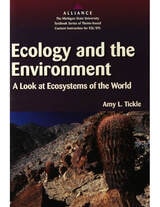
Ecology and the Environment
A Look at Ecosystems of the WorldAmy L. Tickle
University of Michigan Press, 1996

Ecology and the Environment
A Look at Ecosystems of the World: Teacher's ManualAmy L. Tickle
University of Michigan Press, 1996
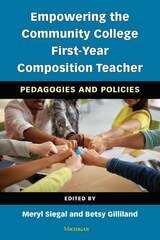
Empowering the Community College First-Year Composition Teacher
Pedagogies and PoliciesMeryl Siegal and Betsy Gilliland
University of Michigan Press, 2021
This volume is an inquiry into community college first-year pedagogy and policy at a time when change has not only been called for but also mandated by state lawmakers who financially control public education. It also acknowledges new policies that are eliminating developmental and remedial writing courses while keeping mind that, for most community college students, first-year composition serves as the last course they will take in the English department toward their associate’s degree.
Chapters focusing on pedagogy and policy are integrated within cohesively themed parts: (1) refining pedagogy; (2) teaching toward acceleration; (3) considering programmatic change; and (4) exploring curriculum through research and policy. The volume concludes with the editors’ reflections regarding future work; a glossary and reflection questions are included.
This volume also serves as a call to action to change the way community colleges attend to faculty concerns. Only by listening to teachers can the concerns discussed in the volume be addressed; it is the teachers who see how societal changes intersect with campus policies and students’ lives on a daily basis.
English Pronunciation
Excercises in Sound Segments, Intonation, and RhythmRobert Lado and Charles C. Fries
University of Michigan Press, 1954
English Sentence Structure
Robert Krohn and the Staff of the Michigan English Language Institute
University of Michigan Press, 1957
English Sentence Structure presents and clarifies all facets of the sentence for beginning and intermediate students. Oral drills, examples, and written exercises form a pattern of regular review and self-evaluation. Each lesson is coordinated with English Pattern Practices.
English Structure Practices
Keith S. Folse
University of Michigan Press, 1983
This is the workbook to accompany English Sentence Structure.
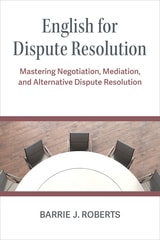
English for Dispute Resolution
Mastering Negotiation, Mediation, and Alternative Dispute ResolutionBarrie J. Roberts
University of Michigan Press, 2025
Whether they are using English for Dispute Resolution as a self-study resource or a course textbook, readers can use the book to develop their own unique negotiation and mediation styles in English and improve their professional-level English skills and soft skills for any purpose. Chapters introduce Alternative Dispute Resolution, negotiation ethics, competitive and collaborative negotiation, negotiation game theory, apologies, drafting written agreements, and mediation. After an engaging hypothetical case that introduces the chapter’s key points, each chapter provides warm-up questions, readings about dispute resolution theory and strategies, language tips, and activities and sample phrases to practice applying chapter lessons to real-world disputes. Chapters also invite readers to explore topics of interest, such as dispute resolution in their home countries, personal and professional lives, and current events, and the growing use of Artificial Intelligence (AI) in ADR. Readers will simultaneously build confidence in their English and cross-cultural dispute resolution skills.
English for Dispute Resolution offers readers:
- Lessons that explain the theories behind Alternative Dispute Resolution, negotiation ethics, competitive and collaborative negotiation, and mediation
- Activities that help them develop their own unique negotiation strategies and styles along with critical thinking, problem-solving, reading, writing, listening, and speaking.
- Step-by-step guidance, sample sentences, and practice activities for applying chapter lessons to real-world disputes.
- Opportunities to explore topics of interest, such as dispute resolution in their home countries, personal and professional lives and current events, and the growing use of Artificial Intelligence (AI) in ADR.
- Key ADR terms and idioms in plain, accessible English.
- Specific tips to improve cross-cultural communication for negotiating and mediating in English.
- A companion website with downloadable checklists, forms, and sample language that can be used for classroom role-plays and real-world negotiations and mediations.
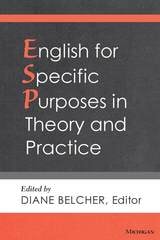
English for Specific Purposes in Theory and Practice
Diane Belcher, Editor
University of Michigan Press, 2009
The field of English for Specific Purposes (ESP) is among the richest areas of second language research and practice because increasing globalization and changing technologies spawn new modes of intercultural connection and new occasions for second language use. English for Specific Purposes in Theory and Practice compasses this burgeoning field by presenting new research and commentary from some of the field’s leading scholars.
This volume explores ESP from academic (secondary and tertiary), occupational (business, medical, and legal), and socio-cultural perspectives. Recurring motifs throughout the volume are the effects of globalization, English as a lingua franca, and the impact of migrant populations. One of the major questions this volume seeks to answer is, How can ESP instructors meet their own teacher knowledge needs? Also considered is, How have ESP practitioners succeeded in gaining control of the knowledge they need to address their students’ needs?
English in Today's Research World
A Writing GuideJohn M. Swales and Christine B. Feak
University of Michigan Press, 2000
In addition to instruction on writing for publication, English in Today's Research World provides needed advice on applications, recommendations, and requests--types of communications that are particularly vulnerable to influences from national cultural expectations and conventions and that, therefore, place the NNS writer at increased disadvantage.
The text is both a reference manual and a course book, so that researchers can continue to use the book after they have completed their formal education. New ESL/EFL teachers can use English in Today's Research World as a reference book for themselves or as a teaching aid in the classroom.
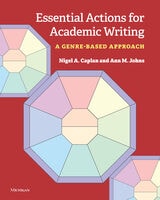
Essential Actions for Academic Writing
A Genre-Based ApproachNigel A. Caplan and Ann M. Johns
University of Michigan Press, 2022
Part I:
- Introduces students to rhetorical situation, genre, register, source use, and a framework for understanding how to approach any new writing task.
- Demonstrates that all writing responds to a context that includes the writer’s identity, the reader’s expectations, the purpose of the text, and the conventions that shape it.
- Explores the essential actions of academic writing (explain, summarize, synthesize, report and interpret data, argue, respond, and analyze).
- Provides examples of the genres and language that support each action.
- Offers four extended projects that combine the essential actions in different genres and contexts.
Exploring Options in Academic Writing
Effective Vocabulary and Grammar UseJan Frodesen and Margi Wald
University of Michigan Press, 2016
Following a unit on using resources for vocabulary development, the contents are divided into three parts: Showing Relationships within Sentences, Connecting and Focusing across Sentences, and Qualifying Statements and Reporting Research. Part 1 focuses on verbs and modifiers that express increases and decreases, verbs and abstract nouns that describe change, connectors and verbs describing causal relationships, and parallel structures. Part 2 explores the words that help connect ideas and add cohesion. Part 3 discusses how to express degrees of certainty and accuracy and the use of reporting verbs.