Results by title
134 books match the query 'English-speaking countries' and 3 start with e
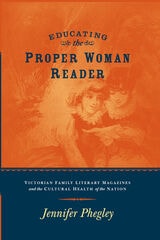
EDUCATING THE PROPER WOMAN READER
VICTORIAN FAMILY LITERARY MAGAZINES & CULTURAL HEALTH OF THE NATIONJennifer Phegley
The Ohio State University Press, 2004
Jennifer Phegley presents an examination of four mid-Victorian magazines that middle-class women read widely. Educating the Proper Woman Reader reevaluates prevailing assumptions about the vexed relationship between nineteenth-century women readers and literary critics.
While many scholars have explored the ways nineteenth-century critics expressed their anxiety about the dangers of women’s unregulated and implicitly uncritical reading practices, which were believed to threaten the sanctity of the home and the cultural status of the nation, Phegley argues that family literary magazines revolutionized the position of women as consumers of print by characterizing them as educated readers and able critics. Her analysis of images of influential women readers (in Harper’s), intellectual women readers (in The Cornhill), independent women readers (in Belgravia), and proto-feminist women readers/critics (in Victoria) indicates that women played a significant role in determining the boundaries of literary culture within these magazines. She argues that these publications supported women’s reading choices, inviting them to define literary culture rather than to consume it passively.
Not only does this book revise our understanding of nineteenth-century attitudes toward women readers, but it also takes a fresh look at the transatlantic context of literary production. Further, Phegley demonstrates the role these publications played in improving cultural literacy among women of the middle classes as well as the interplay between fiction and essays of the time by writers such as Mary Braddon, Charles Dickens, George Eliot, Elizabeth Gaskell, G. H. Lewes, Harriet Martineau, Margaret Oliphant, George Sala, William Thackeray, and Anthony Trollope.

Echo Chambers
Figuring Voice In NarrativePatrick O'Donnell
University of Iowa Press, 1992
Echo Chambers provides an illuminating discussion of the representation of “voice” in novels by Dickens, Joyce, Faulkner, Lowry, and Gaddis. Focusing on the paradoxes of “voice” as an indication of how different authors understand the contradictions of “identity,” O'Donnell charts the recent history of subjectivity as reflected in the development of modern fiction. With strong theoretical underpinning—O'Donnell skillfully utilizes the theories formulated by Bakhtin, Derrida, Bersani, De Man, Deleuze, and Guattari, among others, and the semiotics of voice put forth by Julia Kristeva—Echo Chambers shows how identity is inherently contradictory, conflicted, and multiple.
This insightful volume compellingly demonstrates that “voice” is a revealing (because contradictory and heterogeneous) site where language, the body, culture, and subjectivity meet. Echo Chambers makes an important contribution to the study of modern literature, the semiotics of identity, and cultural poetics as they are informed by the projections of voice in modern narrativ
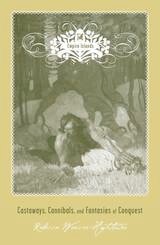
Empire Islands
Castaways, Cannibals, and Fantasies of ConquestRebecca Weaver-Hightower
University of Minnesota Press, 2007