Results by title
83 books match the query 'Enlightenment' and 7 start with e

Eating the Enlightenment
Food and the Sciences in Paris, 1670-1760E. C. Spary
University of Chicago Press, 2012
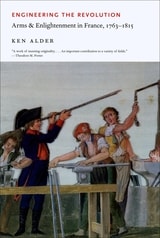
Engineering the Revolution
Arms and Enlightenment in France, 1763-1815Ken Alder
University of Chicago Press, 2010
Engineering the Revolution documents the forging of a new relationship between technology and politics in Revolutionary France, and the inauguration of a distinctively modern form of the “technological life.” Here, Ken Alder rewrites the history of the eighteenth century as the total history of one particular artifact—the gun—by offering a novel and historical account of how material artifacts emerge as the outcome of political struggle. By expanding the “political” to include conflict over material objects, this volume rethinks the nature of engineering rationality, the origins of mass production, the rise of meritocracy, and our interpretation of the Enlightenment and the French Revolution.
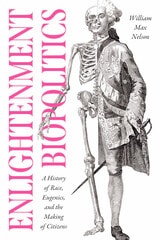
Enlightenment Biopolitics
A History of Race, Eugenics, and the Making of CitizensWilliam Max Nelson
University of Chicago Press, 2024
In Enlightenment Biopolitics, historian William Max Nelson pursues the ambitious task of tracing the context in which biopolitical thought emerged and circulated. He locates that context in the Enlightenment when emancipatory ideals sat alongside the horrors of colonialism, slavery, and race-based discrimination. In fact, these did not just coexist, Nelson argues; they were actually mutually constitutive of Enlightenment ideals.
In this book, Nelson focuses on Enlightenment-era visions of eugenics (including proposals to establish programs of selective breeding), forms of penal slavery, and spurious biological arguments about the supposed inferiority of particular groups. The Enlightenment, he shows, was rife with efforts to shape, harness, and “organize” the minds and especially the bodies of subjects and citizens. In his reading of the birth of biopolitics and its transformations, Nelson examines the shocking conceptual and practical connections between inclusion and exclusion, equality and inequality, rights and race, and the supposed “improvement of the human species” and practices of dehumanization.
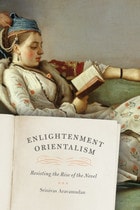
Enlightenment Orientalism
Resisting the Rise of the NovelSrinivas Aravamudan
University of Chicago Press, 2011
Srinivas Aravamudan here reveals how Oriental tales, pseudo-ethnographies, sexual fantasies, and political satires took Europe by storm during the eighteenth century. Naming this body of fiction Enlightenment Orientalism, he poses a range of urgent questions that uncovers the interdependence of Oriental tales and domestic fiction, thereby challenging standard scholarly narratives about the rise of the novel.
Enlightenment Portraits
Edited by Michel Vovelle
University of Chicago Press, 1997
The Enlightenment's leading figures cast their light in an irregular and unequal way: areas and environments in which new ideas penetrated and took effect alternated with shadowy patches. The fundamental structures of society may have remained stable, but new ways of producing, of being, and of appearing made sometimes abrupt headway. Attitudes toward life, birth, love, marriage and sexuality, and death had begun to change.
The twilight of the Enlightenment came at the end of the eighteenth century, part of a sequence of events of which the French Revolutions was simply the paroxysm.
A subtle and complex study of the Enlightenment, this book allows contemporary readers to reflect on how nineteenth- and twentieth-century scholars have constructed their views on eighteenth-century man.

Enlightenment in Colonial Egypt
Ahmad Lutfi al-Sayyid in His GenerationIsrael Gershoni and Molly Bernstein
University of Texas Press, 2026
A study of Ahmad Lutfi al-Sayyid, widely recognized as the creator of Egyptian nationalism, and his impact on Egyptian culture and history.
Ahmad Lutfi al-Sayyid (1872–1963) stands among the most creative, impactful intellectuals of modern Egypt and the Middle East. While best known as the architect of Egyptian nationalism, his nationalist endeavor was in fact part of his broader project to bring enlightenment to Egypt under the yoke of British colonialism. Through his articles, editorials, and mentoring, his newspaper al-Jarida became a key forum for the lively debates of the time, ranging from the role of Islam in society to women's inclusion, all toward shaping a unique colonial modernity for his country.
The most comprehensive study of Lutfi, his writing, and his impact, Enlightenment in Colonial Egypt deconstructs the view that he was a covert apologist for empire out of admiration for the liberal aspects of European enlightenment. Lutfi faced this duality head on: He believed it essential to embrace parts of the West’s enlightenment values and to decolonize and Egyptianize them in order to establish an authentic, indigenous, Egyptian civilization, appropriate for modernity. Israel Gershoni and Molly Bernstein argue that Lutfi successfully engaged with these most difficult challenges, shaping a detailed plan to implement enlightenment in the Egyptian national context.
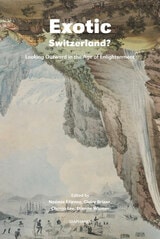
Exotic Switzerland?
Looking Outward in the Age of EnlightenmentEdited by Noémie Étienne, Claire Brizon, Chonja Lee, and Étienne Wismer
Diaphanes, 2020