434 books match the query 'Ethics & Moral Philosophy' and 53 start with e
cover of ET vol 126 num 3

ET vol 126 num 3

The University of Chicago Press

University of Chicago Press Journals, 2016
This is volume 126 issue 3 of Ethics. Ethics features scholarly work that covers a range of topics pertaining to moral, political, and legal philosophy from a variety of intellectual perspectives, including social and political theory, law, and economics. Articles in the journal present new theories, apply theory to contemporary moral issues, and focus on historical works that have significant implications for contemporary theory. In addition to major articles, Ethics publishes critical discussions, symposia, review essays, and book reviews.
[more]
cover of ET vol 128 num 1

ET vol 128 num 1

The University of Chicago Press

University of Chicago Press Journals, 2017
This is volume 128 issue 1 of Ethics. Ethics features scholarly work that covers a range of topics pertaining to moral, political, and legal philosophy from a variety of intellectual perspectives, including social and political theory, law, and economics. Articles in the journal present new theories, apply theory to contemporary moral issues, and focus on historical works that have significant implications for contemporary theory. In addition to major articles, Ethics publishes critical discussions, symposia, review essays, and book reviews.
[more]
cover of Eating Anxiety: The Perils of Food Politics

Eating Anxiety

The Perils of Food Politics

Chad Lavin

University of Minnesota Press, 2013


Debates about obesity are really about the meaning of responsibility. The trend toward local foods reflects the changing nature of space due to new communication technologies. Vegetarian theory capitalizes on biotechnology’s challenge to the meaning of species. And food politics, as this book makes powerfully clear, is actually about the political anxieties surrounding globalization.


In Eating Anxiety, Chad Lavin argues that our culture’s obsession with diet, obesity, meat, and local foods enacts ideological and biopolitical responses to perceived threats to both individual and national sovereignty. Using the occasion of eating to examine assumptions about identity, objectivity, and sovereignty that underwrite so much political order, Lavin explains how food functions to help structure popular and philosophical understandings of the world and the place of humans within it. He introduces the concept of digestive subjectivity and shows how this offers valuable resources for rethinking cherished political ideals surrounding knowledge, democracy, and power.


Exploring discourses of food politics, Eating Anxiety links the concerns of food—especially issues of sustainability, public health, and inequality—to the evolution of the world order and the possibilities for democratic rule. It forces us to question the significance of consumerist politics and—simultaneously—the relationship between politics and ethics, public and private.


[more]
cover of Echoes From The Holocaust: Philosophical Reflections on a Dark Time

Echoes From The Holocaust

Philosophical Reflections on a Dark Time

edited by Alan Rosenberg and Gerald E. Myers

Temple University Press, 1990

The murder of six million Jewish men, women, and children during World War II was an act of such barbarity as to constitute one of the central events of our time; yet a list of the major concerns of professional philosophers since 1945 would exclude the Holocaust. This collection of twenty-three essays, most of which were written expressly for this volume, is the first book to focus comprehensively on the profound issues and philosophical significance of the Holocaust.

The essays, written for general as well as professional readers, convey an extraordinary range of factual information and philosophical reflection in seeking to identify the haunting meanings of the Holocaust. Among the questions addressed are: How should philosophy approach the Holocaust? What part did the philosophical climate play in allowing Hitlerism its temporary triumph? What is the philosophical climate today and what are its probable cultural effects? Can philosophy help our culture to become a bulwark against future agents of evil? The multiple dimensions of the Holocaust—historical, sociological, psychological, religious, moral, and literary—are collected here for concentrated philosophical interpretations.

[more]
cover of Ecological Governance: Toward a New Social Contract with the Earth

Ecological Governance

Toward a New Social Contract with the Earth

Bruce Jennings

West Virginia University Press, 2016

As our economic and natural systems continue on their collision course, Bruce Jennings asks whether we have the political capacity to avoid large-scale environmental disaster. Can liberal democracy, he wonders, respond in time to ecological challenges that require dramatic changes in the way we approach the natural world? Must a more effective governance be less democratic and more autocratic? Or can a new form of grassroots ecological democracy save us from ourselves and the false promises of material consumption run amok?

Ecological Governance is an ethicist’s reckoning with how our political culture, broadly construed, must change in response to climate change. Jennings argues that during the Anthropocene era a social contract of consumption has been forged. Under it people have given political and economic control to elites in exchange for the promise of economic growth. In a new political economy of the future, the terms of the consumptive contract cannot be met without severe ecological damage. We will need a new guiding vision and collective aim, a new social contract of ecological trusteeship and responsibility.


[more]
cover of Elements Of Metaphysics

Elements Of Metaphysics

William Carter

Temple University Press, 1989

"This is a work of the highest quality It is lucid, spells out each position with readily comprehensible arguments, and manages in the process to effortlessly integrate the most current views with classical, historical material.... It is without doubt the best general introduction to current treatments of metaphysics I have seen. A first-rate book." --Gerald Vision, Temple University This introduction to metaphysics provides a concise explanation and discussion of the branch of philosophy that concerns the nature of the world we inhabit. The approach is partly historical but focuses largely on recent arguments and lines of thought. William Carter addresses many issues, among them: the nature of mind, matter, ideas, and substance; the debate between those who believe human beings have free will and those who subscribe to determinism; fatalism, realism, and personal identity; and arguments for and against belief in the existence of God. He also explores the implications of such intellectual exercises for defining the boundaries of human knowledge and human responsibility. Woven into the authors discussion are the ideas of historical and contemporary figures who have made significant philosophical contributions in these areas. Carter tries to eliminate the intimidation that the term "metaphysics" can generate among students and general readers. Demonstrating how metaphysics overlaps extensively with nearly every branch of philosophical inquiry, he provides contemporary and often amusing examples to introduce the important topics of metaphysics and make current technical debates comprehensible for novices.
[more]
cover of Embodied Care: Jane Addams, Maurice Merleau-Ponty, and Feminist Ethics

Embodied Care

Jane Addams, Maurice Merleau-Ponty, and Feminist Ethics

Maurice Hamington

University of Illinois Press, 2004

Until now, ethicists have said little about the body, limiting their comments on it to remarks made in passing or, at best, devoting a chapter to the subject. Embodied Care is the first work to argue for the body's centrality to care ethics, doing so by analyzing our corporeality at the phenomenological level. It develops the idea that our bodies are central to our morality, paying particular attention to the ways we come to care for one another.
 
Hamington's argues that human bodies are "built to care"; as a result, embodiment must be recognized as a central factor in moral consideration. He takes the reader on an exciting journey from modern care ethics to Merleau-Ponty's philosophy of the body and then to Jane Addams's social activism and philosophy. The ideas in Embodied Care do not lead to yet another competing theory of morality; rather, they progress through theory and case studies to suggest that no theory of morality can be complete without a full consideration of the body.
 
[more]
cover of Emerson and the Defense of Equality

Emerson and the Defense of Equality

Greg Garvey

University of Massachusetts Press, 2025

Arguing for equality as the necessary foundation of liberty

During Ralph Waldo Emerson’s lifetime, the idea of universal human equality was under intensive assault. Repeatedly—in contexts ranging from slavery, to marriage, to politics and workers’ rights—Americans of the time were being told that equality was an obsolete ideal and that the future would belong to those who accepted the hard truth that liberty lies not in egalitarian values but in hierarchies of domination and submission. Greg Garvey’s Emerson and the Defense of Equality focuses on Emerson as a real-time defender of equality during the antebellum culture wars.

In contrast to studies that treat individual liberty as Emerson’s primary concern, Garvey argues that Emerson’s works define a broad and sustained defense of equality as the necessary foundation of liberty. When read as part of a debate about equality, Emerson’s Nature is a treatise on individuality and the common weal; his anti-slavery speeches and English Traits advance evolutionary theories to rebut polygenesist arguments for white supremacy; the essays “Love” and “Domestic Life” challenge gender spheres and explore equality in marriage, friendship, and citizenship. As Emerson speculates on the future, “Politics” and “The Young American” anticipate a “beneficent socialism” in which human rights will always have priority over property rights. In his career-long effort to defend a threatened ideal, Emerson develops an aspirational vision of society that understands equality to be a fundamental aspect of liberty.

[more]
cover of Emotions in History – Lost and Found

Emotions in History – Lost and Found

Ute Frevert

Central European University Press, 2011

Coming to terms with emotions and how they influence human behaviour, seems to be of the utmost importance to societies that are obsessed with everything "neuro." On the other hand, emotions have become an object of constant individual and social manipulation since "emotional intelligence" emerged as a buzzword of our times. Reflecting on this burgeoning interest in human emotions makes one think of how this interest developed and what fuelled it. From a historian's point of view, it can be traced back to classical antiquity. But it has undergone shifts and changes which can in turn shed light on social concepts of the self and its relation to other human beings (and nature). The volume focuses on the historicity of emotions and explores the processes that brought them to the fore of public interest and debate.

[more]
cover of Environmental Ethics in the Midwest: Interdisciplinary Approaches

Environmental Ethics in the Midwest

Interdisciplinary Approaches

Ian Smith

Michigan State University Press, 2022
The American Midwest is environmentally rich and complex, home to some of the world’s largest freshwater lakes and streams as well as cities, prairies, forests, and farmlands. Nevertheless, the unique environmental opportunities and challenges the region presents have been left underappreciated and underexplored by environmental ethicists. The close integration of the natural and built environments of the Midwest prompts interdisciplinary inquiry in a particularly pointed way. To remedy the lack of scholarly attention to this area, this volume attends to the way that the broad concerns of environmental ethics manifest in the region. These eight original essays cover a wide range of topics, including agrarian ethics and Stoicism; the Dakota access pipeline and Indigenous women’s activism; philosophy of law and species classification; environmental justice and the Flint water crisis; hog farming and antimicrobial drug resistance; science education standards and climate change education; virtue ethics and ecological restoration; environmental pragmatism and the Clean Water Act; and more. Each accessibly written chapter brings multidisciplinary complexity to bear on this complex region. The authors include philosophers working in environmental ethics and other subfields of philosophy, and together with scholars in fields such as environmental sociology, American Indian studies, and environmental studies, they provide a fresh and necessary perspective on the American Midwest.
[more]
cover of Essays on Logic, Ethics, and Universal Grammar

Essays on Logic, Ethics, and Universal Grammar

Edited by Philip Schofield

University College London, 2025

Never before published in authentic form, this collection of Jeremy Bentham’s essays expands on his ideas about logic, language, ethics, and grammar. 

Best known as the founder of the ethical theory of utilitarianism, Bentham’s philosophical contributions spanned political economy, judicial administration, prison reform, policing, religion, and many more fields. This new addition to The Collected Works of Jeremy Bentham deals with his ideas about logic, language, ethics, and grammar. Distributed across four essays written between 1814 and 1816 and an appendix, it includes discussions of methodization, ontology, real and fictitious entities, and propositions as the fundamental components of language. In addition to constituting a major contribution to the history of logic and language, this collection establishes the philosophical basis for classical utilitarianism and Chrestomathia, Bentham’s major work outlining his materialist theory of language. 

[more]
cover of Essential Vulnerabilities: Plato and Levinas on Relations to the Other

Essential Vulnerabilities

Plato and Levinas on Relations to the Other

Deborah Achtenberg

Northwestern University Press, 2014
In Essential Vulnerabilities, Deborah Achtenberg contests Emmanuel Levinas’s idea that Plato is a philosopher of freedom for whom thought is a return to the self. Instead, Plato, like Levinas, is a philosopher of the other. Nonetheless, Achtenberg argues, Plato and Levinas are different. Though they share the view that human beings are essentially vulnerable and essentially in relation to others, they conceive human vulnerability and responsiveness differently. For Plato, when we see beautiful others, we are overwhelmed by the beauty of what is, by the vision of eternal form. For Levinas, we are disrupted by the newness, foreignness, or singularity of the other. The other, for him, is new or foreign, not eternal. The other is unknowable singularity. By showing these similarities and differences, Achtenberg resituates Plato in relation to Levinas and opens up two contrasting ways that self is essentially in relation to others.
[more]
cover of Ethical Communication: Moral Stances in Human Dialogue

Ethical Communication

Moral Stances in Human Dialogue

Clifford G. Christians and John C. Merrill

University of Missouri Press, 2009

Proponents of professional ethics recognize the importance of theory but also know that the field of ethics is best understood through real-world applications. This book introduces students and practitioners to important ethical concepts through the lives of major thinkers ranging from Aristotle to Ayn Rand, John Stuart Mill to the Dalai Lama.
Some two dozen contributors approach media ethics from five perspectives—altruistic, egoistic, autonomous, legalist, and communitarian—and use real people as examples to convey ethical concepts as something more than mere abstractions. Readers see how Confucius represents group loyalty; Gandhi, nonviolent action; Mother Teresa, the spirit of sacrifice. Each profile provides biographical material, the individual’s basic ethical position and contribution, and insight into how his or her moral teachings can help the modern communicator. The roster of thinkers is gender inclusive, ethnically diverse, and spans a broad range of time and geography to challenge the misperception that moral theory is dominated by Western males.
These profiles challenge us not to give up on moral thinking in our day but to take seriously the abundance of good ideas in ethics that the human race provides. They speak to real-life struggles by applying to such trials the lasting quality of foundational thought. Many of the root values to which they appeal are cross-cultural, even universal.
Exemplifying these five ethical perspectives through more than two dozen mentors provides today’s communicators with a solid grounding of key ideas for improving discussion and attaining social progress in their lives and work. These profiles convey the diversity of means to personal and social betterment through worthwhile ideas that truly make ethics come alive.
[more]
cover of Ethical Excellence: Philosophers, Psychologists, and Real-Life Exemplars Show Us How to Achieve It

Ethical Excellence

Philosophers, Psychologists, and Real-Life Exemplars Show Us How to Achieve It

Heidi M. Giebel

Catholic University of America Press, 2021

Why do some people achieve ethical excellence while others fail? For example, how did Gloria Lewis overcome a lifetime of difficulty and go on to found a non-profit focused on feeding the homeless while Danny Starrett, despite a seemingly ideal childhood, became a rapist and murderer? Why did some Germans rescue their Jewish neighbors while others stood by? One recent study found that four personal variables, taken together, differentiated Nazi-era bystanders from rescuers with startling 96.1% accuracy: social responsibility, altruistic moral reasoning, empathic concern, and risk-taking—traits related to ethical excellences (virtues) like justice, benevolence, and courage. Drawing from the combined wisdom of classical Socratic and Confucian philosophy, recent work in psychology, and the lived experience of recognized moral heroes, the book focuses on how each of us can work toward ethical excellence, becoming more like Lewis and neighbor-rescuers than like Starrett and Nazi-era bystanders. The ancient Socratic and Confucian philosophical traditions offer surprisingly sophisticated advice regarding moral education. Because research in psychology helps us assess the feasibility of cultivating virtue in ourselves and those we influence, Ethical Excellence focuses on combining sound philosophical analysis of ethical virtue and related concepts with relevant empirical research on how these concepts are manifested and developed in everyday practice. Willpower, for example, contributes to development of temperance or moderation, grit relates to perseverance, and empathy is connected to benevolence. Finally, the study of ethically exceptional people—moral heroes or exemplars—serves as living proof that ethical excellence is possible, and exemplars can provide inspiration to attempt it ourselves and guidance regarding how to do so successfully. Relevant stories and excerpts from the author’s own interviews with award-winning ethical exemplars complement the use of philosophical virtue theory and psychological research on virtue-relevant practice. Together, these three approaches—philosophy, psychology, and biography—help to triangulate” ethical excellence and its achievement, presenting a much clearer and more complete picture than we can get from any one of these methods alone.
[more]
cover of Ethical Issues for a New Millennium

Ethical Issues for a New Millennium

Edited by John Howie

Southern Illinois University Press, 2002

Modern advances in science and medicine bring with them an array of complex ethical dilemmas. In Ethical Issues for a New Millennium editor John Howie addresses contemporary ethical problems with eight essays from top thinkers in the field. This collection offers new and comprehensive overviews of some very tough ethical issues that will remain foremost in our minds in the years ahead.  Each essay is written by a recognized authority within his or her specific field, and brings to light ethical questions rooted in ongoing philosophical debates in arenas such as human rights, the welfare state, women’s rights, genetic and gender equality, genetic equity, cloning, organ transplants, environmental ethics, insurrectionist ethics, and the erosion of moral sensibility.


These lectures where originally presented at Southern Illinois University as part of the Wayne Leys Memorial Lectures series. This collection represents the fourth volume in the series.
[more]
cover of Ethical Issues in Contemporary Society

Ethical Issues in Contemporary Society

John Howie

Southern Illinois University Press, 1995

In this volume of Leys Lectures, the third collection of Wayne Leys Memorial Lectures, six distinguished essayists demonstrate the relevance of ethics to contemporary concerns by constructively exploring major ethical issues deeply embedded in our society.

The essays, written by noted scholars Tom Regan, Carol C. Gould, James Rachels, James P. Sterba, Louis P. Pojman, and David L. Norton, focus on issues of feminism, the exploitation of animals, economic injustice, racial prejudice, naive moral relativism, and the failure of public education.

Tom Regan and Louis P. Pojman both address the issue of animal rights. Regan directs his attention to an ethic-of-care feminism, which contends that the ideology of male superiority—not only to women but to all creatures—must be destroyed. By means of a "consistency argument," he extends ethic-of-care feminism to the treatment of animals, insisting that we must not permit to be done to animals "in the name of science" what we would not allow to be done to human beings. Pojman, on the other hand, addresses the question of animal rights through a critical analysis of seven theories of the moral status of animals, arguing that while animals have no natural "rights" since they are unable to enter into contracts, they do deserve to be treated kindly. In his view, much animal research could be abandoned without significant loss.

What rethinking of democracy in terms of freedom and equality is required by economic justice? Carol C. Gould offers an answer to this question by arguing that economic justice requires that workers control the production process as well as the distribution process. Such justice would provide the basis of "positive freedom" as self-development without ignoring the importance of the absence of constraints.

Taking racial prejudice as his paradigm, James Rachels explores the deeper meaning of prejudice and what equality of treatment involves. Noting the subtlety of prejudicial reasoning, he examines how stereotypes, unconscious bias, and the human tendency toward rationalization make it difficult even for people of good will to prevent prejudice from influencing their actions.

James P. Sterba invites the reader to consider a different and more general problem of how to persuade people to act for moral reasons. To accomplish this aim he shows morality to be a requirement of rationality and "the welfare liberal ideal" (the right to welfare and the right to equal opportunity) to be a fusion of the practical ends of five ideals—liberty, fairness, common good, androgyny, and equality.

For David L. Norton, one of our most pressing problems is the failure of our educational system. The system fails to enable students to make wise "life-shaping" choices involving vocation, marriage, children, and friendship. In order to make good choices, human beings must live and work in an environment that provides experiences that authenticate "personal truths" indispensable to worthy living. These personal truths include direct acquaintance with vocational alternatives and participation in actual service to others.

Collectively, these essays bring into sharp focus the urgent moral issues confronting our society and the need for ongoing discussion and examination of these issues in order to gain deeper understanding of and possible solutions to the problems they present.

[more]
cover of Ethical Principles and Practice

Ethical Principles and Practice

John Howie

Southern Illinois University Press, 1987

The second volume in applied ethics based on the distinguished Wayne Leys Memorial Lectureship Series.

With guidelines from legal reasoning, Michael D. Bayles examines “Moral Theory and Application.” Abraham Edel questions “Ethics Applied Or Conduct Enlightened?” The late Warner A. Wick shows in “The Good Person and the Good Society: Some Ideals Foolish and Otherwise” that devotion to ideals need not be either fanaticism or foolishness. John Lachs contends that many public gains are purchased at the cost of individuals being manipulated in “Public Benefit, Private Costs.” James E. Childress in “Gift of Life…” considers ethical issues in obtaining and distributing human organs. Carl Wellman in “Terrorism and Moral Rights” argues that there can be no “rights-based justification” for anti-abortion terrorism.

[more]
cover of Ethical Principles for Social Policy

Ethical Principles for Social Policy

John Howie

Southern Illinois University Press, 1983

Abortion, euthanasia, racism, sexism, pater­nalism, the rights of children, the population explosion, and the dynamics of economic growth are examined in the light of ethical principles by leading philosophers in order to suggest reasonable judgments.

Originally prepared for the distinguished Wayne Leys Memorial Lecture Series at Southern Illinois University, Carbondale, the essayists have addressed themselves to the most pressing ethical questions being asked today. William K. Frankena, Professor Emer­itus, University of Michigan, in “The Ethics of Respect for Life” argues for a qualified view of moral respect for human personality. From his viewpoint it is always prima facie wrong to shorten or prevent human life, but not always actually wrong as other moral conditions may counter the presumed wrong. The late William T. Blackstone in “Zero Population Growth and Zero Economic Growth” contends that justice will require the production of the maximal level of goods to fulfill basic human needs com­patible with the avoidance of ecological catastrophe.

Richard Wasserstrom, Professor of Phi­losophy at the University of California, Santa Cruz, proposes an assimilationist ideal in “Racism, Sexism, and Preferential Treat­ment.” Gerald Dworkin, Professor of Phi­losophy at the University of Illinois, Chicago Circle, dares to ask “Is More Choice Better than Less?” Joel Feinberg, Professor of Phi­losophy at the University of Arizona, in “The Child’s Right to an Open Future,” offers a defense of “rights-in-trust” of children. Tom L. Beauchamp, Professor of Philosophy and Senior Research Scholar at the Kennedy In­stitute-Center for Bioethics of Georgetown University, considers the paternalism used to justify social policies in the practice of medi­cine and insists that it invariably involves a conflict between the ethical principles of be­neficence and autonomy.

[more]
cover of Ethics and Aesthetics of Translation: Exploring the Works of Atxaga, Kundera and Semprún

Ethics and Aesthetics of Translation

Exploring the Works of Atxaga, Kundera and Semprún

Harriet Hulme

University College London, 2018

Ethics and Aesthetics of Translation engages with translation, in both theory and practice, as part of an interrogation of ethical as well as political thought in the work of three bilingual European authors: Bernardo Atxaga, Milan Kundera, and Jorge Semprún. In approaching the work of these authors, the book draws upon the approaches to translation offered by Benjamin, Derrida, Ricoeur, and Deleuze to highlight a broad set of ethical questions, focused upon the limitations of the monolingual and the democratic possibilities of linguistic plurality; upon our innate desire to translate difference into similarity; and upon the ways in which translation responds to the challenges of individual and collective remembrance. Each chapter explores these interlingual but also intercultural, interrelational, and interdisciplinary issues, mapping a journey of translation that begins in the impact of translation upon the work of each author, continues into moments of linguistic translation, untranslatability and mistranslation within their texts and ultimately becomes an exploration of social, political and affective untranslatability. In these journeys, the creative and critical potential of translation emerges as a potent, often violent, but always illuminating, vision of the possibilities of differentiation and connection, generation and memory, in temporal, linguistic, cultural and political terms.
 
[more]
cover of Ethics and Its Sources in Nature and Revelation

Ethics and Its Sources in Nature and Revelation

Karol Wojtyla

Catholic University of America Press, 2026

The Catholic University of America Press is honored to publish the English Critical Edition of the Works of Karol Wojtyła/John Paul II. Prepared under the auspices of the John Paul II Institute in Washington DC, the English Critical Edition will comprise more than 20 volumes, covering all of John Paul II’s writings in the years before his papacy and a thematic selection of his papal writings. The third volume of the series presents various ethical and anthropological works by Karol Wojtyła. In addition to multiple essays, this volume features his larger works such as Ethics: Its Concept and Methodology, A Primer of Ethics, Considerations on the Essence of Man, and On the Knowability and Knowledge of God. It also contains Wojtyła’s reviews of books, master’s theses, and doctoral dissertations, written chiefly while he lectured at the Catholic University of Lublin. As was the case with previous volumes, Volume 3 also relies on the original manuscripts and typescripts of Wojtyła’s works. These original texts were compared with the Polish published editions, and all significant differences between them have been marked in the scholarly apparatus. Some of the essays in this volume have not been previously published in English, while some others have never been published before.
[more]
cover of Ethics and Morality in Sport Management: Fourth Edition

Ethics and Morality in Sport Management

Fourth Edition

Joy T. DeSensi

FiT Publishing, 2020

Ethics and morality are generally viewed as critical areas in contemporary sport and need not be limited to such topics as sportsmanship, the use of performance-enhancing drugs, violence and cheating. Those in sport management are responsible for addressing ethical and moral questions pertaining to professionalism, equity, legal and financial management, personnel concerns, governance and policies, league and franchise issues, and matters of social justice associated with all aspects of sport. Sport managers must also be aware of and approach these queries logically, rationally and with sensitivity to ensure the integrity of sport, the sport community and society at large.

Ethics & Morality in Sport Management, 4th edition, presents concepts and theories in ethics and morality and demonstrates their applicability in sport management. While addressed primarily to undergraduate and graduate students interested in the organization and administration of sport, this text is also  a practical guide and reference for professionals already in the field, as well as athletes, coaches, franchise owners, journalists, spectators, governmental agencies and others associated with sport. Sport managers must be aware of and concerned about their own obligations, rights and responsibilities, as well as those they influence. As such, nothing short of sound ethical and moral reasoning must inform their managerial decisions and actions. This text aims to make clear the nature of ethics and morality, introducing readers to several major ethical theories, and discussing and analyzing the practical ramifications of these precepts in several sport management contexts.
[more]
cover of Ethics and Personality: Essays in Moral Psychology

Ethics and Personality

Essays in Moral Psychology

Edited by John Deigh

University of Chicago Press, 1992
This anthology focuses on emotions and motives that relate to our status as moral agents, our capacity for moral judgement, and the practices that help to define our social lives. Attachment, trust, respect, conscience, guilt, revenge, depravity, and forgiveness are among the topics discussed. Collectively, the thirteen essays in this collection represent a time-honored tradition in ethics: the effort to throw light on fundamental questions concerning the complexities of the human soul.
[more]
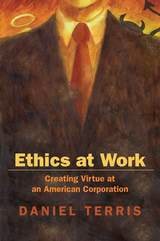
cover of Ethics at Work: Creating Virtue at an American Corporation

Ethics at Work

Creating Virtue at an American Corporation

Daniel Terris

Brandeis University Press, 2013
The defense industry has, to some people’s surprise, the broadest and most sustained set of ethics programs of any sector of American business today. Lockheed Martin, which specializes in a host of high-technology products and services for the federal government, has dramatically escalated its formal ethics and business conduct program since the mega-corporation was formed through a merger in 1995. The Ethics and Business Conduct Division employs 65 “ethics officers” in sites around the United States, and it requires the firm’s 130,000-plus employees to devote at least one hour per year to consideration of the ethical issues of the business, at a cost of millions of dollars per year. Daniel Terris spent two years researching Lockheed Martin materials and interviewing its ethics officers and ordinary employees to develop this rich case study of the ethics program at this powerful global corporation. This study begins with a survey of American attitudes toward ethics in business over the past century, raising the question of whether ethics can be genuinely built into the modern mega-corporation. Terris then develops a portrait of Lockheed Martin—its history and the nature of its far-flung businesses—turning at last to its ethics program, which was created following a series of bribery, overcharging, and corruption scandals in the 1970s and 1980s. By 1996, Lockheed Martin had in place some dull, preachy ethics programs designed to provide basic information on telling right from wrong in business practice. But then-CEO Norm Augustine wanted to liven things up, so he turned to an unlikely source of inspiration: the irreverent Dilbert comic strip. The company came up with a board game that resembled Clue, but used Dilbert characters to explore ethical case studies drawn from real-life Lockheed Martin incidents. Terris examines the success of the board game, as well as subsequent efforts including special workshops, a film festival, and biennial ethics surveys to engage employees in broad-based discussions of ethics at work. Although Terris applauds Lockheed Martin’s ethics program as “gloriously democratic” in its focus on the responsibility of every worker for the ethical dimensions of his or her actions, he is concerned that the broad-based focus tends to divert attention from the ethical responsibilities of senior management and the moral complexities of collective decision-making. While he admires the ambitious scope of the program, he notes that the corporation’s definition of “ethics” focuses on individual behavior rather than on the impact of the corporation’s broader policies on local, national, and global communities. The ultimate effect of such programs may be to create more ethical business practices—but, ironically, at the expense of the public good.
[more]
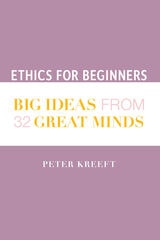
cover of Ethics for Beginners: Big Ideas from 32 Great Minds

Ethics for Beginners

Big Ideas from 32 Great Minds

Peter Kreeft

St. Augustine's Press, 2019

 This is not a typical ethics textbook.

Most ethics textbooks are anthologies of articles by contemporary philosophers, or a whole book by one contemporary philosopher, about ethical puzzles to be solved by logical analysis. This is good mental exercise but it will not change your life, and you will not remember it ten years from now. You will not remember a hundred bright little ideas, you will remember only a few Big Ideas, the ones that changed your life. This book is about 52 of them..

And it is by 32 great philosophers. They are all dead. (Philosophers die, but philosophy does not; it buries all its undertakers.) Living philosophers who write ethics textbooks are usually very bright, but they do not include any name we know will live for centuries. Why apprentice yourself to second rate scribblers like me when you can apprentice yourself to the greatest minds in history? Why not learn from Socrates, Buddha, Confucius, Plato, Aristotle, Kant, Kierkegaard, and Nietzsche? Why prefer little minds to big ones?

They disagree with each other, to be sure, but all of them will help you, not least those who contradict you and challenge you, and stretch you by forcing you to reply to them, and fight with them. I am appalled by the fact that 90% of the best philosophy students at the best universities, which say they cultivate "diversity," have exactly the same politically correct opinions, whether of the Left or the Right. 

When you were a child your mother probably reminded you before you went out not to forget something like your lunch box or your umbrella. Ethics today is usually treated that way: as an afterthought: check with an ethicist before doing the really important things like business or law or medicine or diplomacy. But ethics is not a P.S. to life. It is about the most fundamental things in life: values, good and evil. Socrates said that a good person does not worry much about little things like whether he lives or dies, but only about big things like whether he is a good person or a bad one. 

[more]
cover of Ethics of Maimonides

Ethics of Maimonides

Hermann Cohen, Translated by Almut Sh. Bruckstein

University of Wisconsin Press, 2004

    Hermann Cohen’s essay on Maimonides’ ethics is one of the most fundamental texts of twentieth-century Jewish philosophy, correlating Platonic, prophetic, Maimonidean, and Kantian traditions. Almut Sh. Bruckstein provides the first English translation and her own extensive commentary on this landmark 1908 work, which inspired readings of medieval and rabbinic sources by Leo Strauss, Franz Rosenzweig, and Emmanuel Levinas.
    Cohen rejects the notion that we should try to understand texts of the past solely in the context of their own historical era. Subverting the historical order, he interprets the ethical meanings of texts in the light of a future yet to be realized. He commits the entire Jewish tradition to a universal socialism prophetically inspired by ideals of humanity, peace, and universal justice.
    Through her own probing commentary on Cohen’s text, like the margin notes of a medieval treatise, Bruckstein performs the hermeneutical act that lies at the core of Cohen’s argument: she reads Jewish sources from a perspective that recognizes the interpretive act of commentary itself.

[more]
cover of Ethics, Life and Institutions: An Attempt at Practical Philosophy

Ethics, Life and Institutions

An Attempt at Practical Philosophy

Jan Sokol

Karolinum Press, 2017

General complaints about moral decay, however frequent and even justified they may be, are of little use. This book does not complain; it acts. Jan Sokol’s Ethics, Life and Institutions applies our ever improving knowledge in various fields to questions of morality in an effort to enhance our ability to discern different moral phenomena and to discuss them more precisely.

With few exceptions, moral philosophy considers the acting person to be an autonomous, independent individual pursuing his or her own happiness. But in the context of social institutions—for example, in workplaces—it is often an organization’s goals, not an individual’s, that take precedence. In complex networks of organizations, morals take a different shape. Divided into three parts, this book begins by exploring basic notions such as freedom, life, responsibility, and justice, and their relationship to practical philosophy; looks to the main schools of Western thought in the search for a common moral foundation; and reintroduces the forgotten idea of biological and cultural heritage—an idea that could prove fundamental in addressing our responsibility not only to human lives, but also to the natural world. In a closing analysis, Sokol brings all of these moral concepts to bear on problems connected to the growing complexity of institutions, offering hope for a practical philosophy for the modern world.
[more]
cover of Ethics, volume 131 number 4 (July 2021)

Ethics, volume 131 number 4 (July 2021)

The University of Chicago Press

University of Chicago Press Journals, 2021
This is volume 131 issue 4 of Ethics. Ethics features scholarly work that covers a range of topics pertaining to moral, political, and legal philosophy from a variety of intellectual perspectives, including social and political theory, law, and economics. Articles in the journal present new theories, apply theory to contemporary moral issues, and focus on historical works that have significant implications for contemporary theory. In addition to major articles, Ethics publishes critical discussions, symposia, review essays, and book reviews.
[more]
cover of Ethics, volume 132 number 1 (October 2021)

Ethics, volume 132 number 1 (October 2021)

The University of Chicago Press

University of Chicago Press Journals, 2021
This is volume 132 issue 1 of Ethics. Ethics features scholarly work that covers a range of topics pertaining to moral, political, and legal philosophy from a variety of intellectual perspectives, including social and political theory, law, and economics. Articles in the journal present new theories, apply theory to contemporary moral issues, and focus on historical works that have significant implications for contemporary theory. In addition to major articles, Ethics publishes critical discussions, symposia, review essays, and book reviews.
[more]
cover of Ethics, volume 132 number 2 (January 2022)

Ethics, volume 132 number 2 (January 2022)

The University of Chicago Press

University of Chicago Press Journals, 2022
This is volume 132 issue 2 of Ethics. Ethics features scholarly work that covers a range of topics pertaining to moral, political, and legal philosophy from a variety of intellectual perspectives, including social and political theory, law, and economics. Articles in the journal present new theories, apply theory to contemporary moral issues, and focus on historical works that have significant implications for contemporary theory. In addition to major articles, Ethics publishes critical discussions, symposia, review essays, and book reviews.
[more]
cover of Ethics, volume 132 number 3 (April 2022)

Ethics, volume 132 number 3 (April 2022)

The University of Chicago Press

University of Chicago Press Journals, 2022
This is volume 132 issue 3 of Ethics. Ethics features scholarly work that covers a range of topics pertaining to moral, political, and legal philosophy from a variety of intellectual perspectives, including social and political theory, law, and economics. Articles in the journal present new theories, apply theory to contemporary moral issues, and focus on historical works that have significant implications for contemporary theory. In addition to major articles, Ethics publishes critical discussions, symposia, review essays, and book reviews.
[more]
cover of Ethics, volume 132 number 4 (July 2022)

Ethics, volume 132 number 4 (July 2022)

The University of Chicago Press

University of Chicago Press Journals, 2022
This is volume 132 issue 4 of Ethics. Ethics features scholarly work that covers a range of topics pertaining to moral, political, and legal philosophy from a variety of intellectual perspectives, including social and political theory, law, and economics. Articles in the journal present new theories, apply theory to contemporary moral issues, and focus on historical works that have significant implications for contemporary theory. In addition to major articles, Ethics publishes critical discussions, symposia, review essays, and book reviews.
[more]
cover of Ethics, volume 133 number 1 (October 2022)

Ethics, volume 133 number 1 (October 2022)

The University of Chicago Press

University of Chicago Press Journals, 2022
This is volume 133 issue 1 of Ethics. Ethics features scholarly work that covers a range of topics pertaining to moral, political, and legal philosophy from a variety of intellectual perspectives, including social and political theory, law, and economics. Articles in the journal present new theories, apply theory to contemporary moral issues, and focus on historical works that have significant implications for contemporary theory. In addition to major articles, Ethics publishes critical discussions, symposia, review essays, and book reviews.
[more]
cover of Ethics, volume 133 number 2 (January 2023)

Ethics, volume 133 number 2 (January 2023)

The University of Chicago Press

University of Chicago Press Journals, 2023
This is volume 133 issue 2 of Ethics. Ethics features scholarly work that covers a range of topics pertaining to moral, political, and legal philosophy from a variety of intellectual perspectives, including social and political theory, law, and economics. Articles in the journal present new theories, apply theory to contemporary moral issues, and focus on historical works that have significant implications for contemporary theory. In addition to major articles, Ethics publishes critical discussions, symposia, review essays, and book reviews.
[more]
cover of Ethics, volume 133 number 3 (April 2023)

Ethics, volume 133 number 3 (April 2023)

The University of Chicago Press

University of Chicago Press Journals, 2023
This is volume 133 issue 3 of Ethics. Ethics features scholarly work that covers a range of topics pertaining to moral, political, and legal philosophy from a variety of intellectual perspectives, including social and political theory, law, and economics. Articles in the journal present new theories, apply theory to contemporary moral issues, and focus on historical works that have significant implications for contemporary theory. In addition to major articles, Ethics publishes critical discussions, symposia, review essays, and book reviews.
[more]
cover of Ethics, volume 133 number 4 (July 2023)

Ethics, volume 133 number 4 (July 2023)

The University of Chicago Press

University of Chicago Press Journals, 2023
This is volume 133 issue 4 of Ethics. Ethics features scholarly work that covers a range of topics pertaining to moral, political, and legal philosophy from a variety of intellectual perspectives, including social and political theory, law, and economics. Articles in the journal present new theories, apply theory to contemporary moral issues, and focus on historical works that have significant implications for contemporary theory. In addition to major articles, Ethics publishes critical discussions, symposia, review essays, and book reviews.
[more]
cover of Ethics, volume 134 number 1 (October 2023)

Ethics, volume 134 number 1 (October 2023)

The University of Chicago Press

University of Chicago Press Journals, 2023
This is volume 134 issue 1 of Ethics. Ethics features scholarly work that covers a range of topics pertaining to moral, political, and legal philosophy from a variety of intellectual perspectives, including social and political theory, law, and economics. Articles in the journal present new theories, apply theory to contemporary moral issues, and focus on historical works that have significant implications for contemporary theory. In addition to major articles, Ethics publishes critical discussions, symposia, review essays, and book reviews.
[more]
cover of Ethics, volume 134 number 2 (January 2024)

Ethics, volume 134 number 2 (January 2024)

The University of Chicago Press

University of Chicago Press Journals, 2024
This is volume 134 issue 2 of Ethics. Ethics features scholarly work that covers a range of topics pertaining to moral, political, and legal philosophy from a variety of intellectual perspectives, including social and political theory, law, and economics. Articles in the journal present new theories, apply theory to contemporary moral issues, and focus on historical works that have significant implications for contemporary theory. In addition to major articles, Ethics publishes critical discussions, symposia, review essays, and book reviews.
[more]
cover of Ethics, volume 134 number 3 (April 2024)

Ethics, volume 134 number 3 (April 2024)

The University of Chicago Press

University of Chicago Press Journals, 2024
This is volume 134 issue 3 of Ethics. Ethics features scholarly work that covers a range of topics pertaining to moral, political, and legal philosophy from a variety of intellectual perspectives, including social and political theory, law, and economics. Articles in the journal present new theories, apply theory to contemporary moral issues, and focus on historical works that have significant implications for contemporary theory. In addition to major articles, Ethics publishes critical discussions, symposia, review essays, and book reviews.
[more]
cover of Ethics, volume 134 number 4 (July 2024)

Ethics, volume 134 number 4 (July 2024)

The University of Chicago Press

University of Chicago Press Journals, 2024
This is volume 134 issue 4 of Ethics. Ethics features scholarly work that covers a range of topics pertaining to moral, political, and legal philosophy from a variety of intellectual perspectives, including social and political theory, law, and economics. Articles in the journal present new theories, apply theory to contemporary moral issues, and focus on historical works that have significant implications for contemporary theory. In addition to major articles, Ethics publishes critical discussions, symposia, review essays, and book reviews.
[more]
cover of Ethics, volume 135 number 1 (October 2024)

Ethics, volume 135 number 1 (October 2024)

The University of Chicago Press

University of Chicago Press Journals, 2024
This is volume 135 issue 1 of Ethics. Ethics features scholarly work that covers a range of topics pertaining to moral, political, and legal philosophy from a variety of intellectual perspectives, including social and political theory, law, and economics. Articles in the journal present new theories, apply theory to contemporary moral issues, and focus on historical works that have significant implications for contemporary theory. In addition to major articles, Ethics publishes critical discussions, symposia, review essays, and book reviews.
[more]
cover of Ethics, volume 135 number 2 (January 2025)

Ethics, volume 135 number 2 (January 2025)

The University of Chicago Press

University of Chicago Press Journals, 2025
This is volume 135 issue 2 of Ethics. Ethics features scholarly work that covers a range of topics pertaining to moral, political, and legal philosophy from a variety of intellectual perspectives, including social and political theory, law, and economics. Articles in the journal present new theories, apply theory to contemporary moral issues, and focus on historical works that have significant implications for contemporary theory. In addition to major articles, Ethics publishes critical discussions, symposia, review essays, and book reviews.
[more]
cover of Ethics, volume 135 number 3 (April 2025)

Ethics, volume 135 number 3 (April 2025)

The University of Chicago Press

University of Chicago Press Journals, 2025
This is volume 135 issue 3 of Ethics. Ethics features scholarly work that covers a range of topics pertaining to moral, political, and legal philosophy from a variety of intellectual perspectives, including social and political theory, law, and economics. Articles in the journal present new theories, apply theory to contemporary moral issues, and focus on historical works that have significant implications for contemporary theory. In addition to major articles, Ethics publishes critical discussions, symposia, review essays, and book reviews.
[more]
cover of Ethics, volume 135 number 4 (July 2025)

Ethics, volume 135 number 4 (July 2025)

The University of Chicago Press

University of Chicago Press Journals, 2025
This is volume 135 issue 4 of Ethics. Ethics features scholarly work that covers a range of topics pertaining to moral, political, and legal philosophy from a variety of intellectual perspectives, including social and political theory, law, and economics. Articles in the journal present new theories, apply theory to contemporary moral issues, and focus on historical works that have significant implications for contemporary theory. In addition to major articles, Ethics publishes critical discussions, symposia, review essays, and book reviews.
[more]
cover of Ethics, volume 136 number 1 (October 2025)

Ethics, volume 136 number 1 (October 2025)

The University of Chicago Press

University of Chicago Press Journals, 2025
This is volume 136 issue 1 of Ethics. Ethics features scholarly work that covers a range of topics pertaining to moral, political, and legal philosophy from a variety of intellectual perspectives, including social and political theory, law, and economics. Articles in the journal present new theories, apply theory to contemporary moral issues, and focus on historical works that have significant implications for contemporary theory. In addition to major articles, Ethics publishes critical discussions, symposia, review essays, and book reviews.
[more]
cover of Ethics, volume 136 number 2 (January 2026)

Ethics, volume 136 number 2 (January 2026)

The University of Chicago Press

University of Chicago Press Journals, 2026
This is volume 136 issue 2 of Ethics. Ethics features scholarly work that covers a range of topics pertaining to moral, political, and legal philosophy from a variety of intellectual perspectives, including social and political theory, law, and economics. Articles in the journal present new theories, apply theory to contemporary moral issues, and focus on historical works that have significant implications for contemporary theory. In addition to major articles, Ethics publishes critical discussions, symposia, review essays, and book reviews.
[more]
cover of Ethics, volume 136 number 3 (April 2026)

Ethics, volume 136 number 3 (April 2026)

The University of Chicago Press

University of Chicago Press Journals, 2026
This is volume 136 issue 3 of Ethics. Ethics features scholarly work that covers a range of topics pertaining to moral, political, and legal philosophy from a variety of intellectual perspectives, including social and political theory, law, and economics. Articles in the journal present new theories, apply theory to contemporary moral issues, and focus on historical works that have significant implications for contemporary theory. In addition to major articles, Ethics publishes critical discussions, symposia, review essays, and book reviews.
[more]
cover of Ethics, volume 136 number 4 (July 2026)

Ethics, volume 136 number 4 (July 2026)

The University of Chicago Press

University of Chicago Press Journals, 2026
This is volume 136 issue 4 of Ethics. Ethics features scholarly work that covers a range of topics pertaining to moral, political, and legal philosophy from a variety of intellectual perspectives, including social and political theory, law, and economics. Articles in the journal present new theories, apply theory to contemporary moral issues, and focus on historical works that have significant implications for contemporary theory. In addition to major articles, Ethics publishes critical discussions, symposia, review essays, and book reviews.
[more]
cover of Ethics, volume 137 number 1 (October 2026)

Ethics, volume 137 number 1 (October 2026)

The University of Chicago Press

University of Chicago Press Journals, 2026
This is volume 137 issue 1 of Ethics. Ethics features scholarly work that covers a range of topics pertaining to moral, political, and legal philosophy from a variety of intellectual perspectives, including social and political theory, law, and economics. Articles in the journal present new theories, apply theory to contemporary moral issues, and focus on historical works that have significant implications for contemporary theory. In addition to major articles, Ethics publishes critical discussions, symposia, review essays, and book reviews.
[more]
cover of Evaluating Art

Evaluating Art

George Dickie

Temple University Press, 1989
"Those who think they know George Dickie's views should be sure to read this book. They are in for some interesting surprises. Of course, those unfamiliar with Dickie's views will also learn a lot." --Anita Silvers, San Francisco State University In this book George Dickie presents a theory about how to judge a work of art--as opposed to a theory that explains why a particular work is defined as art. Focusing mainly on the writings of Monroe Beardsley and critically examining the views of seven other philosophers and art critics--Paul Ziff, Frank Sibley, Nelson Goodman, Nicholas Wolterstorff, David Hume, Bruce Vermazen, and J. O. Urmson--Dickie synthesizes their insights to discover what can be derived from their theories. On this basis, he attempts to work out a theory of art evaluation--the first such book on this topic by a contemporary philosopher. Initially, the author outlines all possible theories of art evaluation, assuming that traditional evaluative notions are used. He identifies seven theory-types that fall under four general headings: imitation value theory, objective intrinsic value theories, subjective intrinsic value theory, and instrumental value theories. Dickie then discusses the historical development of the theory of art evaluation, examining the ways in which eighteenth- and nineteenth-century philosophers treated representation and other cognitive dimensions of art as artistic values. His thorough analysis of the work of other contemporary theorists argues for a theory of art evaluation derived from various strands of thought.
[more]
cover of Every Revolution Was First a Thought: The Civil War and Transcendentalism in Transatlantic Context

Every Revolution Was First a Thought

The Civil War and Transcendentalism in Transatlantic Context

Aren Lerner Craig

University of Massachusetts Press, 2025

Tracing the impact of transcendental philosophy on Union soldiers and their loved ones during the American Civil War

Scholars of the American Civil War have long wondered about the seemingly earnest and sincere sentimental commitment that most Northern soldiers had to their nation and the North’s cause. Unlike many others in other wars, Union soldiers appeared to embrace the war with an unusual conviction and sacrificed their lives with a rare nobility. Their grieving relatives were also buoyed up by their steadfast beliefs in the righteousness of the cause. What was so different about this war, and this period of American history, and what encouraged such an outlook?

In Every Revolution Was First a Thought, Aren Lerner Craig argues that in the Civil War era the American Transcendentalist movement provided a coherent worldview that fostered powerful idealism around issues of character, gender, race, and nationhood, even in the worst of times. Through an exploration of diaries, newspaper editorials, popular songs, and more, Craig demonstrates how Transcendentalist thought moved from elite intellectual circles to the public, providing people a firm belief in the power of individual agency to shape the world and a view of spirituality in which each person was divine, and thus beyond death and destruction. Transcendentalist tenets proved strong enough to withstand the devastation of war and inspired high levels of faith and optimism in soldiers and civilians alike throughout the conflict.

Craig traces the origins of Transcendentalism across the Atlantic, to ideas from Scottish Realism and German Idealism, and connects these philosophies to writings and speeches of major figures like Ralph Waldo Emerson, Henry David Thoreau, and Margaret Fuller. This intellectual history offers a new interpretation of Transcendental thought and its role in the Civil War.

[more]