Results by title
91 books match the query 'Feminists' and 3 start with e
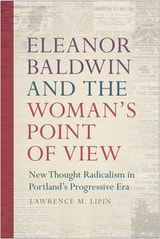
Eleanor Baldwin and the Woman's Point of View
New Thought Radicalism in Portland’s Progressive EraLawrence M. Lipin
Oregon State University Press, 2017
Eleanor Baldwin and the Woman’s Point of View is an intellectual biography of a long-forgotten radical female journalist in Portland, whose daily women’s columns provide a window into the breadth of intellectual radicalism in Progressive Era journalism. Baldwin was one of an early generation of female journalists who were hired to lure female readers to the daily newspaper’s department store advertisements. Instead of catering to the demands of consumerism, Baldwin quickly brought an anti-capitalist, antiracist agenda to her column, “The Woman’s Point of View." She eschewed household hints and instead focused on the immorality of capitalists and imperialists while emphasizing the need for women to become independent and productive citizens.
A century before the Occupy movement and the Women’s March, Baldwin spoke truth to power. Imbued with a New Thought spirituality that presumed progressive thought could directly affect material reality, she wrote to move history forward. And yet, the trajectory of history proved as hard to forecast then as now. While her personal story seems to embody a modern progressivism, blending abolition with labor reform and anti-banker activism—positions from which she never wavered—her path grew more complicated as times changed in the aftermath of World War I, when she would advocate on behalf of both the Bolsheviks and the Ku Klux Klan.
In this deeply researched and nuanced account of Eleanor Baldwin’s intellectual journey, historian Larry Lipin reveals how even the most dedicated radical can be overcome by unforeseen events. Eleanor Baldwin and the Woman’s Point of View restores a missing chapter in Portland’s Progressive Era history and rescues this passionate, intriguing, and quixotic character from undeserved obscurity.
[more]
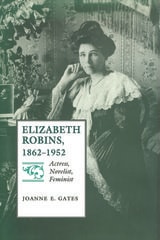
Elizabeth Robins, 1862–1952
Actress, Novelist, FeministJoanne E. Gates
University of Alabama Press, 1994
Robins’s writing on behalf of women’s rights issues in the first quarter of the twentieth century represents an important contribution to feminist politics
From Childhood, Elizabeth Robins dreamed of a successful career on the stage. Her first impulse to visit England, in 1888, stemmed from her desire to secure better opportunities as an actress, and she soon gained celebrity playing Ibsen’s heroines. While buoyed by this success, she began writing fiction that treated the feminist issues of her time: organized prostitution, women’s positions in war-torn England, and the dangers of rearmament. In her acting, writing, and political activism, she consistently challenged existing roles for women. Robins’s work is marked by a number of true-life components, and this first biography to use the vast collection of her private papers demonstrates how Robins transformed her own life into literary and dramatic capital.
Robins published several novels under the pseudonym C. E. Raimond, culminating in the sensational male-female bildungsroman, The Open Question: A Tale of Two Temperaments, which was set in her native Zanesville, Ohio, and publication of which finally disclosed her identity.
Her fiction is compared to that of Henry James, Edith Wharton, and Willa Cather. Many of her heroines share the characteristics of exhibiting force or willed silence, and Gates's analysis of this trait has implications for feminist theorists in a number of fields.
[more]
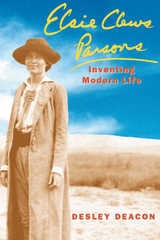
Elsie Clews Parsons
Inventing Modern LifeDesley Deacon
University of Chicago Press, 1997
Elsie Clews Parsons was a pioneering feminist, an eminent anthropologist, and an ardent social critic. In Elsie Clews Parsons, Desley Deacon reconstructs Parsons's efforts to overcome gender biases in both academia and society.
[more]