Results by title
77 books match the query 'Fieldwork' and 4 start with e
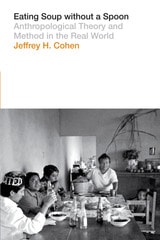
Eating Soup without a Spoon
Anthropological Theory and Method in the Real WorldBy Jeffrey H. Cohen
University of Texas Press, 2015
Significant scholarship exists on anthropological fieldwork and methodologies. Some anthropologists have also published memoirs of their research experiences. Renowned anthropologist Jeffrey Cohen’s Eating Soup without a Spoon is a first-of-its-kind hybrid of the two, expertly melding story with methodology to create a compelling narrative of fieldwork that is deeply grounded in anthropological theory.
Cohen’s first foray into fieldwork was in 1992, when he lived in Santa Anna del Valle in rural Oaxaca, Mexico. While recounting his experiences studying how rural folks adapted to far-reaching economic changes, Cohen is candid about the mistakes he made and the struggles in the village. From the pressures of gaining the trust of a population to the fear of making errors in data collection, Cohen explores the intellectual processes behind ethnographic research. He offers tips for collecting data, avoiding pitfalls, and embracing the chaos and shocks that come with working in an unfamiliar environment. Cohen’s own photographs enrich his vivid portrayals of daily life.
In this groundbreaking work, Cohen discusses the adventure, wonder, community, and friendships he encountered during his first year of work, but, first and foremost, he writes in service to the field as a place to do research: to test ideas, develop theories, and model how humans cope and react to the world.

Ethnographers In The Field
The Psychology of ResearchJohn L. Wengle
University of Alabama Press, 1988
A study of how doing field research submerged in a different culture impacts one's sense of identity.
Ethnographic Chiasmus
Essays on Culture, Conflict and RhetoricIvo Strecker
Michigan State University Press, 2011
Exotic No More
Anthropology on the Front LinesEdited by Jeremy MacClancy
University of Chicago Press, 2002
In Exotic No More, an initiative of the Royal Anthropological Institute, some of today's most respected anthropologists demonstrate, in clear, unpretentious prose, the tremendous contributions that anthropology can make to contemporary society. They cover issues ranging from fundamentalism to forced migration, child labor to crack dealing, human rights to hunger, ethnicity to environmentalism, intellectual property rights to international capitalisms. But Exotic No More is more than a litany of gloom and doom; the essays also explore topics usually associated with leisure or "high" culture, including the media, visual arts, tourism, and music. Each author uses specific examples from their fieldwork to illustrate their discussions, and 62 photographs enliven the text.
Throughout the book, the contributors highlight anthropology's commitment to taking people seriously on their own terms, paying close attention to what they are saying and doing, and trying to understand how they see the world and why. Sometimes this bottom-up perspective makes the strange familiar, but it can also make the familiar strange, exposing the cultural basis of seemingly "natural" behaviors and challenging us to rethink some of our most cherished ideas—about gender, "free" markets, "race," and "refugees," among many others.
Contributors:
William O. Beeman
Philippe Bourgois
John Chernoff
E. Valentine Daniel
Alex de Waal
Judith Ennew
James Fairhead
Sarah Franklin
Michael Gilsenan
Faye Ginsburg
Alma Gottlieb
Christopher Hann
Faye V. Harrison
Richard Jenkins
Melissa Leach
Margaret Lock
Jeremy MacClancy
Jonathan Mazower
Ellen Messer
A. David Napier
Nancy Scheper-Hughes
Jane Schneider
Parker Shipton
Christopher B. Steiner