Results by title
279 books match the query 'Film & Video' and 6 start with e
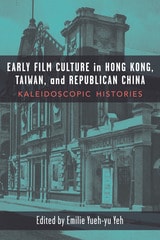
Early Film Culture in Hong Kong, Taiwan, and Republican China
Kaleidoscopic HistoriesEmilie Yueh-yu Yeh, Editor
University of Michigan Press, 2018
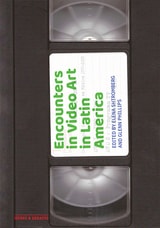
Encounters in Video Art in Latin America
Elena Shtromberg
J. Paul Getty Trust, The, 2023
The emergence of video art in Latin America is marked by multiple points of development, across more than a dozen artistic centers, over a period of more than twenty-five years. When it was first introduced during the 1960s, video was seen as empowering: the portability of early equipment and the possibility of instant playback allowed artists to challenge and at times subvert the mainstream media. Video art in Latin America was—and still is—closely related to the desire for social change. Themes related to gender, ethnic, and racial identity as well as the consequences of social inequality and ecological disasters have been fundamental to many artists’ practices.
This compendium explores the history and current state of artistic experimentation with video throughout Latin America. Departing from the relatively small body of existing scholarship in English, much of which focuses on individual countries, this volume approaches the topic thematically, positioning video artworks from different periods and regions throughout Latin America in dialogue with each other. Organized in four broad sections—Encounters, Networks and Archives, Memory and Crisis, and Indigenous Perspectives—the book’s essays and interviews encourage readers to examine the medium of video across varied chronologies and geographies.
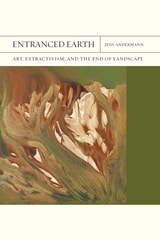
Entranced Earth
Art, Extractivism, and the End of LandscapeJens Andermann
Northwestern University Press, 2023
A sweeping analysis of the lasting effects of neocolonial extractivism in Latin American aesthetic modernity from 1920 to the present
Looking to the extractive frontier as a focal point of Latin American art, literature, music, and film, Jens Andermann asks what emerges at the other end of landscape. Art in the Global South has long represented and interrogated “insurgent nature”—organic and inorganic matter, human and nonhuman life, thrown into turmoil.
In Entranced Earth: Art, Extractivism, and the End of Landscape, Andermann traces the impact of despaisamiento—world-destroying un-landscaping—throughout the Latin American modernist archive. At the same time, he explores innovative, resilient modes of allyship forged between diverse actors through their shared experiences of destruction. From the literary regionalism of the 1930s to contemporary bio art, from modernist garden architecture to representations of migration and displacement in sound art and film, Entranced Earth tracks the crisis of landscape and environmental exhaustion beyond despair toward speculative, experimental forms of survival.

Essay Film and Narrative Techniques
Screen-writing Non-fictionEdited by Romana Turina and Kiki Tianqi Yu
Intellect Books, 2025
Uniting filmmakers and practice-led researchers, Essay Film and Narrative Techniques: Screen-writing Non-fiction explores the evolving language of essay film through various methods of narration, including production diaries, self-critiques, interviews, and theoretical analyses. Including canonical works and unconventional approaches, this collection emphasizes how essay films blur the lines between personal expression and collective storytelling.
In this volume, renowned scholars and practitioners unpack the conceptual and contextual dimensions of screenwriting for essay film, considering its role as both a cinematic and research tool. Whether reflecting on the personal camera or hybrid creative methodologies, the essays provide invaluable insights into how essay films are written and realized.
With its interdisciplinary scope and innovative approach, this work is a beneficial resource for academics, filmmakers, and students of documentary and experimental cinema, offering a nuanced understanding of how screenwriting shapes nonfiction storytelling.
Europe and Love in Cinema
Edited by Luisa Passerini, Jo Labanyi, and Karen Diehl
Intellect Books, 2012
Europe and Love in Cinema explores the relationship between love and Europeanness in a wide range of films from the 1920s to the present. A critical look at the manner in which love—in its broadest sense—is portrayed in cinema from across Europe and the United States, this volume exposes constructed notions of "Europeanness" that both set Europe apart and define some parts of it as more "European" than others. Through the international distribution process, these films in turn engage with ideas of Europe from both outside and within, while some, treated extensively in this volume, even offer alternative models of love. A bracing collection of essays from top film scholars, Europe and Love in Cinema demonstrates the centrality of desire to film narrative and explores multiple models of love within Europe's frontiers.
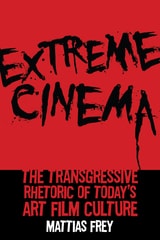
Extreme Cinema
The Transgressive Rhetoric of Today's Art Film CultureFrey, Mattias
Rutgers University Press, 2016
From Shortbus to Shame and from Oldboy to Irreversible, film festival premieres regularly make international headlines for their shockingly graphic depictions of sex and violence. Film critics and scholars alike often regard these movies as the work of visionary auteurs, hailing directors like Michael Haneke and Lars von Trier as heirs to a tradition of transgressive art. In this provocative new book, Mattias Frey offers a very different perspective on these films, exposing how they are also calculated products, designed to achieve global notoriety in a competitive marketplace.