Results by title
836 books match the query 'France' and 31 start with e
Early French Cookery
Sources, History, Original Recipes and Modern AdaptationsD. Eleanor Scully and Terence Scully
University of Michigan Press, 2002
Chapters include an overview of early French culinary traditions, foodstuffs that were used, and methods of preparation. Early French Cookery also discusses the equipment of the kitchens and dining rooms that were used, and characterizes those who prepared the food and those who consumed it.
The recipes are set out in a modern format, with quantities given in both metric and standard U.S. measurements. Recipes are grouped by category: appetizers, vegetables, fish dishes, desserts, and so forth.
Early French Cookery concludes with a fascinating look at a day in the life of a contemporary master chef at a duke's court. We watch Master Chiquart organize the purchase, storage, preparation, and serving of the food consumed by a duke and his dozens of family members, courtiers, staff and servants--and all done without benefit of grocery stores, refrigeration, labor-saving electric appliances, or running water.
Early French Cookery will be of interest to a wide variety of people, from those who like to hold unusual parties to those who are interested in the economics of the middle ages.
D. Eleanor Scully is an occasional lecturer at the Stratford Chef School and advisor to Wilfrid Laurier University on Medieval and Renaissance cooking and customs. Terence Scully is Professor of French Language and Literature, Wilfrid Laurier University, Waterloo, Ontario.

East Lynne
Mitchell, Sally
Rutgers University Press, 1984
Eating the Enlightenment
Food and the Sciences in Paris, 1670-1760E. C. Spary
University of Chicago Press, 2012
Echoes of the Marseillaise
Two Centuries Look Back on the French RevolutionHobsbawm, Eric
Rutgers University Press, 1990
We can learn a great deal from studying the French Revolution itself, but we can also learn from studying the ways in which scholars have interpreted the French Revolution, and from the ways their views have changed. For over a century following the Revolution, commentators and scholars spoke of it in glowing terms. But in the past three decades, revisionist historians have become skeptical. Eric Hobsbawm reiterates the centrality of the Revolution for history on a global basis. He argues that those who wrote about the Revolution in the nineteenth century were convinced it had changed their lives dramatically, improving the economy and the lot of peasants. They saw the Revolution as a prototype of of the bourgeois revolution, enabling the middle class to gain power from the ruling class of aristocrats. Many believed proletarian revolutions would inevitably follow. In the years between 1917 and the 1960s, Marxists continued to use the French Revolution as a point of reference, paying increasing attention to the social and economic factors in the Revolution, not only to the political factors. In the 1970s and 1980s, many historians began to argue that the Revolution achieved modest results at disproportionate costs. Hobsbawm argues that this massive historiographical reaction against the centrality of the Revolution reflects the personal politics of those contemporary historians for whom Marxism and communism are now out of favor. They are, he maintains, wrong. The Revolution transformed the world permanently and introduced forces that continue to transform it.
Echoes of the Marseillaise
Two Centuries Look Back on the French RevolutionHobsbawm, Eric
Rutgers University Press, 2019
E.J. Hobsbawm’s classic historiographic study—written at the very moment when a new set of revolutions swept through the Eastern Bloc and brought down the Iron Curtain—explores how the French Revolution was perceived over the following two centuries. He traces how the French Revolution became integral to nineteenth-century political discourse, when everyone from bourgeois liberals to radical socialists cited these historical events, even as they disagreed on what their meaning. And he considers why references to the French Revolution continued to inflame passions into the twentieth century, as a rhetorical touchstone for communist revolutionaries and as a boogeyman for social conservatives.
Echoes of the Marseillaise is a stimulating examination of how the same events have been reimagined by different generations and factions to serve various political agendas. It will give readers a new appreciation for how the French Revolution not only made history, but also shaped our fundamental notions about history itself.
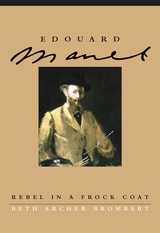
Edouard Manet
Rebel in a Frock CoatBeth Archer Brombert
University of Chicago Press, 1997
"One of the pleasures of reading her is to follow the way she weaves life, art and history into a smooth tapestry. The art emerges from the life, and in the broadest possible context: in terms of its creator's life and concerns and in terns of its historical and cultural setting."—Eric Gibson, The Washington Times Books
"Richly detailed and informative . . . [this biography] exposes the character of an artist who maintained a sharply defined duality between his public and private personas."—Edward J. Sozanski, Philadelphia Inquirer
"Brombert's reading of important canvasses . . . shine, as do her accounts of the changing social and political environment in which Manet worked. . . . Well researched, complexly conceived, and clearly written."—Kirkus Reviews
"Brilliant . . . [this book] grants us a far deeper understanding of why [Manet's] paintings outraged so many of his peers, and why these same masterpieces resonate so richly in our psyches a century later."—Booklist, starred review
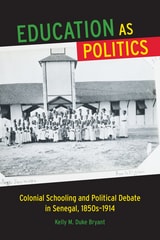
Education as Politics
Colonial Schooling and Political Debate in Senegal, 1850s–1914Kelly M. Duke Bryant
University of Wisconsin Press, 2015
Kelly M. Duke Bryant demonstrates the critical impact of colonial schooling on Senegalese politics by examining the response to it by Africans from a variety of backgrounds and statuses—including rural chiefs, Islamic teachers, and educated young urbanites. For those Africans who chose to engage with them, the French schools in Senegal provided a new source of patronage, a potentially beneficial connection to the bureaucratizing colonial state, a basis for claims to authority or power, or an arena in which to debate pressing issues like the future of Qur’anic schooling and the increasing racism of urban society under colonial rule.
Based on evidence from archives in Senegal and France, and on interviews Duke Bryant conducted in Senegal, she demonstrates that colonial schooling remade African politics during this period of transition to French rule, creating political spaces that were at once African and colonial, and ultimately allowing Diagne to claim election victory.

Eiffel Tower Confidential
What It Meant and What It Stands ForHollis Clayson
University of Chicago Press, 2027
A revelatory behind-the-scenes look at a universally recognized landmark: the Eiffel Tower.
The Eiffel Tower is widely photographed, visited, and written about, but it holds a wealth of stories that are rarely told. When it was built, the three-hundred-meter structure was the tallest on earth, but it bore little resemblance to the stripped-down, modernized monument that is known and loved today. With Eiffel Tower Confidential, art historian Hollis Clayson makes this familiar landmark strange again, offering expert insight into the life of the Tower.
Here she traces the creative financing of the Tower before its construction began, shares images made in its early years, and illuminates the role the Tower played in celebrating French Imperialism. She tells the fascinating story of iron ornamentation that helped the Tower win approval as the centerpiece of the 1889 Universal Exposition but was ripped off and discarded in 1937, and she investigates the sinister backstory behind how the dazzling illumination of the Tower—which combined 10,000 gas lights in glass globes, two kinds of electric spotlights placed at the summit, and Bengal flames on the platforms—was designed to function as an instrument of surveillance.
This extraordinary account takes us into the long shadow of the Eiffel Tower, inviting readers to get to know this acclaimed landmark on an unprecedented level.
Eleanor of Aquitaine, as It Was Said
Truth and Tales about the Medieval QueenKaren Sullivan
University of Chicago Press, 2023
Much of what we know about Eleanor of Aquitaine, Queen of France and then Queen of England, we know from recorded rumor—gossip often qualified by the curious phrase “it was said,” or the love songs, ballads, and romances that gossip inspired. While we can mine these stories for evidence about the historical Eleanor, Karen Sullivan invites us to consider, instead, what even the most fantastical of these tales reveals about this queen and life as a twelfth-century noblewoman. She reads the Middle Ages, not to impose our current conceptual categories on its culture, but to expose the conceptual categories medieval women used to make sense of their lives. Along the way, Sullivan paints a fresh portrait of this singular medieval queen and the women who shared her world.

Eleanor of Aquitaine
Patron and PoliticianEdited by William W. Kibler
University of Texas Press, 1976
Eleanor of Aquitaine was the wife of two kings, Louis VII of France and Henry II Plantagenet of England, and the mother of two others, Richard the Lionhearted and John Lackland. In her eventful, often stormy life, she not only influenced the course of events in the twelfth century but also encouraged remarkable advances in the literary and fine arts. In this book, experts in five disciplines—history, art history, music, French and English literature—evaluate the influence of Eleanor and her court on history and the arts.
Elizabeth A. R. Brown views Eleanor as having played a significant role as parent and politician, but not as patron. Rebecca A. Baltzer takes a new look at the music of the period that was written by and for Eleanor, her court, and her family. Moshé Lazar reexamines her relationship to the courtly-love literature of the period. Eleanor S. Greenhill and Larry M. Ayres reassess her influence in the realm of art history. Rossell Hope Robbins traces the lines extending from the French courtly literature of Eleanor's period down into fourteenth-century Chaucerian England. The essays reflect divergent but generally complementary assessments of this remarkable woman's influence on her own era and on future times as well.
This volume is the result of a symposium held at the University of Texas in 1973.

Elements of French Deaf Heritage
Ulf Hedberg
Gallaudet University Press, 2019
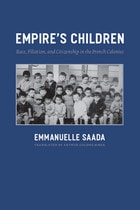
Empire's Children
Race, Filiation, and Citizenship in the French ColoniesEmmanuelle Saada
University of Chicago Press, 2012
Europe’s imperial projects were often predicated on a series of legal and scientific distinctions that were frequently challenged by the reality of social and sexual interactions between the colonized and the colonizers.When Emmanuelle Saada discovered a 1928 decree defining the status of persons of mixed parentage born in French Indochina—the métis—she found not only a remarkable artifact of colonial rule, but a legal bombshell that introduced race into French law for the first time. The decree was the culmination of a decades-long effort to resolve the “métis question”: the educational, social, and civil issues surrounding the mixed population. Operating at the intersection of history, anthropology, and law, Empire’s Children reveals the unacknowledged but central role of race in the definition of French nationality.
Through extensive archival work in both France and Vietnam, and a close reading of primary and secondary material from the Pacific islands and sub-Saharan and North Africa, Saada has created in Empire’s Children an original and compelling perspective on colonialism, law, race, and culture from the end of the nineteenth century until decolonization.
Enchanted Eloquence
Fairy Tales by Seventeenth–Century French Women WritersEdited and Translated by Lewis C. Seifert and Domna C. Stanton
Iter Press, 2010
—Jack Zipes
Professor of German, Emeritus, University of Minnesota

Enchanted Islands
Picturing the Allure of Conquest in Eighteenth-Century FranceMary D. Sheriff
University of Chicago Press, 2018

Enemy Within
Culture Wars and Political Identity in Novels of the French Third RepublicGilbert D. Chaitin
The Ohio State University Press, 2008
Engineering the Revolution
Arms and Enlightenment in France, 1763-1815Ken Alder
University of Chicago Press, 2010
Engineering the Revolution documents the forging of a new relationship between technology and politics in Revolutionary France, and the inauguration of a distinctively modern form of the “technological life.” Here, Ken Alder rewrites the history of the eighteenth century as the total history of one particular artifact—the gun—by offering a novel and historical account of how material artifacts emerge as the outcome of political struggle. By expanding the “political” to include conflict over material objects, this volume rethinks the nature of engineering rationality, the origins of mass production, the rise of meritocracy, and our interpretation of the Enlightenment and the French Revolution.
Enlightenment Biopolitics
A History of Race, Eugenics, and the Making of CitizensWilliam Max Nelson
University of Chicago Press, 2024
In Enlightenment Biopolitics, historian William Max Nelson pursues the ambitious task of tracing the context in which biopolitical thought emerged and circulated. He locates that context in the Enlightenment when emancipatory ideals sat alongside the horrors of colonialism, slavery, and race-based discrimination. In fact, these did not just coexist, Nelson argues; they were actually mutually constitutive of Enlightenment ideals.
In this book, Nelson focuses on Enlightenment-era visions of eugenics (including proposals to establish programs of selective breeding), forms of penal slavery, and spurious biological arguments about the supposed inferiority of particular groups. The Enlightenment, he shows, was rife with efforts to shape, harness, and “organize” the minds and especially the bodies of subjects and citizens. In his reading of the birth of biopolitics and its transformations, Nelson examines the shocking conceptual and practical connections between inclusion and exclusion, equality and inequality, rights and race, and the supposed “improvement of the human species” and practices of dehumanization.
Enlightenment Portraits
Edited by Michel Vovelle
University of Chicago Press, 1997
The Enlightenment's leading figures cast their light in an irregular and unequal way: areas and environments in which new ideas penetrated and took effect alternated with shadowy patches. The fundamental structures of society may have remained stable, but new ways of producing, of being, and of appearing made sometimes abrupt headway. Attitudes toward life, birth, love, marriage and sexuality, and death had begun to change.
The twilight of the Enlightenment came at the end of the eighteenth century, part of a sequence of events of which the French Revolutions was simply the paroxysm.
A subtle and complex study of the Enlightenment, this book allows contemporary readers to reflect on how nineteenth- and twentieth-century scholars have constructed their views on eighteenth-century man.

Environmental Imaginaries of the Middle East and North Africa
Diana K. Davis
Ohio University Press, 2011
The landscapes of the Middle East have captured our imaginations throughout history. Images of endless golden dunes, camel caravans, isolated desert oases, and rivers lined with palm trees have often framed written and visual representations of the region. Embedded in these portrayals is the common belief that the environment, in most places, has been deforested and desertified by centuries of misuse. It is precisely such orientalist environmental imaginaries, increasingly undermined by contemporary ecological data, that the eleven authors in this volume question. This is the first volume to critically examine culturally constructed views of the environmental history of the Middle East and suggest that they have often benefitted elites at the expense of the ecologies and the peoples of the region. The contributors expose many of the questionable policies and practices born of these environmental imaginaries and related histories that have been utilized in the region since the colonial period. They further reveal how power, in the form of development programs, notions of nationalism, and hydrological maps, for instance, relates to environmental knowledge production.
Contributors: Samer Alatout, Edmund Burke III, Shaul Cohen, Diana K. Davis, Jennifer L. Derr, Leila M. Harris, Alan Mikhail, Timothy Mitchell, Priya Satia, Jeannie Sowers, and George R. Trumbull IV

Envisioning Brazil
A Guide to Brazilian Studies in the United StatesEdited by Marshall C. Eakin and Paulo Roberto de Almeida
University of Wisconsin Press, 2005
Envisioning Brazil is a comprehensive and sweeping assessment of Brazilian studies in the United States. Focusing on synthesis and interpretation and assessing trends and perspectives, this reference work provides an overview of the writings on Brazil by United States scholars since 1945.
"The Development of Brazilian Studies in the United States," provides an overview of Brazilian Studies in North American universities. "Perspectives from the Disciplines" surveys the various academic disciplines that cultivate Brazilian studies: Portuguese language studies, Brazilian literature, art, music, history, anthropology, Amazonian ethnology, economics, politics, and sociology. "Counterpoints: Brazilian Studies in Britain and France" places the contributions of U.S. scholars in an international perspective. "Bibliographic and Reference Sources" offers a chronology of key publications, an essay on the impact of the digital age on Brazilian sources, and a selective bibliography.
Equal in Monastic Profession
Religious Women in Medieval FrancePenelope D. Johnson
University of Chicago Press, 1991
Johnson researched more than two dozen nunneries in northern France from the eleventh century through the thirteenth century, balancing a qualitative reading of medieval monastic documents with a quantitative analysis of a lengthy thirteenth-century visitation record which allows an important comparison of nuns and monks. A fascinating look at the world of medieval spirituality, this work enriches our understanding of women's role in premodern Europe and in church history.

Erik Satie
Mary E. Davis
Reaktion Books, 2007
A composer who dabbled in the Dada movement, a Bohemian “gymnopédiste” of fin-de-siècle Montmartre, and a legendary dresser known as “The Velvet Gentleman,” Erik Satie cut a unique figure among early twentieth-century European composers. Yet his legacy has largely languished in the shadows of Stravinsky, Debussy, and Ravel. Mary E. Davis now brings Satie to life in this fascinating new biography.
Satie redefined the composer’s art, devising new methods of artistic expression that melded ordinary and rarified elements of words, visual art, and music. Davis argues that Satie’s modernist aesthetic was grounded in the contradictions of his life—such as enrolling in the conservative Schola Cantorum after working as a cabaret performer—and is reflected in his irreverent essays, drawn art, and music. Erik Satie explores how the composer was embraced by avant-garde artists and fashionable Parisian elite, and how his experiences inspired him to create the musical style of Neoclassicism. Satie also employed the power of the image through his infamous fashion statements, Davis contends, and became part of a nascent celebrity culture.
A cogent and informative portrait, Erik Satie upends the accepted history of modernist music and restores the composer to his rightful pioneering status.

Escape Through the Pyrenees
Lisa Fittko
Northwestern University Press, 2000

Essay on the Origin of Languages and Writings Related to Music
Jean Jacques Rousseau
Dartmouth College Press, 2009
Essays in French Colonial History
Proceedings of the 21st Annual Meeting of the French Colonial Historical SocietyA.J.B. Johnston
Michigan State University Press, 1997
On 31 May - 3 June 1995, more than 200 participants gathered in Sydney and at Fortress Louisbourg, Nova Scotia, for the 21st annual conference of the French Colonial Historical Society. Essays in French Colonial History contains seventeen of the best articles presented at this meeting. It is a wide-ranging collection that explores many new and innovative facets of the French experience outre mer. The contributors, a mix of established experts and younger scholars, examine French activity in North America, the West Indies, Africa, and South America and focus on issues military, social, cultural, native, and political history.
Among the subject areas explored are: the 16th century French colonies in Brazil and Florida; Victor Hugues and the Reign of Terror on Guadeloupe; commerce and the distinctiveness of Louisbourg; the importance of letter-writing and compagnonnage; unresolved territory of the Creek Nation; case studies in the area of transition patrimonial; French colonial interests and policies in Atlantic Canada, Africa, and South America; attitudes among African Americans in post-French St. Louis; and a research report on the Historical Atlas of Quebec.
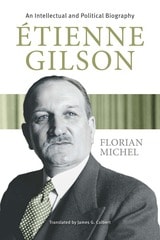
Etienne Gilson
An Intellectual and Political BiographyFlorian Michel
Catholic University of America Press, 2023

Evenings with the Orchestra
Hector Berlioz
University of Chicago Press, 1999

Every Factory a Fortress
The French Labor Movement in the Age of Ford and HitlerMichael Torigian
Ohio University Press, 1999
French trade unions played a historical role in the 1930s quite unlike that of any other labor movement. Against a backdrop of social unrest, parliamentary crisis, and impending world war, industrial unionists in the great metal-fabricating plants of the Paris Region carried out a series of street mobilizations, factory occupations, and general strikes that were virtually unique in Western history.
The unionization of the metal industry, following a series of anti-fascist demonstrations and plant seizures, would constitute the defining episode in modern French labor history and one of the great chapters in European social history. Yet little is known of these extraordinary events.
With a style that captures the vivid character of these experiences, Every Factory a Fortress tells the story of the Paris metal workers, who succeeded in organizing the largest Communist union in the Western world, reshaping the parameters of French social relations, and, ultimately, altering the course of French destinies.

Evil by Design
The Creation and Marketing of the Femme FataleElizabeth K. Menon
University of Illinois Press, 2000
Evil by Design documents the search for the origins of the iconic “femme fatale.” Depicted as a dangerous, depraved, and deadly woman, this image was found frequently in Salon paintings from 1885 to 1910.
Elizabeth K. Menon’s study is the first to use popular sources to make the critical link between the femme fatale and the rise of feminism. In addition to the Salon paintings, Menon sifts through a variety of popular sources, including French illustrated journals, literature, posters, and decorative arts. Over 120 images depict women with serpents, evil flowers, and even miniature men having their hearts cooked. She argues that the evolution of the femme fatale, with both literary and visual links to the biblical Eve figure, came as a response to increasing feminism and the desire by men to halt its spread.

Evolution of Desire
A Life of René GirardCynthia L Haven
Michigan State University Press, 2018

Extreme-Occident
French Intellectuals and AmericaJean-Philippe Mathy
University of Chicago Press, 1993
Western site that gives historical reality to the utopias of the Renaissance and the Enlightenment?
Jean-Philippe Mathy offers the first systematic examination of French texts that address the question of America. He shows how prominent French intellectuals have represented America as myth and metaphor, covering the entire ideological spectrum from Maurras to Duhamel, and from Sartre to Aron. The texts themselves range from novels and poems to travel narratives and philosophical essays by Claudel, Sartre, de Beauvoir, Lyotard, Baudrillard, Kristeva, and many others.
Mathy deftly situates these discourses on America against the background of French intellectual and political history since 1789. The judgments on American culture that originate in France, he contends, are also statements about France itself. Widespread condemnation of American
materialism and pragmatism cuts across deep ideological and political divides in France, primarily because French intellectuals still operate within a framework of critical and aesthetic models born in the late Middle Ages and the Renaissance and elaborated in the age of French classicism.
Mathy engages issues central to interpreting the American experience, such as the current controversies over multiculturalism and Eurocentrism. Although Mathy deals mainly with French authors, he does not limit himself to them. Rather, he uses a comparative, cross-cultural approach that also takes in accounts of America by Nietzsche, Heidegger, Junger, Gramsci, and other Europeans, as well as American self-interpretations from Emerson and Dewey to Cornel West and Christopher Lasch.
Because debates on American modernity have played a crucial intellectual role in France, Extrême-Occident is a major contribution to modern French cultural
history. It will be essential reading for anyone wishing to understand the main currents of twentieth-century French thought.