Results by title
212 books match the query 'German' and 7 start with e
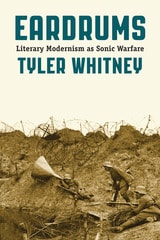
Eardrums
Literary Modernism as Sonic WarfareTyler Whitney
Northwestern University Press, 2019
In this innovative study, Tyler Whitney demonstrates how a transformation and militarization of the civilian soundscape in the late nineteenth and early twentieth centuries left indelible traces on the literature that defined the period. Both formally and thematically, the modernist aesthetics of Franz Kafka, Robert Musil, Detlev von Liliencron, and Peter Altenberg drew on this blurring of martial and civilian soundscapes in traumatic and performative repetitions of war. At the same time, Richard Huelsenbeck assaulted audiences in Zurich with his “sound poems,” which combined references to World War I, colonialism, and violent encounters in urban spaces with nonsensical utterances and linguistic detritus—all accompanied by the relentless beating of a drum on the stage of the Cabaret Voltaire.
Eardrums is the first book-length study to explore the relationship between acoustical modernity and German modernism, charting a literary and cultural history written in and around the eardrum. The result is not only a new way of understanding the sonic impulses behind key literary texts from the period. It also outlines an entirely new approach to the study of literature as as the interaction of text and sonic practice, voice and noise, which will be of interest to scholars across literary studies, media theory, sound studies, and the history of science.
Eardrums is the first book-length study to explore the relationship between acoustical modernity and German modernism, charting a literary and cultural history written in and around the eardrum. The result is not only a new way of understanding the sonic impulses behind key literary texts from the period. It also outlines an entirely new approach to the study of literature as as the interaction of text and sonic practice, voice and noise, which will be of interest to scholars across literary studies, media theory, sound studies, and the history of science.
[more]
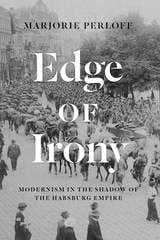
Edge of Irony
Modernism in the Shadow of the Habsburg EmpireMarjorie Perloff
University of Chicago Press, 2016
Among the brilliant writers and thinkers who emerged from the multicultural and multilingual world of the Austro-Hungarian Empire were Joseph Roth, Robert Musil, and Ludwig Wittgenstein. For them, the trauma of World War I included the sudden loss of the geographical entity into which they had been born: in 1918, the empire was dissolved overnight, leaving Austria a small, fragile republic that would last only twenty years before being annexed by Hitler’s Third Reich. In this major reconsideration of European modernism, Marjorie Perloff identifies and explores the aesthetic world that emerged from the rubble of Vienna and other former Habsburg territories—an “Austro-Modernism” that produced a major body of drama, fiction, poetry, and autobiography.
Perloff explores works ranging from Karl Kraus’s drama The Last Days of Mankind and Elias Canetti’s memoir The Tongue Set Free to Ludwig Wittgenstein’s notebooks and Paul Celan’s lyric poetry. Throughout, she shows that Austro-Modernist literature is characterized less by the formal and technical inventions of a modernism familiar to us in the work of Joyce and Pound, Dada and Futurism, than by a radical irony beneath a seemingly conventional surface, an acute sense of exile, and a sensibility more erotic and quixotic than that of its German contemporaries. Skeptical and disillusioned, Austro-Modernism prefers to ask questions rather than formulate answers.
Perloff explores works ranging from Karl Kraus’s drama The Last Days of Mankind and Elias Canetti’s memoir The Tongue Set Free to Ludwig Wittgenstein’s notebooks and Paul Celan’s lyric poetry. Throughout, she shows that Austro-Modernist literature is characterized less by the formal and technical inventions of a modernism familiar to us in the work of Joyce and Pound, Dada and Futurism, than by a radical irony beneath a seemingly conventional surface, an acute sense of exile, and a sensibility more erotic and quixotic than that of its German contemporaries. Skeptical and disillusioned, Austro-Modernism prefers to ask questions rather than formulate answers.
[more]
Elements of German
Phonology and MorphologyElmer H. Antonsen
University of Alabama Press, 2007
A practical guidebook for students of German
Elements of German fills a gap in advanced undergraduate and beginning graduate levels of German language study by presenting more advanced concepts of the language in a light intended for practical use rather than theoretical discourse. This text provides a means to improve knowledge and command of grammatically correct German as it is spoken and written. It also introduces methods and tools of linguistic analysis in the areas of phonology and morphology. Unlike books that treat phonology in a cursory way, this text delves into the problems of word formation and the intricacies of inflection and derivation. Exercises are included throughout to help better absorb the rules for real-world language use. This volume provides an in-depth look at the German language from the ground up. Its detailed approach makes this book an excellent complement to the work of less specific grammar textbooks and reviews.
Elements of German fills a gap in advanced undergraduate and beginning graduate levels of German language study by presenting more advanced concepts of the language in a light intended for practical use rather than theoretical discourse. This text provides a means to improve knowledge and command of grammatically correct German as it is spoken and written. It also introduces methods and tools of linguistic analysis in the areas of phonology and morphology. Unlike books that treat phonology in a cursory way, this text delves into the problems of word formation and the intricacies of inflection and derivation. Exercises are included throughout to help better absorb the rules for real-world language use. This volume provides an in-depth look at the German language from the ground up. Its detailed approach makes this book an excellent complement to the work of less specific grammar textbooks and reviews.
[more]
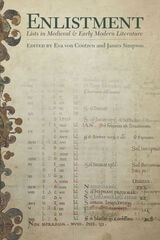
Enlistment
Lists in Medieval and Early Modern LiteratureEdited by Eva von Contzen and James Simpson
The Ohio State University Press, 2022
Bestiaries. Lapidaries. Lunaries. Inventories and household vocabularies. Lists are everywhere in medieval and early modern texts––evidence of the need to manage and order knowledge and experience. Yet until now, listing as a formal practice has received scant scholarly attention. In Enlistment, foremost medievalists and early modernists from both the Anglo-American and German traditions investigate the humble list as a platform for better understanding how and why lists captivated period audiences. From epic catalogues of trees in Geoffrey Chaucer and Edmund Spenser to genealogies and the names of the divine, the lists in question come from a variety of periods, languages, and genres. Throughout, contributors demonstrate how lists have the curious capacity to challenge our categories of thinking and ordering of the world. The lists we encounter in medieval and early modern literature can thus be seen as seismographs of cultural knowledge and also as testing grounds for defining the ineffable, or unfathomable, or that which would be dangerous if otherwise expressed.
Contributors: Suzanne Conklin Akbari, Ingo Berensmeyer, Eva von Contzen, Alex Davis, Andrew James Johnston, Wolfram R. Keller, Alexis Kellner Becker, Kathryn Mogk Wagner, Martha Rust, James Simpson
Contributors: Suzanne Conklin Akbari, Ingo Berensmeyer, Eva von Contzen, Alex Davis, Andrew James Johnston, Wolfram R. Keller, Alexis Kellner Becker, Kathryn Mogk Wagner, Martha Rust, James Simpson
[more]
Epic and Exile
Novels of the German Popular Front, 1933-1945Hunter Bivens
Northwestern University Press, 2015
The antifascist exile beginning in 1933 led to a cooling among the émigrés of the artistic and literary modernist experiments of the Weimar Republic and to a return to realism and the traditional novel form. Epic and Exile examines the Popular Front– oriented cultural initiatives of the 1930s less in terms of their political strategy than in their function as a cultural and literary program for the exiles, implying a specific relationship to questions of artistic form, historical conceptions, and indeed the political as such. A popular front aesthetics is, Bivens argues, realist and modernist at once, and, in its focus on the opacities and contradictions of everyday life as a historical formation, it is particularly concerned with problems of the epic form.
[more]
Eros and Inwardness in Vienna
Weininger, Musil, DodererDavid S. Luft
University of Chicago Press, 2003
Although we usually think of the intellectual legacy of twentieth-century Vienna as synonymous with Sigmund Freud and his psychoanalytic theories, other prominent writers from Vienna were also radically reconceiving sexuality and gender. In this probing new study, David Luft recovers the work of three such writers: Otto Weininger, Robert Musil, and Heimito von Doderer. His account emphasizes the distinctive intellectual world of liberal Vienna, especially the impact of Schopenhauer and Nietzsche in this highly scientific intellectual world.
According to Luft, Otto Weininger viewed human beings as bisexual and applied this theme to issues of creativity and morality. Robert Musil developed a creative ethics that was closely related to his open, flexible view of sexuality and gender. And Heimito von Doderer portrayed his own sexual obsessions as a way of understanding the power of total ideologies, including his own attraction to National Socialism. For Luft, the significance of these three writers lies in their understandings of eros and inwardness and in the roles that both play in ethical experience and the formation of meaningful relations to the world-a process that continues to engage artists, writers, and thinkers today.
Eros and Inwardness in Vienna will profoundly reshape our understanding of Vienna's intellectual history. It will be important for anyone interested in Austrian or German history, literature, or philosophy.
[more]
Ethics and the Dynamic Observer Narrator
Reckoning with Past and Present in German LiteratureKatra A. Byram
The Ohio State University Press, 2015
In Ethics and the Dynamic Observer Narrator: Reckoning with Past and Present in German Literature, Katra A. Byram proposes a new category—the dynamic observer form—to describe a narrative situation that emerges when stories about others become an avenue to negotiate a narrator’s own identity across past and present. Focusing on German-language fiction from the nineteenth and twentieth centuries, Byram demonstrates how the dynamic observer form highlights historical tensions and explores the nexus of history, identity, narrative, and ethics in the modern moment.
Ethics and the Dynamic Observer Narrator contributes to scholarship on both narrative theory and the historical and cultural context of German and Austrian literary studies. Narrative theory, according to Byram, should understand this form to register complex interactions between history and narrative form. Byram also juxtaposes new readings of works by Textor, Storm, and Raabe from the nineteenth century with analyses of twentieth-century works by Grass, Handke, and Sebald, ultimately reframing our understanding of literary Vergangenheitsbewältigung, or the struggle to come to terms with the past. Overall, Byram shows that neither the problem of reckoning with the past nor the dynamic observer form is unique to Germany’s post-WWII era. Both are products of the dynamics of modern identity, surfacing whenever critical change separates what was from what is.
Ethics and the Dynamic Observer Narrator contributes to scholarship on both narrative theory and the historical and cultural context of German and Austrian literary studies. Narrative theory, according to Byram, should understand this form to register complex interactions between history and narrative form. Byram also juxtaposes new readings of works by Textor, Storm, and Raabe from the nineteenth century with analyses of twentieth-century works by Grass, Handke, and Sebald, ultimately reframing our understanding of literary Vergangenheitsbewältigung, or the struggle to come to terms with the past. Overall, Byram shows that neither the problem of reckoning with the past nor the dynamic observer form is unique to Germany’s post-WWII era. Both are products of the dynamics of modern identity, surfacing whenever critical change separates what was from what is.
[more]