Results by title
67 books match the query 'Global Warming & Climate Change' and 6 start with e
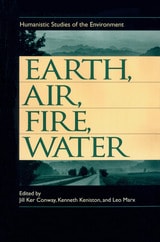
Earth, Air, Fire, Water
Humanistic Studies of the EnvironmentJill Ker Conway
University of Massachusetts Press, 1999
Written in a clear, accessible style with a general audience in mind, the essays in this volume offer fresh approaches to thinking about environmental issues. When we consider the forms of environmental decline most urgently in need of attention—eroding soils, shrinking forests, expanding deserts, acid rain, ozone depletion, air pollution, poisoned water supplies, the loss of biological diversity—it may seem logical that scientists should be the people mobilized to tackle these problems. Yet to devise effective solutions for today's environmental threats, we must situate them within their larger historical, societal, and cultural settings. Amelioration does not require exclusively scientific knowledge, but also changes based upon law and public policy, on institutional structures and practices, on habits of consumption, and on countless other facets of daily life. Earth, Air, Fire, Water seeks to redirect our thinking about environmental issues by locating them in the behavior of human beings—in the institutions, beliefs, and practices that mediate between people and that obscure but beautiful nonhuman world we refer to as “nature.” The book opens with a section on the elements and the ways humans have understood them in the past. There follows a section devoted to social institutions and the ways in which we can learn from current and past efforts to study the interaction between people and nature. The concluding section analyzes the culture of modernity and the ways in which the human imagination has changed in response to the arrival of modern technology. In addition to the editors, contributors include Gregory Nagy, Donald Worster, Stephen J. Pyne, John F. Richards, Richard White, Terence Turner, Barbara Epstein, Oleg N. Yanitsky, Bina Agarwal, Anton Struchkov, Yaakov Garb, and Louis Menand.
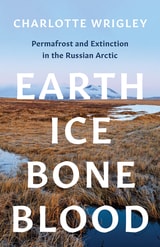
Earth, Ice, Bone, Blood
Permafrost and Extinction in the Russian ArcticCharlotte Wrigley
University of Minnesota Press, 2023
Exploring one of the greatest potential contributors to climate change—thawing permafrost—and the anxiety of extinction on an increasingly hostile planet
Climate scientists point to permafrost as a “ticking time bomb” for the planet, and from the Arctic, apocalyptic narratives proliferate on the devastating effects permafrost thaw poses to human survival. In Earth, Ice, Bone, Blood, Charlotte Wrigley considers how permafrost—and its disappearance—redefines extinction to be a lack of continuity, both material and social, and something that affects not only life on earth but nonlife, too.
Earth, Ice, Bone, Blood approaches the topic of thawing permafrost and the wild new economies and mitigation strategies forming in the far north through a study of the Sakha Republic, Russia’s largest region, and its capital city Yakutsk, which is the coldest city in the world and built on permafrost. Wrigley examines people who are creating commerce out of thawing permafrost, including scientists wishing to recreate the prehistoric “Mammoth steppe” ecosystem by eventually rewilding resurrected woolly mammoths, Indigenous people who forage the tundra for exposed mammoth bodies to sell their tusks, and government officials hoping to keep their city standing as the ground collapses under it. Warming begets thawing begets economic activity— and as a result, permafrost becomes discontinuous, both as land and as a social category, in ways that have implications for the entire planet. Discontinuity, Wrigley shows, eventually evolves into extinction.
Offering a new way of defining extinction through the concept of “discontinuity,” Earth, Ice, Bone, Blood presents a meditative and story-focused engagement with permafrost as more than just frozen ground.
Ecological Governance
Toward a New Social Contract with the EarthBruce Jennings
West Virginia University Press, 2016
As our economic and natural systems continue on their collision course, Bruce Jennings asks whether we have the political capacity to avoid large-scale environmental disaster. Can liberal democracy, he wonders, respond in time to ecological challenges that require dramatic changes in the way we approach the natural world? Must a more effective governance be less democratic and more autocratic? Or can a new form of grassroots ecological democracy save us from ourselves and the false promises of material consumption run amok?
Ecological Governance is an ethicist’s reckoning with how our political culture, broadly construed, must change in response to climate change. Jennings argues that during the Anthropocene era a social contract of consumption has been forged. Under it people have given political and economic control to elites in exchange for the promise of economic growth. In a new political economy of the future, the terms of the consumptive contract cannot be met without severe ecological damage. We will need a new guiding vision and collective aim, a new social contract of ecological trusteeship and responsibility.
Ecologists and Environmental Politics
A History of Contemporary EcologyStephen Bocking
West Virginia University Press, 2017
Bocking tells this history through four case studies: the origins and early research of the Nature Conservancy in Great Britain; the development of ecology at the Oak Ridge National Laboratory in Tennessee; the work of the Hubbard Brook Ecosystem Study in New Hampshire; and research in fisheries ecology at the University of Toronto. By comparing these case studies, Bocking demonstrates how the places of contemporary science—laboratories, landscapes, and funding agencies—and science’s purposes, as expressed through the political roles of expertise and specific managerial and regulatory responsibilities, have shaped contemporary ecology and its application to pressing environmental problems.
Energy Culture
Art and Theory on Oil and BeyondImre Szeman
West Virginia University Press, 2019
Energy Culture is a provocative book about oil’s firm grip on our politics and everyday lives. It brings together essays and artwork produced in a collaborative environment to stimulate new ways of thinking and to achieve a more just and sustainable world.
The original work collected in Energy Culture creatively engages energy as a social form through lively arguments and artistic research organized around three vectors of inquiry. The first maps how fossil fuels became, and continue to be, embedded in North American society, from the ideology of tar sands reclamation projects to dreams of fiber optic cables running through the Northwest Passage. The second comprises creative and artistic responses to the dominance of fossil fuels in everyday life and to the challenge of realizing new energy cultures. The final section addresses the conceptual and political challenges posed by energy transition and calls into question established views on energy. Its contributions caution against solar capitalism, explore the politics of sabotage, and imagine an energy efficient transportation system called “the switch.” Imbued with a sense of urgency and hope, Energy Culture exposes the deep imbrications of energy and culture while pointing provocatively to ways of thinking and living otherwise.
Environmental Change in the Lake Tahoe Basin
A Synthesis of Science and Public PolicyRobert N. Coats
University of Nevada Press, 2025
For over a century, scientific research and management efforts have aimed to mitigate the impacts of logging, mining, pollution, and invasive species while balancing urban development, tourism, and ecological preservation on the Lake. The book explores these challenges through a multidisciplinary lens, integrating environmental science, policy analysis, and case studies of both successful and failed management strategies. Written by experts who have played direct roles in key scientific discoveries and policy decisions, the book also examines the influence of environmental organizations and litigation in shaping conservation efforts.
At its core, the authors argue that the Tahoe Basin serves as a model for science-driven land and water stewardship. The book evaluates long-term monitoring programs, offering actionable recommendations for improving environmental oversight and resource management. Combining scientific analysis with accessible language, Environmental Change in the Lake Tahoe Basin serves as an up-to-date review of the region’s environmental challenges, providing an essential guide for scientists, resource managers, and policymakers.
The authors will donate all royalties from the sale of this volume to the Union of Concerned Scientist, www.ucs.org.