Results by title
129 books match the query 'God' and 4 start with e
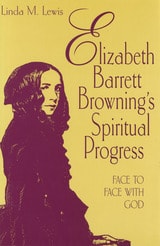
Elizabeth Barrett Browning's Spiritual Progress
Face to Face With GodLinda M. Lewis
University of Missouri Press, 1997
Elizabeth Barrett Browning believed that "Christ's religion is essentially poetry—poetry glorified." In Elizabeth Barrett Browning's Spiritual Progress, Linda M. Lewis studies Browning's religion as poetry, her poetry as religion. The book interprets Browning's literary life as an arduous spiritual quest—the successive stages being a rejection of Promethean pride for Christ-like humility, affirmation of the gospels of suffering and of work, internalization of the doctrine of Apocalypse, and ascent to divine love and truth.
Lewis follows this religious crusade from the poet's childhood to her posthumous Last Poems--including such topics as her Bible reading, her introduction to the Greek church fathers and the English Protestant reformers, the theological debates in which she participated, her quarrel with the theology of Paradise Lost, and her scandalous involvement in mesmerism and Swedenborgianism. Using insights from contemporary feminist thought, Lewis argues that Browning's religious assumptions and insights range from the conventional to the iconoclastic and that women's spirituality is, for Browning as well as for other Victorian women writers, separate from orthodox patriarchy. Lewis demonstrates that Browning's political and social ideology--often labeled inconsistent and illogical—really makes sense in light of this spiritual quest, which leads her to confront her God "face to face."
Elizabeth Barrett Browning's Spiritual Progress examines not only Browning's most admired works, such as Sonnets from the Portuguese and Aurora Leigh, but also her large body of political works and her important early poems—The Seraphim and A Drama of Exile. This intertextual book compares Browning's ideology to that of feminists such as Margaret Fuller, Harriet Martineau, and Florence Nightingale; influential conservatives such as Thomas Carlyle; and those most esteemed of Victorian poets, Alfred Lord Tennyson and Robert Browning.
Concluding with an examination of religion as a central focus of Victorian women poets, Lewis clarifies the ways in which Browning differs from Christina Rossetti, Felicia Hemans, Dora Greenwell, Jean Ingelow, and Mary Howitt. Elizabeth Barrett Browning's Spiritual Progress maintains that Browning's peculiar face-to-face struggle with the patristic and poetic tradition—as well as with God—sets her work apart.

Evidence for God from Physics and Philosophy
Extending the Legacy of Monsignor George Lemaître and St. Thomas AquinasRobert J. Spitzer, S.J.
St. Augustine's Press, 2015
Expanding Humanitys Vision Of God
Robert Herrmann
Templeton Press, 2001
How has our understanding of our world and our place in the universe changed in recent decades through the momentous discoveries of science? Do recent developments in the philosophy of science, which place limitations on scientific knowing, provide a more level playing field? This collection of essays and sermons, which have not been readily available before, address these thought-provoking questions.
The John Templeton Foundation sponsored an essay and sermon contest to convey an expanded vision of God, one that is informed by recent discoveries of science on the nature of the universe and the place we have in the world. These selections are the winners of that competition.
The book is divided into three sections: “Contemporary Science Raising Theological Questions,” “New Visions of Theology,” and “Historical and Philosophical Perspectives on the Science-Religion Dialogue.” The essays cover such areas as physics, theology, cosmology, origins, and artificial intelligence.
“There is another way to conceive our life together. There is another way to conceive of our life in God, but it requires a different worldview—not a clockwork universe in which individuals function as discrete springs and gears, but one that looks more like a luminous web, in which the whole is far more than the parts. In this universe, there is no such thing as an individual apart from his or her relationships. Every interaction—between people and people, between people and things, between things and things—changes the face of history. Life on earth cannot be reduced to four sure-fire rules. It is an ever-unfolding mystery that defies precise prediction. Meanwhile, in this universe, there is no such thing as 'parts‚' The whole is the fundamental unit of reality.” —Barbara Brown Taylor, “Physics and Faith,”
Experience, Reason, and God
Eugene Thomas Long
Catholic University of America Press, 2018