Results by title
230 books match the query 'Government relations' and 4 start with e
Editorializing "The Indian Problem"
The New York Times on Native Americans, 1860-1900Robert Hays. Foreword by: Paul Simon
Southern Illinois University Press, 2007
American history demonstrates time and again the price of Manifest Destiny.
Encounters on Contested Lands
Indigenous Performances of Sovereignty and Nationhood in QuébecJulie Burelle
Northwestern University Press, 2019
Winner, 2020 Ann Saddlemyer Award
Finalist, ATHE Outstanding Book Award for 2020
Mention Spéciale, Société québécoise d'études théâtrale
In Encounters on Contested Lands, Julie Burelle employs a performance studies lens to examine how instances of Indigenous self-representation in Québec challenge the national and identity discourses of the French Québécois de souche—the French-speaking descendants of white European settlers who understand themselves to be settlers no more but rather colonized and rightfully belonging to the territory of Québec.
Analyzing a wide variety of performances, Burelle brings together the theater of Alexis Martin and the film L'Empreinte, which repositions the French Québécois de souche as métis, with protest marches led by Innu activists; the Indigenous company Ondinnok's theater of repatriation; the films of Yves Sioui Durand, Alanis Obomsawin, and the Wapikoni Mobile project; and the visual work of Nadia Myre. These performances, Burelle argues, challenge received definitions of sovereignty and articulate new ones while proposing to the province and, more specifically, to the French Québécois de souche, that there are alternative ways to imagine Québec's future and remember its past.
The performances insist on Québec's contested nature and reframe it as animated by competing sovereignties. Together they reveal how the "colonial present tense" and "tense colonial present" operate in conjunction as they work to imagine an alternative future predicated on decolonization. Encounters on Contested Lands engages with theater and performance studies while making unique and needed contributions to Québec and Canadian studies, as well as to Indigenous and settler-colonial studies.
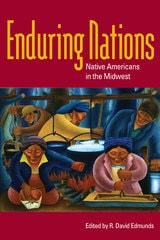
Enduring Nations
Native Americans in the MidwestEdited by R. David Edmunds
University of Illinois Press, 2007
Enduring Nations documents how tribal peoples have adapted to cultural change while shaping midwestern history. Examining the transformation of Native American communities, which often occurred in response to shifting government policy, the contributors explore the role of women, controversial tribal enterprises and economies, social welfare practices, and native peoples' frequent displacement to locations such as reservations and urban centers. Central to both past and contemporary discussions of Native American cultural change is whether Native American identity should be determined by genetics, shared cultural values, or a combination of the two.
Contributors are Bradley J. Birzer, Brenda J. Child, Thomas Burnell Colbert, Gregory Evans Dowd, R. David Edmunds, Brian Hosmer, Rebecca Kugel, James B. LaGrand, Melissa L. Meyer, Lucy Eldersveld Murphy, Alan G. Shackelford, Susan Sleeper-Smith, and Stephen Warren.
Everything You Know about Indians Is Wrong
Paul Chaat Smith
University of Minnesota Press, 2009
Forceful and eloquent essays on the American Indian in culture and history
In this sweeping work of memoir and commentary, leading cultural critic Paul Chaat Smith illustrates with dry wit and brutal honesty the contradictions of life in “the Indian business.”
Raised in suburban Maryland and Oklahoma, Smith dove head first into the political radicalism of the 1970s, working with the American Indian Movement until it dissolved into dysfunction and infighting. Afterward he lived in New York, the city of choice for political exiles, and eventually arrived in Washington, D.C., at the newly minted National Museum of the American Indian (“a bad idea whose time has come”) as a curator. In his journey from fighting activist to federal employee, Smith tells us he has discovered at least two things: there is no one true representation of the American Indian experience, and even the best intentions sometimes result in catastrophe.
Everything You Know about Indians Is Wrong is a highly entertaining and, at times, searing critique of the deeply disputed role of American Indians in the United States. In “A Place Called Irony,” Smith whizzes through his early life, showing us the ironic pop culture signposts that marked this Native American’s coming of age in suburbia: “We would order Chinese food and slap a favorite video into the machine—the Grammy Awards or a Reagan press conference—and argue about Cyndi Lauper or who should coach the Knicks.” In “Lost in Translation,” Smith explores why American Indians are so often misunderstood and misrepresented in today’s media: “We’re lousy television.” In “Every Picture Tells a Story,” Smith remembers his Comanche grandfather as he muses on the images of American Indians as “a half-remembered presence, both comforting and dangerous, lurking just below the surface.”
Smith walks this tightrope between comforting and dangerous, offering unrepentant skepticism and, ultimately, empathy. “This book is called Everything You Know about Indians Is Wrong, but it’s a book title, folks, not to be taken literally. Of course I don’t mean everything, just most things. And ‘you’ really means we, as in all of us.”