106 books match the query 'Grammar' and 4 start with e
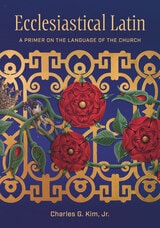
cover of Ecclesiastical Latin: A Primer on the Language of the Church

Ecclesiastical Latin

A Primer on the Language of the Church

Charles G. Kim, Jr.

Catholic University of America Press, 2024
Ecclesiastical Latin: A Primer on the Language of the Church offers a thorough introduction to the Latin language in 32 chapters, which can be completed in one academic year. The text presents each section in plain language, fully explaining complicated grammar terms which may be unfamiliar to a contemporary audience. Every chapter includes copious examples and practice sentences of the grammar covered, as well as stories drawn from the Vulgate, or Church tradition. In addition to encountering the vocabulary and grammar in practice sentences, the text also offers prayers from the liturgy which illustrate the grammar, as well as sentences which come directly from the corpus of original Ecclesiastical Latin. By the end of the book, students will feel comfortable reading through the Vulgate or praying the liturgy in Latin with more understanding. The grammar structures for each chapter roughly follow the organization of grammar as it is presented in Hans Orberg's Lingua Latina. The student can thus practice more of the language in full immersion with confidence, while also learning the vocabulary and style of later Ecclesiastical Latin.
[more]
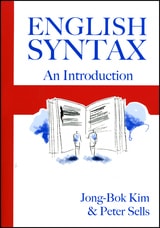
cover of English Syntax: An Introduction

English Syntax

An Introduction

Jon-Bok Kim and Peter Sells

CSLI, 2008

Focusing on the descriptive facts of English, this volume provides a systematic introduction to English syntax for students with no prior knowledge of English grammar or syntactic analysis. English Syntax aims to help students appreciate the various sentence patterns available in the language, understand insights into core data of its syntax, develop analytic abilities to further explore the patterns of English, and learn precise ways of formalizing syntactic analysis for a variety of English data and major constructions such as agreement, raising and control, the auxiliary system, passive, wh- questions, relative clauses, extrapolation, and clefts.


[more]
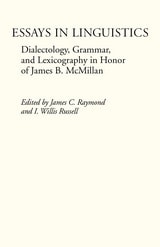
cover of Essays in Linguistics: Dialectology, Grammar, and Lexicography in Honor of James B. Mcmillan

Essays in Linguistics

Dialectology, Grammar, and Lexicography in Honor of James B. Mcmillan

James C. Raymond

University of Alabama Press, 2004

"Raymond and Russell have fashioned a lively, useful volume. . . . The ability and integrity of the contributors make much of the difference, but the editors have given the book direction by soliciting state of the art essays in three fields . . . dialectology (the articles represent area linguistics at its best), grammar and usage (Algeo on usage shibboleths is particularly fine), and lexicography (a delight)."

—Choice

"These essays are quietly unassuming in tone but highly useful."

—Language in Society
[more]
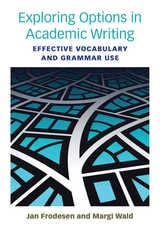
cover of Exploring Options in Academic Writing: Effective Vocabulary and Grammar Use

Exploring Options in Academic Writing

Effective Vocabulary and Grammar Use

Jan Frodesen and Margi Wald

University of Michigan Press, 2016

Exploring Options is designed to help student writers develop their knowledge and use of academic language to meet the demands of college- and university-level writing assignments. It draws on the research identifying lexical and grammatical patterns across academic contexts and provides authentic reading contexts for structured vocabulary learning. Recognizing that vocabulary choices in writing often require consideration of grammatical structure, Exploring Options focuses on specific kinds of lexico-grammatical decisions—that is, the ones involving the interaction between vocabulary and grammar--that students face in shaping, connecting, and restructuring their ideas. The book helps writers learn how to effectively use resources such as learner dictionaries, thesauruses, and concordancers to improve academic word knowledge.
 
Following a unit on using resources for vocabulary development, the contents are divided into three parts: Showing Relationships within Sentences, Connecting and Focusing across Sentences, and Qualifying Statements and Reporting Research. Part 1 focuses on verbs and modifiers that express increases and decreases, verbs and abstract nouns that describe change, connectors and verbs describing causal relationships, and parallel structures. Part 2 explores the words that help connect ideas and add cohesion. Part 3 discusses how to express degrees of certainty and accuracy and the use of reporting verbs. 
[more]