73 books match the query 'Higher Education' and 4 start with e
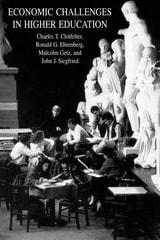
cover of Economic Challenges in Higher Education

Economic Challenges in Higher Education

Charles T. Clotfelter, Ronald G. Ehrenberg, Malcolm Getz, and John J. Siegfried

University of Chicago Press, 1991

The last two decades have been a turbulent period for American higher education, with profound demographic shifts, gyrating salaries, and marked changes in the economy. While enrollments rose about 50% in that period, sharp increases in tuition and fees at colleges and universities provoke accusations of inefficiency, even outright institutional greed and irresponsibility. As the 1990s progress, surpluses in the academic labor supply may give way to shortages in many fields, but will there be enough new Ph.D.'s to go around?

Drawing on the authors' experience as economists and educators, this book offers an accessible analysis of three crucial economic issues: the growth and composition of undergraduate enrollments, the supply of faculty in the academic labor market, and the cost of operating colleges and universities. The study provides valuable insights for administrators and scholars of education.
[more]
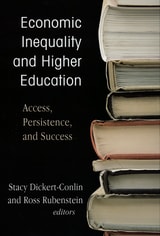
cover of Economic Inequality and Higher Education: Access, Persistence, and Success

Economic Inequality and Higher Education

Access, Persistence, and Success

Stacy Dickert-Conlin

Russell Sage Foundation, 2007
The vast disparities in college attendance and graduation rates between students from different class backgrounds is a growing social concern. Economic Inequality and Higher Education investigates the connection between income inequality and unequal access to higher education, and proposes solutions that the state and federal governments and schools themselves can undertake to make college accessible to students from all backgrounds. Economic Inequality and Higher Education convenes experts from the fields of education, economics, and public policy to assess the barriers that prevent low-income students from completing college. For many students from disadvantaged socioeconomic backgrounds, the challenge isn't getting into college, but getting out with a degree. Helping this group will require improving the quality of education in the community colleges and lower-tier public universities they are most likely to attend. Documenting the extensive disjuncture between the content of state-mandated high school testing and college placement exams, Michael Kirst calls for greater alignment between K-12 and college education. Amanda Pallais and Sarah Turner examine barriers to access at elite universities for low-income students—including tuition costs, lack of information, and poor high school records—as well as recent initiatives to increase socioeconomic diversity at private and public universities. Top private universities have increased the level and transparency of financial aid, while elite public universities have focused on outreach, mentoring, and counseling, and both sets of reforms show signs of success. Ron Ehrenberg notes that financial aid policies in both public and private universities have recently shifted towards merit-based aid, away from the need-based aid that is most helpful to low-income students. Ehrenberg calls on government policy makers to create incentives for colleges to increase their representation of low-income students. Higher education is often vaunted as the primary engine of upward mobility. Instead, as inequality in America rises, colleges may be reproducing income disparities from one generation to the next. Economic Inequality and Higher Education illuminates this worrisome trend and suggests reforms that educational institutions and the government must implement to make the dream of a college degree a reality for all motivated students.
[more]
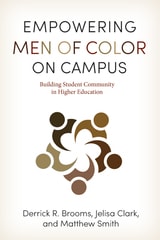
cover of Empowering Men of Color on Campus: Building Student Community in Higher Education

Empowering Men of Color on Campus

Building Student Community in Higher Education

Brooms, Derrick R.

Rutgers University Press, 2018
While recruitment efforts toward men of color have increased at many colleges and universities, their retention and graduation rates still lag behind those of their white peers. Men of color, particularly black and Latino men, face a number of unique challenges in their educational careers that often impact their presence on campus and inhibit their collegiate success. Empowering Men of Color on Campus examines how men of color negotiate college through their engagement in Brothers for United Success (B4US), an institutionally-based male-centered program at a Hispanic Serving Institution. Derrick R. Brooms, Jelisa Clark, and Matthew Smith introduce the concept of educational agency, which is harbored in cultural wealth and demonstrates how ongoing B4US engagement empowers the men’s efforts and abilities to persist in college. They found that the cultural wealth(s) of the community enhanced the students’ educational agency, which bolstered their academic aspirations, academic and social engagement, and personal development. The authors demonstrate how educational agency and cultural wealth can be developed and refined given salient and meaningful immersions, experiences, engagements, and communal connections. 
[more]
cover of Equity and Inclusion in Higher Education: Strategies for Teaching

Equity and Inclusion in Higher Education

Strategies for Teaching

Edited by Rita Kumar and Brenda Refaei

University of Minnesota Press, 2020

Americans’ perception of college students does not correlate with the reality of the rich diversity seen on university campuses. Over 60% of Americans believe the average age of a college student is 20 years old but, in fact, it’s 26.4 years old. Demographics in the classroom are shifting and instructors bear a responsibility to adjust their teaching style and curriculum to be inclusive for all students.

Equity and Inclusion for Higher Education Strategies for Teaching, edited by Rita Kumar and Brenda Refaei, details the necessity for an inclusive curriculum with examples of discipline-specific activities and modules. The intersectionality of race, age, socioeconomic status, and ability all embody the diversity college instructors encounter in their classrooms. Through the chapters in this book, the contributors make apparent the "hidden curriculum," which is taught implicitly instead of explicitly. The editors focus on learner-centered environments and accessibility of classroom materials for traditionally marginalized students; a critical part of the labor needed to create an inclusive curriculum.

This text provides instructors with resources to create equity-based learning environments. It challenges instructors to see beyond Eurocentric curriculums and expand their pedagogy to include intercultural competence. The contributors challenge the student/instructor dichotomy and embrace collaboration between the two to construct a curriculum that fits all students' needs. The resources and examples in this book demonstrate the importance of inclusion and equity in the classroom. A companion community page provides examples and tools from the editors and contributing authors, which allows for readers to add materials from their own classrooms. This book and collaborative toolkit allow instructors to begin intentional practice of an inclusive curriculum and implement changes to promote respect for diversity.

[more]