Results by title
438 books match the query 'Hispanic & Latino' and 14 start with e
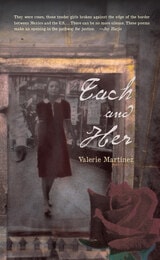
Each and Her
Valerie Martínez
University of Arizona Press, 2010
Martínez departs from traditional narrative to reveal the hidden effects and outcomes of the horrific and heart-wrenching cases of femicide. These poems—lyric fragments and prose passages that form a collage—have an intricate relation to one another, creating a complex literary quilt that feels like it can be read from the beginning, the end, or anywhere in between. Martínez is personally invested in the topic, evoking the loss of her sister, and Each and Her emerges as a biography of sorts and a compelling homage to all those who have suffered. Other authors may elaborate on or investigate this topic, but Martínez humanizes it by including names, quotations, realistic details, and stark imagery.
The women of Juárez, like other women around the world, are ravaged by inequality, discontinuity, politics, and economic plagues that contribute to gender violence. Martínez offers us a poignant and alarming glance into another world with these never-before-told stories. Her refreshing and explosive voice will keep readers transfixed and intrigued about these events and emotions—removed from us and yet so close to the heart.
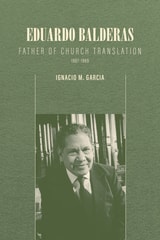
Eduardo Balderas
Father of Church Translation, 1907-1989Ignacio M. Garcia
Signature Books, 2024
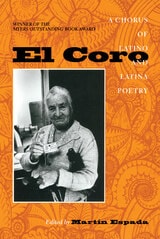
El Coro
A Chorus of Latino and Latina PoetryMartin Espada
University of Massachusetts Press, 1997
Here we find the open expression of anger and grief, self-mocking humor, the music of protest, the quiet assertion of dignity, and the raucous celebration of survival. There are poems about stoop labor and welfare offices and housing projects, but also poems about the Four Horsemen of the Apocalypse and the Minotaur.
Among the poets are former farm workers and gang members, a practicing physician, an ex-tenant lawyer, two professional chefs, and a Vietnam veteran. One poet was a political prisoner for six years; another staged a famous hunger strike; still another was indicted for her work with Central American refugees. In many ways this collection of poets comprises a chorus. Their song humanizes in the face of dehumanization.
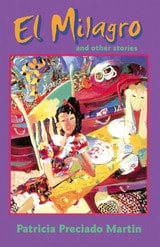
El Milagro and Other Stories
Patricia Preciado Martin
University of Arizona Press, 1996
Reminiscent of Like Water for Chocolate, the book is a rich mix of the simplest ingredients—food, family, tradition. We see Silviana striding to her chicken coop, triggering the "feathered pandemonium" of chickens who smell death in the air. We meet Elena, standing before the mirror in her wedding dress, and Teodoro Sánchez, who sleeps under the sky and smells of “chaparral and mesquite pollen and the stream bottom and the bone dust of generations. There’s the monsignor sitting on the edge of a sofa, sipping Nescafé from a china cup, and here is Sister Francisca "with her warm, minty breath" warning us away from impure thoughts. Be on your best behavior, too, in Tía Petra’s Edwardian parlor—la Doña Petrita, descended from conquistadores, might just deliver a tap on your head with her silver-handled walking stick. Then, with Mamacita, spend a summer afternoon bent over your embroidery with trembling hand and sweaty upper lip, and all the while wondering what in the world it feels like to be kissed.
Intermingled with the author’s stories are collective memories of the barrio, tales halfway between heaven and earth that seem to connect barrio residents to each other and to their past. These cuentos are mystical and dreamy, peopled with ghosts and miracles and Aztec princesses dressed in feathers and gold. Come, sit down and have some salsa and a tortilla—fresh and homemade, it goes without saying; people who buy tortillas at the market "might as well move to Los Angeles, for they have already lost their souls." Then open the pages of this book. Help yourself to another feast of food and flowers, music and dancing, sunshine and moonlight—everything glorious and mundane, serious and humorous, earthly and spiritual, poignant and joyful, in la vida mexicoamericana.
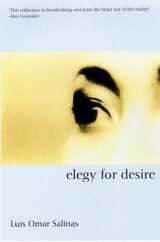
Elegy for Desire
Luis Omar Salinas
University of Arizona Press, 2005
Are those of love and those of death.
I’m half in love and half dead.
It stands to reason that I’ve come upon a difficult task.
Despite his disclaimer, it seems no difficult task at all. One of the pioneers of Chicano poetry and a highly esteemed artist in the Mexican American community, Luis Omar Salinas is a poet with Tex-Mex bordertown roots whose work is studied at the Sorbonne. Beginning with his legendary first book, Crazy Gypsy, he has been a major figure not only in Chicano literature but in all of American poetry—both a poet of the people and a voice for other poets.
In Elegy for Desire, Salinas has crafted visionary poems about growing older and looking back on a rich life of poetry. In this quiet yet hallucinatory volume, Salinas offers us a prismatic collection of odes, elegies, and cantos of desire—complex poems about our place in the world. Poems to be savored in solitude, or better still with an intimate companion. Few poets, Latino or otherwise, are as daring with love poetry that is so honestly fierce. Salinas gives us a meditation on gently aging while continuing to celebrate personal experience that draws upon the world. One need only sample these rich, elegant stanzas to recognize the wealth of wisdom found in their words.
Elegy for Desire is a testament to a singular talent that has survived for decades . . . and will continue to inspire long beyond his lifetime.
The dead can’t complain, and lovers always do.
Well, I’m here, and that is important.
And if life can be as exciting as this,
I must be doing something right.
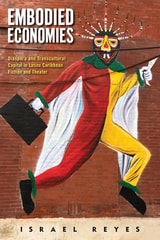
Embodied Economies
Diaspora and Transcultural Capital in Latinx Caribbean Fiction and TheaterIsrael Reyes
Rutgers University Press, 2022
In chapters that compare works by Lin-Manuel Miranda, Nilo Cruz, Edwin Sánchez, Ángel Lozada, Rita Indiana Hernández, Dolores Prida, and Mayra Santos Febres, Reyes examines the contradictions of transcultural capital, its potential to establish networks of support in Latinx enclaves, and the risks it poses for reproducing the inequities of power and privilege that have always been at the heart of the American Dream. Embodied Economies shares new perspectives through its comparison of works written in both English and Spanish, and the literary voices that emerge from the US and the Hispanic Caribbean.
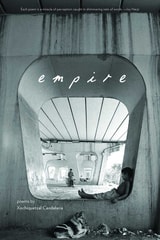
Empire
Xochiquetzal Candelaria
University of Arizona Press, 2011
This distinctive collection ranges from the frighteningly whimsical image of Cortés dancing gleefully around a cannon to the haunting and poignant discovery of a dead refugee boy seemingly buried within the poet herself. The blending of styles works to blur the lines between subjects, creating a textured narrative full of both imagination and nuance.
Ultimately, Empire situates individual experience in the wider social context, highlighting the power of poetry as song, performance, testimony, and witness. Addressing themes such as war, family, poverty, gender, race, and migration, Candelaria gives us a dialogue between historical and personal narratives, as well as discreet “conversations” between content and form.
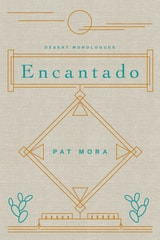
Encantado
Desert MonologuesPat Mora
University of Arizona Press, 2018
Each poem forms a story that reveals the complex and emotional journeys we take through life. Mora meanders through the thoughts of Encantado’s residents—the mothers and sisters, brothers and fathers in whom we see slivers of ourselves and our loved ones—and paints a portrait of a community through its inhabitants’ own diverse voices. Even the river has a voice we understand.
Inspired by both the real and imagined stories around her, Mora transports us to the heart of what it means to join in a chorus of voices. A community. A town. Encantado.
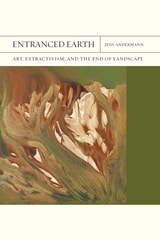
Entranced Earth
Art, Extractivism, and the End of LandscapeJens Andermann
Northwestern University Press, 2023
A sweeping analysis of the lasting effects of neocolonial extractivism in Latin American aesthetic modernity from 1920 to the present
Looking to the extractive frontier as a focal point of Latin American art, literature, music, and film, Jens Andermann asks what emerges at the other end of landscape. Art in the Global South has long represented and interrogated “insurgent nature”—organic and inorganic matter, human and nonhuman life, thrown into turmoil.
In Entranced Earth: Art, Extractivism, and the End of Landscape, Andermann traces the impact of despaisamiento—world-destroying un-landscaping—throughout the Latin American modernist archive. At the same time, he explores innovative, resilient modes of allyship forged between diverse actors through their shared experiences of destruction. From the literary regionalism of the 1930s to contemporary bio art, from modernist garden architecture to representations of migration and displacement in sound art and film, Entranced Earth tracks the crisis of landscape and environmental exhaustion beyond despair toward speculative, experimental forms of survival.
Entre Guadalupe y Malinche
Tejanas in Literature and ArtEdited by Inés Hernández-Ávila and Norma Elia Cantú
University of Texas Press, 2016
Mexican and Mexican American women have written about Texas and their lives in the state since colonial times. Edited by fellow Tejanas Inés Hernández-Ávila and Norma Elia Cantú, Entre Guadalupe y Malinche gathers, for the first time, a representative body of work about the lives and experiences of women who identify as Tejanas in both the literary and visual arts.
The writings of more than fifty authors and the artwork of eight artists manifest the nuanced complexity of what it means to be Tejana and how this identity offers alternative perspectives to contemporary notions of Chicana identity, community, and culture. Considering Texas-Mexican women and their identity formations, subjectivities, and location on the longest border between Mexico and any of the southwestern states acknowledges the profound influence that land and history have on a people and a community, and how Tejana creative traditions have been shaped by historical, geographical, cultural, linguistic, social, and political forces. This representation of Tejana arts and letters brings together the work of rising stars along with well-known figures such as writers Gloria Anzaldúa, Emma Pérez, Alicia Gaspar de Alba, Carmen Tafolla, and Pat Mora, and artists such as Carmen Lomas Garza, Kathy Vargas, Santa Barraza, and more. The collection attests to the rooted presence of the original indigenous peoples of the land now known as Tejas, as well as a strong Chicana/Mexicana feminism that has its precursors in Tejana history itself.
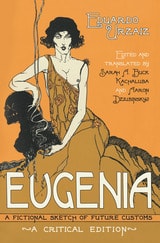
Eugenia
A Fictional Sketch of Future CustomsEduardo Urzaiz, Edited and translated by Sarah A. Buck Kachaluba and Aaron Dziubinskyj
University of Wisconsin Press, 2016
the story of a eugenically engineered society of the future.
It is the year 2218. In "Villautopia," the capital of a Central American nation, the
state selects young, biologically desirable citizens to act as breeders. Embryos
are implanted in males to increase a flagging population rate, and the offspring
are raised in state facilities until old enough to choose their own, nonnuclear
families. Sterilization of children with mental or physical abnormalities further
ensures the purity of the gene pool.
Written two years before Yevgeny Zamyatin's We and twelve years before
Aldous Huxley's Brave New World, Eugenia recounts the story of Ernesto, who at age twenty-three is selected as a breeder. Celiana, his thirty-eight-year-old lover
and an accomplished scholar, is deemed unfit for reproduction. To cope with
her feelings of guilt and hopelessness, she increasingly turns to marijuana, and
her scholarly productivity declines. Meanwhile Ernesto falls in love with a fellow
breeder, a young woman named Eugenia—but the life they ultimately choose is
not quite what the state had envisioned.
Taking up important challenges of modern society—population growth,
reproductive behavior and technologies, experimentation with gender roles,
and changes in family dynamics—Eugenia is published here in English for the
first time. Sarah A. Buck Kachaluba and Aaron Dziubinskyj provide a critical
apparatus helping readers to understand the novel's literary genesis and genealogy
as well as its historical context. Arising from its twentieth-century origins, yet
remarkably contemporary, Eugenia is a treasure of speculative fiction.
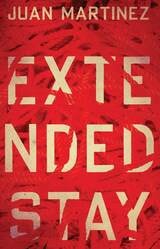
Extended Stay
Juan Martinez
University of Arizona Press, 2023
In a rundown neighborhood in the heart of Las Vegas, the Alicia hotel awakens and beckons to the most vulnerable—those with something to hide.
After his parents are killed in a horrific roadside execution, Alvaro flees his home in Colombia and finds work as a line cook at the seedy hotel. Together with his sister, Carmen, he begins to make a new life in the desert, earning a promotion to management along with an irresistible offer to stay at the hotel rent-free. But as beloved photographs go missing, cockroaches seep from the walls, and grotesque strangers wander the corridors, the promise of the Alicia decays into nightmare. Alvaro discovers that the hotel is a small appendage of an enormous creature that feeds on guests and their secrets, one that will eventually bring him face-to-face with the memories he most wants to outrun. Alvaro, Carmen, and their friends decide to cooperate with the creature rather than fight it. But in their efforts to appease it, do they sacrifice too much of themselves?
Haunting and visceral, Extended Stay uses the language of body horror and the gothic to comment on the complicated relationship between the Latinx undocumented experience and capitalism, the erasure of those living and working on the margins, the heavy toll exacted by memory, and the queasy permeability of boundaries that separate the waking world from the world of dreams.
Extinct Lands, Temporal Geographies
Chicana Literature and the Urgency of SpaceMary Pat Brady
Duke University Press, 2002
The history of the American Southwest in large part entails the transformation of lived, embodied space into zones of police surveillance, warehouse districts, highway interchanges, and shopping malls—a movement that Chicana writers have contested from its inception. Brady examines this long-standing engagement with space, first in the work of early newspaper essayists and fiction writers who opposed Anglo characterizations of Northern Sonora that were highly detrimental to Mexican Americans, and then in the work of authors who explore border crossing. Through the writing of Sandra Cisneros, Cherríe Moraga, Terri de la Peña, Norma Cantú, Monserrat Fontes, Gloria Anzaldúa, and others, Brady shows how categories such as race, gender, and sexuality are spatially enacted and created—and made to appear natural and unyielding. In a spatial critique of the war on drugs, she reveals how scale—the process by which space is divided, organized, and categorized—has become a crucial tool in the management and policing of the narcotics economy.
en el norte / soy del sur
José Felipe Alvergue
Omnidawn, 2026
José Felipe Alvergue’s en el norte/soy del sur, which translates to “in the north I am of the south,” is an exploration into the limits of the American sonnet, one that seeks to establish a stable sense of place, while opening vistas at each turn. Stitching together multiple sonnets into what he calls “sonnet essays,” Alvergue rides their turns—or “voltas”—that are guided by memories and photographs of his family’s migratory history between El Salvador and the United States.
The resulting text is a story of human geography that considers the coordinates of a long, continuous thought about what it means to be “of a place” as a defining characteristic of identity, when one is also “in a place” that sets strict limits on the political and historical potential of im/migrants. A deeply human documentary work that delves into one family’s migration across the hemisphere, en el norte/soy del sur hopes to give shape to the collective and often amorphous history of migration in the face of narratives that peddle spectacularized distillation and essentialism.