Results by title
2646 books match the query 'History & Criticism' and 68 start with e
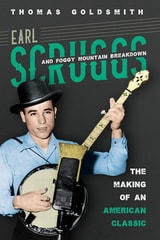
Earl Scruggs and Foggy Mountain Breakdown
The Making of an American ClassicThomas Goldsmith
University of Illinois Press, 2019
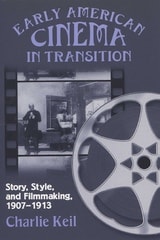
Early American Cinema in Transition
Story, Style, and Filmmaking, 1907–1913Charlie Keil
University of Wisconsin Press, 2001
The period 1907–1913 marks a crucial transitional moment in American cinema. As moving picture shows changed from mere novelty to an increasingly popular entertainment, fledgling studios responded with longer running times and more complex storytelling. A growing trade press and changing production procedures also influenced filmmaking. In Early American Cinema in Transition, Charlie Keil looks at a broad cross-section of fiction films to examine the formal changes in cinema of this period and the ways that filmmakers developed narrative techniques to suit the fifteen-minute, one-reel format.
Keil outlines the kinds of narratives that proved most suitable for a single reel’s duration, the particular demands that time and space exerted on this early form of film narration, and the ways filmmakers employed the unique features of a primarily visual medium to craft stories that would appeal to an audience numbering in the millions. He underscores his analysis with a detailed look at six films: The Boy Detective; The Forgotten Watch; Rose O’Salem-Town; Cupid’s Monkey Wrench; Belle Boyd, A Confederate Spy; and Suspense.
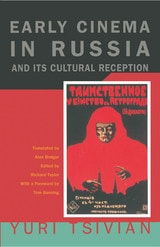
Early Cinema in Russia and Its Cultural Reception
Yuri Tsivian
University of Chicago Press, 1998
"Tsivian casts a probing beam of illumination into some of the most obscure areas of film history. And the terrain he lights up with his careful assembly and insightful reading of the records of early film viewing in Russia not only changes our sense of the history of this period but also . . . causes us to re-evaluate some of our most basic theoretical and historical assumptions about what a film is and how it affects its audiences."—Tom Gunning, from the Foreword
"Early Cinema in Russia . . . reveals Tsivian's strengths very well and demonstrates why he is . . . the finest film historian of his generation in the former Soviet Union."—Denise Y. Youngblood, Historical Journal of Film, Radio, and Television
"A work of fundamental importance."—Julian Graffy, Recent Studies of Russian and Soviet Cinema
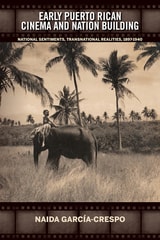
Early Puerto Rican Cinema and Nation Building
National Sentiments, Transnational Realities, 1897-1940Naida García-Crespo
Bucknell University Press, 2019
Published by Bucknell University Press. Distributed worldwide by Rutgers University Press.
Early Women Stars, Volume 16
Jennifer M. Bean and Diane Negra, eds.
Duke University Press, 0
Essays focus on figures across the wide international lexicon of stardom, including stunt star Pearl White, iconic French performer Musidora, imported European vamp Pola Negri, pixie heroine Colleen Moore, and Chinese star Xuan Jinglin. Other articles revisit figures, such as Mary Pickford and Greta Garbo, whose stardom appears to be self-evident but proves more complex than previous accounts have suggested. In this collection, early female stars function as a medium through which authors reconceptualize feminist film history and historiography.
Contributors. Jennifer M. Bean, Vicki Callahan, Lucy Fischer, Amelie Hastie, Diane Negra, Gaylyn Studlar, Zhen Zhang
Ebert's Bests
Roger Ebert
University of Chicago Press, 2013
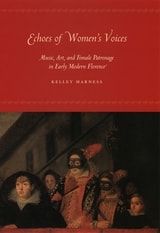
Echoes of Women's Voices
Music, Art, and Female Patronage in Early Modern FlorenceKelley Harness
University of Chicago Press, 2006
Through commissions, patrons sought to promote a vision of the world and their place in it. The unique social norms, laws, educational backgrounds, and life experiences of female patrons meant the expression of a worldview that differed significantly from that of their male counterparts. Joining exceptional archival research with telling analysis of significant examples of music, art, and drama, Kelley Harness challenges the prevailing view that Florence saw a political and artistic decline during this period. She argues convincingly that the female domination of these years brought forth artistic patronage that was both continuous and well-conceived.
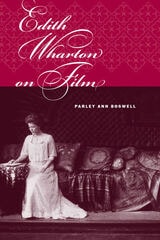
Edith Wharton on Film
Parley Ann Boswell
Southern Illinois University Press, 2007
Edith Wharton (1862–1937), who lived nearly half of her life during the cinema age when she published many of her well-known works, acknowledged that she disliked the movies, characterizing them as an enemy of the imagination. Yet her fiction often referenced film and popular Hollywood culture, and she even sold the rights to several of her novels to Hollywood studios.
Edith Wharton on Film explores these seeming contradictions and examines the relationships among Wharton’s writings, the popular culture in which she published them, and the subsequent film adaptations of her work (three from the 1930s and four from the 1990s). Author Parley Ann Boswell examines the texts in which Wharton referenced film and Hollywood culture and evaluates the extant films adapted from Wharton’s fiction.
The volume introduces Wharton’s use of cinema culture in her fiction through the 1917 novella Summer, written during the nation’s first wave of feminism, in which the heroine Charity Royall is moviegoer and new American woman, consumer and consumable. Boswell considers the source of this conformity and entrapment, especially for women. She discloses how Wharton struggled to write popular stories and then how she revealed her antipathy toward popular movie culture in two late novels.
Boswell describes Wharton’s financial dependence on the American movie industry, which fueled her antagonism toward Hollywood culture, her well-documented disdain for popular culture, and her struggles to publish in women’s magazines.
This first full-length study that examines the film adaptations of Wharton’s fiction covers seven films adapted from Wharton’s works between 1930 and 2000 and the fifty-year gap in Wharton film adaptations. The study also analyzes Sophy Viner in The Reef as pre-Hollywood ingénue, characters in Twilight Sleep and The Children and the real Hollywood figures who might have inspired them, and The Sheik and racial stereotypes.
Boswell traces the complicated relationship of fiction and narrative film, the adaptations and cinematic metaphors of Wharton’s work in the 1990s, and Wharton’s persona as an outsider. Wharton’s fiction on film corresponds in striking ways to American noir cinema, says Boswell, because contemporary filmmakers recognize and celebrate the subversive qualities of Wharton’s work.
Edith Wharton on Film, which includes eleven illustrations, enhances Wharton’s stature as a major American author and provides persuasive evidence that her fiction should be read as American noir literature.
Editing and Special/Visual Effects
Keil, Charlie
Rutgers University Press, 2016
Edna Ferber's Hollywood
American Fictions of Gender, Race, and HistoryBy J. E. Smyth
University of Texas Press, 2009
Edna Ferber's Hollywood reveals one of the most influential artistic relationships of the twentieth century—the four-decade partnership between historical novelist Edna Ferber and the Hollywood studios. Ferber was one of America's most controversial popular historians, a writer whose uniquely feminist, multiracial view of the national past deliberately clashed with traditional narratives of white masculine power. Hollywood paid premium sums to adapt her novels, creating some of the most memorable films of the studio era—among them Show Boat, Cimarron, and Giant. Her historical fiction resonated with Hollywood's interest in prestigious historical filmmaking aimed principally, but not exclusively, at female audiences.
In Edna Ferber's Hollywood, J. E. Smyth explores the research, writing, marketing, reception, and production histories of Hollywood's Ferber franchise. Smyth tracks Ferber's working relationships with Samuel Goldwyn, Leland Hayward, George Stevens, and James Dean; her landmark contract negotiations with Warner Bros.; and the controversies surrounding Giant's critique of Jim-Crow Texas. But Edna Ferber's Hollywood is also the study of the historical vision of an American outsider—a woman, a Jew, a novelist with few literary pretensions, an unashamed middlebrow who challenged the prescribed boundaries among gender, race, history, and fiction. In a masterful film and literary history, Smyth explores how Ferber's work helped shape Hollywood's attitude toward the American past.
Education in the School of Dreams
Travelogues and Early Nonfiction FilmJennifer Lynn Peterson
Duke University Press, 2013
Peterson describes the travelogue's characteristic form and style and demonstrates how imperialist ideologies were realized and reshaped through the moving image. She argues that although educational films were intended to legitimate filmgoing for middle-class audiences, travelogues were not simply vehicles for elite ideology. As a form of instructive entertainment, these technological moving landscapes were both formulaic and also wondrous and dreamlike. Considering issues of spectatorship and affect, Peterson argues that scenics produced and disrupted viewers' complacency about their own place in the world.
Edward Albee
Toby Zinman
University of Michigan Press, 2008
Edward Albee was a giant in American theater, in the same pantheon with Arthur Miller, Eugene O’Neill, and Tennessee Williams. His prolific career included three Pulitzer Prizes and the 2005 Lifetime Achievement Tony Award.
Albee continued producing major works for the theater into his eighties, including a prequel to The Zoo Story, which shocked the country when it first appeared in 1958—and his plays have seen major revivals on and off Broadway in recent years. Yet even with this resurgence of popularity, no up-to-date treatment of his plays is currently in print.
With engaging discussions of his most famous plays, such as Who’s Afraid of Virginia Woolf and Three Tall Women, as well as his lesser known works, this essential guide reveals the heart of Albee’s drama, highlighting the themes of sex, death, loneliness, and time that have occupied the playwright during his more than fifty years in the theater.
Toby Zinman is the theater critic for the Philadelphia Inquirer. She has written for numerous publications, including Variety,American Theater, and Theatre Journal. She is Professor of English at the University of the Arts, Philadelphia.
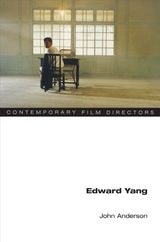
Edward Yang
John Anderson
University of Illinois Press, 2005
Having largely given up on a career in film, Edward Yang had been working as a computer engineer for several years when he saw Herzog's Aguirre, Wrath of God. Inspired to return to film, Yang, along with a handful of other filmmakers, including the great Hou Hsiao-hsien, went on to found the Taiwanese New Wave of the early 1980s.
Film critic John Anderson's Edward Yang offers a comprehensive overview of the work of the writer-director—already considered one of the most important filmmakers of the past twenty years—from his breakthrough feature That Day, on the Beach to the epic Yi-Yi. Rooted in questions about what it means to be Taiwanese, Yang's films reveal the complexity of life within the island's patchwork culture. Anderson identifies the key narrative strategies, formal devices, moral vision, and sociopolitical concerns shot through Yang's films. He explains what makes these films so distinctive by pinpointing the specific qualities of Yang's style and outlook.
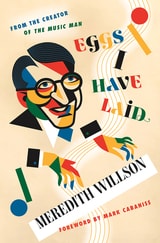
Eggs I Have Laid
Meredith Willson
University of Minnesota Press, 2025
Back in print: the playful and personal memoir of Meredith Willson’s creative tribulations and triumphs before The Music Man
Composer, musical director, writer, lecturer, and piccoloist Meredith Willson laid many eggs throughout his career—but not all those eggs would hatch quite so gloriously as his Broadway hit The Music Man. In Eggs I Have Laid, Willson genially chronicles the failures that he faced as he made his place in show business during the pivotal early 1950s, when radio was being overtaken by television.
From Hollywood to New York, London, and Paris, and back to his hometown of Mason City, Iowa, Willson sets each scene vividly, bringing to life his encounters with zeitgeist stars, from collaborators Tallulah Bankhead and Fred Allen to Orson Welles and Carmen Miranda. His signature wit excels as he relates his tales of eggs dropped, notable among them the lavishly produced variety program The Big Show, his ill-fated attempt to be a radio bulwark against the encroaching tide of television.
First published in 1955, Eggs I Have Laid features delightful curiosities, like an eight-page “platonic dialogue” about quitting smoking and the lyrics to a love song with the occupancy limits of the New York Fire Code as its central metaphor. It is at once a vivid chronicle and a trove of insight from the hilarious, perseverant mind of Meredith Willson.

Eight 1/2 Federico Fellini
Affron, Charles
Rutgers University Press, 1987
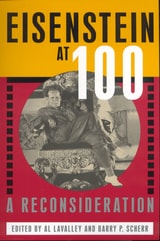
Eisenstein at 100
Edited by Al LaValley and P. Scherr
Rutgers University Press, 2001
Like many other figures once closely associated with the Soviet state, the great Russian filmmaker Sergei Eisenstein has become the subject of renewed interest. A decade after the fall of the Soviet Union, and with fresh material on his life and art now available, a more complex picture of Eisenstein is emerging. This collection-featuring the work of major film theorists and Russian scholars-offers the first post-Soviet reconsideration of Eisenstein's contribution to world cinema.
The contributors address themes previously avoided by Soviet critics, such as sexuality, religion, gender, and politics, in The Battleship Potemkin, October, Alexander Nevsky, and Ivan the Terrible. These films and others are also reassessed in light of a more thorough knowledge of Eisenstein’s life and of the complicated historical, cultural, and political contexts in which he worked. Of particular concern here is Eisenstein’s struggle with Soviet censorship, which resulted in a tenuous balance between the pressures of the state and his goals as an artist. Essays explore the manner in which Eisenstein’s later theoretical writings reveal continuity with the more well known earlier work, issues of historical revisionism, and the relationship between autobiography and the films. Eisenstein’s undeniable influence on his contemporaries and subsequent generations, as well as his reception by the film community and the public, are illuminated.
Rather than fostering the popular image of Eisenstein as the “inventor” of film montage, the director of Potemkin, and the enthusiastic early supporter of the Bolsheviks, Eisenstein at 100 presents a much richer and more profound picture of Eisenstein the man, the director, and the film theorist.
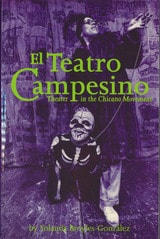
El Teatro Campesino
Theater in the Chicano MovementBy Yolanda Broyles-González
University of Texas Press, 1994
Born in 1965 as an organizing tool within César Chávez's United Farm Workers union, El Teatro Campesino became the premier Chicana/o performance ensemble to emerge out of the Chicano movement of the 1960s and 1970s. This study demythologizes and reinterprets the company's history from its origins in California's farm labor struggles to its successes in Europe and on Broadway until the disbanding of the original collective ensemble in 1980 with the subsequent adoption of mainstream production techniques.
Yolanda Broyles-González corrects many misconceptions concerning the Teatro's creation and evolution. She draws from a rich storehouse of previously untapped material, such as interviews with numerous ensemble members, production notes, and unpublished diaries, to highlight the reality of the collective creation that characterized the Teatro's work.
Writing within contemporary cultural studies theory, Broyles-González sheds light on class, gender, race, and cultural issues. Her work situates the Teatro within working-class Mexican performance history, the Chicano movement, gender relations, and recent attempts to mainstream.
Elaine May
Elizabeth Alsop
University of Illinois Press, 2025
A compelling reconsideration of an iconoclast and original, Elaine May reveals how a surprisingly radical auteur created her trademark cinema of discomfort.
Elena, Princesa of the Periphery
Disney’s Flexible Latina GirlDiana Leon-Boys
Rutgers University Press, 2023
2024 National Communication Association's Critical and Cultural Communication Studies Division (CCSD) Book of the year award
2023 National Communication Association's Feminist and Gender Studies Division Bonnie Ritter Outstanding Feminist Book Award
In the summer of 2016, Disney introduced its first Latina princess, Elena of Avalor. Princesa of the Periphery explores this Disney property using multiple case studies to understand its approach to girlhood and Latinidad. Following the circuit of culture model, author Diana Leon-Boys teases out moments of complex negotiations by Disney, producers, and audiences as they navigate Elena’s circulation. Case studies highlight how a flexible Latinidad is deployed through corporate materials, social media pages, theme park experiences, and the television series to create a princess who is both marginal to Disney’s normative vision of princesshood and central to Disney’s claims of diversification. This multi-layered analysis of Disney’s mediated Latina girlhood interrogates the complex relationship between the U.S.’s largest ethnic minority and a global conglomerate that stands in for the U.S. on the global stage.

Elfriede Jelinek s Princess Plays, Volume 36
Tom Sellar , ed.
Duke University Press, 0
Elfriede Jelinek and The Princess Plays includes an article on Jelinek’s changing position in the world of letters by Gitta Honegger, a leading Jelinek scholar and translator. Accompanying this major article is Honegger’s extended interview with the author; they discuss Jelinek’s aesthetic influences and ideas, what it’s like to win the Nobel Prize, and its implications for the writer. In addition to the first English-language publication of three short plays from Elfriede Jelinek’s Princess Plays, this issue of Theater includes Gitta Honegger’s extended and deeply personal interview with Jelinek, as well as Honegger’s article on her changing position in the world of letters since winning the 2004 Nobel Prize. The issue, which also includes articles on France’s Théâtre du Soleil, offers a compelling portrait of Jelinek and a rare introduction to her provocative theater.
Contributors. Duccio Bellugi, Gitta Honegger, Elfriede Jelinek, Robert Kluyver, Marina Kotzamani, Judith Miller, Ariane Mnouchkine, Béatrice Picon-Vallin, Anthony Richter, Gordon Rogoff, René Solis, Emmanuel Wallon, Philippa Wehle
Elliott Carter Speaks
Unpublished LecturesElliott Carter. Edited and with an Introduction by Laura Emmery
University of Illinois Press, 2021
Expansive and essential, Elliott Carter Speaks opens up the artist's teaching and introspection to new contemporary perspectives on his thought and art.
Please note that the order and arrangement of materials in this book differs from that of Elliott Carter’s original lectures.
Elusive Archives
Material Culture in FormationMartin Brückner
University of Delaware Press, 2021
The essays that comprise Elusive Archives raise a common question: how do we study material culture when the objects of study are transient, evanescent, dispersed or subjective? Such things resist the taxonomic protocols that institutions, such as museums and archives, rely on to channel their acquisitions into meaningful collections. What holds these disparate things together here are the questions authors ask of them. Each essay creates by means of its method a provisional collection of things, an elusive archive. Scattered matter then becomes fixed within each author’s analytical framework rather than within the walls of an archive’s reading room or in cases along a museum corridor.
This book follows the ways in which objects may be identified, gathered, arranged, conceptualized and even displayed rather than by “discovering” artifacts in an archive and then asking how they came to be there. The authors approach material culture outside the traditional bounds of learning about the past. Their essays are varied not only in subject matter but also in narrative format and conceptual reach, making the volume accessible and easy to navigate for a quick reference or, if read straight through, build toward a new way to think about material culture.
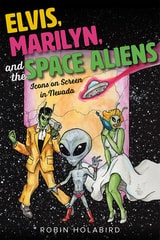
Elvis, Marilyn, and the Space Aliens
Icons on Screen in NevadaRobin Holabird
University of Nevada Press, 2017
Elvis Presley, Marilyn Monroe, and space aliens like the Transformers share a surprising connection along with James Bond, Indiana Jones, and Rocky Balboa. These beloved icons played active roles in movie and television projects set in the state of Nevada. Long time state film commissioner and movie reviewer Holabird explores the blending of icons and Nevada, along with her personal experiences of watching movies, talking with famous people, and showing off a diverse range of stunning and iconic locations like Las Vegas, Reno, Lake Tahoe, and Area 51.
Holabird shows how Nevada’s flash, flair, and fostering of the forbidden provided magic for singers, sexpots, and strange creatures from other worlds. She also gives readers an insider’s look into moviemaking in Nevada by drawing on her extensive experience as a film commissioner. This is a unique take on film history and culture, and Holabird explores eighteen film genres populated by one-of-a-kind characters with ties to Nevada. Along with being a film history of the state of Nevada written by a consummate insider, the book is a fun mixture of research, personal experiences, and analysis about how Nevada became the location of choice for a broad spectrum of well-known films and characters.
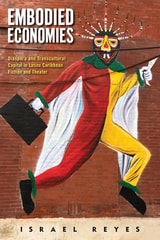
Embodied Economies
Diaspora and Transcultural Capital in Latinx Caribbean Fiction and TheaterIsrael Reyes
Rutgers University Press, 2022
In chapters that compare works by Lin-Manuel Miranda, Nilo Cruz, Edwin Sánchez, Ángel Lozada, Rita Indiana Hernández, Dolores Prida, and Mayra Santos Febres, Reyes examines the contradictions of transcultural capital, its potential to establish networks of support in Latinx enclaves, and the risks it poses for reproducing the inequities of power and privilege that have always been at the heart of the American Dream. Embodied Economies shares new perspectives through its comparison of works written in both English and Spanish, and the literary voices that emerge from the US and the Hispanic Caribbean.
Emily Dickinson's Music Book and the Musical Life of an American Poet
George Boziwick
University of Massachusetts Press, 2022
After years of studying piano as a young woman in her family home in Amherst, Massachusetts, Emily Dickinson curated her music book, a common practice at the time. Now part of the Dickinson Collection in the Houghton Library of Harvard University, this bound volume of 107 pieces of published sheet music includes the poet’s favorite instrumental piano music and vocal music, ranging from theme and variation sets to vernacular music, which was also enjoyed by the family’s servants.
Offering a fresh historical perspective on a poetic voice that has become canonical in American literature, this original study brings this artifact to life, documenting Dickinson’s early years of musical study through the time her music was bound in the early 1850s, which tellingly coincided with the writing of her first poems. Using Dickinson’s letters and poems alongside newspapers and other archival sources, George Boziwick explores the various composers, music sellers, and publishers behind this music and Dickinson’s attendance at performances, presenting new insights into the multiple layers of meaning that music held for her.
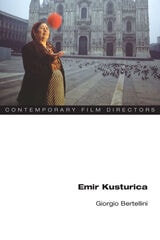
Emir Kusturica
Emir Kusturica
University of Illinois Press, 2015
Leading scholar-critic Giorgio Bertellini divides Kusturica's career into three stages--dissention, disconnection, and dissonance--to reflect both the historic and cultural changes going on around him and the changes his cinema has undergone. He uses Kusturica's Palme d'Or winning Underground (1995)--the famously inflammatory take on Yugoslav history after World War II--as the pivot between the tone of romantic, yet pungent critique of the director's early works and later journeys into Balkanist farce marked by slapstick and a self-conscious primitivism.
Eschewing the one-sided polemics Kusturica's work often provokes, Bertellini employs balanced discussion and critical analysis to offer a fascinating and up-to-date consideration of a major figure in world cinema.
Empty Moments
Cinema, Modernity, and DriftLeo Charney
Duke University Press, 1998
Empty Moments creates a catalytic dialogue among those who, at the time of the invention of film, attempted to define the experience of the fleeting present. Interspersing philosophical discussions with stylistically innovative prose, Charney mingles Proust’s conception of time/memory with Cubism’s attempt to interpret time through perspective and Surrealism’s exploration of subliminal representations of the present. Other topics include Husserl’s insistence that the present can only be fantasy or fabrication and the focus on impossibility, imperfection, and loss in Kelvin’s laws of thermodynamics. Ultimately, Charney’s work hints at parallels among such examples, the advent and popularity of cinema, and early film theory.
A book with a structural modernity of its own, Empty Moments will appeal to those interested in cinema and its history, as well as to other historians, philosophers, literary, and cultural scholars of modernity.
Enacting History
Edited by Scott Magelssen and Rhona Justice-Malloy
University of Alabama Press, 2011
Where performance meets the past: exploring how we stage, shape, and experience history.
Enacting History is a collection of new essays exploring the world of historical performances. The volume focuses on performances outside the traditional sphere of theatre, among them living history museums, battle reenactments, pageants, renaissance festivals, and adventure-tourism destinations. This volume argues that the recent surge in such performances have raised significant questions about the need for, interest in, and value of such nontraditional theater. Many of these performances claim a greater or lesser degree of historical "accuracy" or "authenticity," and the authors tease out the representational and historiographic issues related to these arguments. How, for instance, are issues of race, ethnicity, and gender dealt with at museums that purport to be accurate windows into the past? How are politics and labor issues handled in local- or state-funded institutions that rely on volunteer performers? How do tourists' expectations shape the choices made by would-be purveyors of the past? Where do matters of taste or censorship enter in when reconciling the archival evidence with a family-friendly mission?
Essays in the collection address, among other subjects, reenactments of period cookery and cuisine at a Maryland renaissance festival; the roles of women as represented at Minnesota's premiere living history museum, Historic Fort Snelling; and the Lewis and Clark bicentennial play as cultural commemoration. The editors argue that historical performances like these-regardless of their truth-telling claims-are an important means to communicate, document, and even shape history, and allow for a level of participation and accessibility that is unique to performance. Enacting History is an entertaining and informative account of the public's fascination with acting out and watching history and of the diverse methods of fulfilling this need.
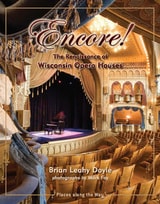
Encore!
The Renaissance of Wisconsin Opera HousesBrian Leahy Doyle
Wisconsin Historical Society Press, 2009
A remarkable number of Wisconsin towns and cities were home to an opera house in the late 1800s and early 1900s. Some were freestanding structures built by local benefactors, industrialists, and capitalists. Others were located within a city hall building and financed by local tax dollars with the support of government officials who believed in the value of the arts for their community
In Encore! The Renaissance of Wisconsin Opera Houses, Brian Leahy Doyle chronicles the histories of ten Wisconsin opera houses and theaters, from their construction to their heydays as live performance spaces and through the periods when many of these stages went dark. But what makes these stories so compelling is that all but one of the featured theaters has been restored to its original splendor. Just as the beginnings of these theaters were often the result of the efforts of local citizens, Doyle discovers that their restoration is due to the commitment of dedicated and passionate people. More than one of these revived theaters has spurred the revitalization of its surrounding downtown business district as well.
Encore! is the second book in the Places along the Way series. Richly illustrated with historic and contemporary photos, the Places along the Way series links Wisconsin's past with its present, exploring the state's history through its architecture.
Encounters on Contested Lands
Indigenous Performances of Sovereignty and Nationhood in QuébecJulie Burelle
Northwestern University Press, 2019
Winner, 2020 Ann Saddlemyer Award
Finalist, ATHE Outstanding Book Award for 2020
Mention Spéciale, Société québécoise d'études théâtrale
In Encounters on Contested Lands, Julie Burelle employs a performance studies lens to examine how instances of Indigenous self-representation in Québec challenge the national and identity discourses of the French Québécois de souche—the French-speaking descendants of white European settlers who understand themselves to be settlers no more but rather colonized and rightfully belonging to the territory of Québec.
Analyzing a wide variety of performances, Burelle brings together the theater of Alexis Martin and the film L'Empreinte, which repositions the French Québécois de souche as métis, with protest marches led by Innu activists; the Indigenous company Ondinnok's theater of repatriation; the films of Yves Sioui Durand, Alanis Obomsawin, and the Wapikoni Mobile project; and the visual work of Nadia Myre. These performances, Burelle argues, challenge received definitions of sovereignty and articulate new ones while proposing to the province and, more specifically, to the French Québécois de souche, that there are alternative ways to imagine Québec's future and remember its past.
The performances insist on Québec's contested nature and reframe it as animated by competing sovereignties. Together they reveal how the "colonial present tense" and "tense colonial present" operate in conjunction as they work to imagine an alternative future predicated on decolonization. Encounters on Contested Lands engages with theater and performance studies while making unique and needed contributions to Québec and Canadian studies, as well as to Indigenous and settler-colonial studies.
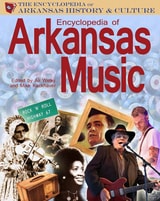
Encyclopedia of Arkansas Music
Ali Welky
Butler Center for Arkansas Studies, 2013
What do a rockabilly musician turned cinematic swamp monster, a composer of player-piano music, an avant-garde cellist, a musical instrument that lent its name to a weapon, a rock musician turned Catholic monk, some of the best audio speakers in the world, and the creator of Schoolhouse Rock! have in common? That’s right–they all come from Arkansas.
Encyclopedia of Arkansas Music is a special project of the Encyclopedia of Arkansas History & Culture (EOA), an online encyclopedia launched in 2006 by the Butler Center for Arkansas Studies at the Central Arkansas Library System.
This colorful, photo-filled reference work spanning all aspects of Arkansas’s musical past and present includes more than 150 entries on musicians, ensembles, musical works, and events.
Endless Intervals
Cinema, Psychology, and Semiotechnics around 1900Jeffrey West Kirkwood
University of Minnesota Press, 2022
Revealing cinema’s place in the coevolution of media technology and the human
Cinema did not die with the digital, it gave rise to it. According to Jeffrey West Kirkwood, the notion that digital technologies replaced analog obscures how the earliest cinema laid the technological and philosophical groundwork for the digital world. In Endless Intervals, he introduces a theory of semiotechnics that explains how discrete intervals of machines came to represent something like a mind—and why they were feared for their challenge to the uniqueness of human intelligence.
Examining histories of early cinematic machines, Kirkwood locates the foundations for a scientific vision of the psyche as well as the information age. He theorizes an epochal shift in the understanding of mechanical stops, breaks, and pauses that demonstrates how cinema engineered an entirely new model of the psyche—a model that was at once mechanical and semiotic, discrete and continuous, physiological and psychological, analog and digital.
Recovering largely forgotten and untranslated texts, Endless Intervals makes the case that cinema, rather than being a technology assaulting the psyche, is in fact the technology that produced the modern psyche. Kirkwood considers the ways machines can create meaning, offering a fascinating theory of how the discontinuous intervals of soulless mechanisms ultimately produced a rich continuous experience of inner life.
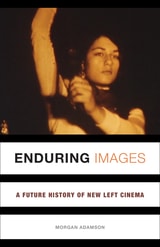
Enduring Images
A Future History of New Left CinemaMorgan Adamson
University of Minnesota Press, 2018
An integrated look at the political films of the 1960s and ’70s and how the New Left transformed cinema
A timely reassessment of political film culture in the 1960s and ’70s, Enduring Images examines international cinematic movements of the New Left in light of sweeping cultural and economic changes of that era. Looking at new forms of cinematic resistance—including detailed readings of particular films, collectives, and movements—Morgan Adamson makes a case for cinema’s centrality to the global New Left.
Enduring Images details how student, labor, anti-imperialist, Black Power, and second-wave feminist movements broke with auteur cinema and sought to forge local and international solidarities by producing political essay films, generating new ways of being and thinking in common. Adamson produces a comparative and theoretical account of New Left cinema that engages with discussions of work, debt, information, and resistance. Enduring Images argues that the cinemas of the New Left are sites to examine, through the lens of struggle, the reshaping of global capitalism during the pivotal moment in which they were made, while at the same time exploring how these movements endure in contemporary culture and politics.
Including in-depth discussions of Third Cinema in Argentina, feminist cinema in Italy, Newsreel movements in the United States, and cybernetics in early video, Enduring Images is an essential examination of the political films of the 1960s and ’70s.
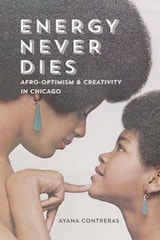
Energy Never Dies
Afro-Optimism and Creativity in ChicagoAyana Contreras
University of Illinois Press, 2021
Passionate and enlightening, Energy Never Dies uses the power of storytelling to show how optimism and courage fuel the dreams of Black Chicago.
English Pastoral Music
From Arcadia to Utopia, 1900-1955Eric Saylor
University of Illinois Press, 2017
English Theatrical Anecdotes, 1660-1800
Heather Ladd
University of Delaware Press, 2022
Entertaining the Nation
American Drama in the Eighteenth and Nineteenth CenturiesTice L. Miller
Southern Illinois University Press, 2007
In this survey of eighteenth- and nineteenth-century American drama, Tice L. Miller examines American plays written before a canon was established in American dramatic literature and provides analyses central to the culture that produced them. Entertaining the Nation: American Drama in the Eighteenth and Nineteenth Centuries evaluates plays in the early years of the republic, reveals shifts in taste from the classical to the contemporary in the 1840s and 1850s, and considers the increasing influence of realism at the end of the nineteenth century.
Miller explores the relationship between American drama and societal issues during this period. While never completely shedding its English roots, says Miller, the American drama addressed issues important on this side of the Atlantic such as egalitarianism, republicanism, immigration, slavery, the West, Wall Street, and the Civil War.
In considering the theme of egalitarianism, the volume notes Alexis de Tocqueville’s observation in 1831 that equality was more important to Americans than liberty. Also addressed is the Yankee character, which became a staple in American comedy for much of the nineteenth century.
Miller analyzes several English plays and notes how David Garrick’s reforms in London were carried over to the colonies. Garrick faced an increasingly middle-class public, offers Miller, and had to make adjustments to plays and to his repertory to draw an audience.
The volumealso looks at the shift in drama that paralleled the one in political power from the aristocrats who founded the nation to Jacksonian democrats. Miller traces how the proliferation of newspapers developed a demand for plays that reflected contemporary society and details how playwrights scrambled to put those symbols of the outside world on stage to appeal to the public. Steamships and trains, slavery and adaptations of Uncle Tom’s Cabin, and French influences are presented as popular subjects during that time.
Entertaining the Nation effectively outlines the civilizing force of drama in the establishment and development of the nation, ameliorating differences among the various theatergoing classes, and provides a microcosm of the changes on and off the stage in America during these two centuries.
Entertaining the Third Reich
Illusions of Wholeness in Nazi CinemaLinda Schulte-Sasse
Duke University Press, 1996
Drawing on theoretical work, particularly that of Lacan and Zizek, Schulte-Sasse shows how films such as Jew Süsss and The Great King construct fantasies of social harmony, often through distorted versions of familiar stories from eighteenth-century German literature, history, and philosophy. Schulte-Sasse observes, for example, that Nazi films, with their valorization of bourgeois culture and use of familiar narrative models, display a curious affinity with the world of Enlightenment culture that the politics of National Socialism would seem to contradict.
Schulte-Sasse argues that film served National Socialism less because of its ideological homogeneity than because of the appeal and familiarity of its underlying literary paradigms and because the medium itself guarantees a pleasurable illusion of wholeness. Entertaining the Third Reich will be of interest to a wide range of scholars, including those engaged in the study of cinema, popular culture, Nazism and Nazi art, the workings of fascist culture, and the history of modern ideology.
Environment and Narrative
New Directions in EconarratologyEdited by Erin James and Eric Morel
The Ohio State University Press, 2020
To explore the methodological possibilities within “econarratology,” the contributors evaluate the mechanics of how narratives convey environmental understanding via building blocks such as the organization of time and space, characterization, focalization, description, and narration. They also query how readers emotionally and cognitively engage with such representations and how the process of encountering different environments in narratives stands to affect real-world attitudes and behaviors. By positioning narratives as important repositories of values, political and ethical ideas, and behaviors that determine how we engage with our ecological homes, the authors in this volume suggest that to change the way that we interact with the environment requires not only new stories but also a better understanding of the ones that have long been in circulation.
Envisioning Asia
On Location, Travel, and the Cinematic Geography of U.S. OrientalismJeanette Roan
University of Michigan Press, 2010
"Whereas some other scholars read selected films mainly to illustrate political arguments, Roan never loses sight of the particularities of film as a distinctive cultural form and practice. Her drive to see 'cinema as a mechanism of American orientalism' results in not just a textual analysis of these films, but also a history of their material production and distribution."
---Josephine Lee, University of Minnesota
"Envisioning Asia offers an exciting new contribution to our understandings of the historical developments of American Orientalism. Jeannette Roan deftly situates changing cinematic technologies within the context of U.S. imperial agendas in this richly nuanced analysis of 'shooting on location' in Asia in early 20th century American cinema."
---Wendy Kozol, Oberlin College
"Through her vivid illustration of the role of American cinema in the material, visual, and ideological production of Asia, Jeanette Roan takes the reader on a journey to Asia through a very different route from the virtual travel taken by the viewers of the films she discusses."
---Mari Yoshihara, University of Hawai'i at Manoa
The birth of cinema coincides with the beginnings of U.S. expansion overseas, and the classic Hollywood era coincides with the rise of the United States as a global superpower. In Envisioning Asia, Jeanette Roan argues that throughout this period, the cinema's function as a form of virtual travel, coupled with its purported "authenticity," served to advance America's shifting interests in Asia. Its ability to fulfill this imperial role depended, however, not only on the cinematic representations themselves but on the marketing of the films' production histories---and, in particular, their use of Asian locations. Roan demonstrates this point in relation to a wide range of productions, offering an engaging and useful survey of a largely neglected body of film. Not only that, by focusing on the material practices involved in shooting films on location---that is, the actual travels, negotiations, and labor of making a film---she moves beyond formal analysis to produce a richly detailed history of American interests, attitudes, and cultural practices during the first half of the twentieth century.
Jeanette Roan is Adjunct Professor of Visual Studies at California College of the Arts and author of "Exotic Explorations: Travels to Asia and the Pacific in Early Cinema" in Re/collecting Early Asian America: Essays in Cultural History (2002).
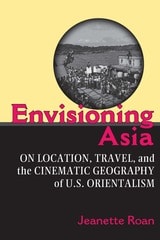
Cover art: Publicity still, Tokyo File 212 (Dorrell McGowan and Stuart McGowan, 1951). The accompanying text reads: "Hundreds of spectators gather on the sidelines as technicians prepare to photograph a parade scene in 'Tokyo File 212,' a Breakston-McGowan Production filmed in Japan for RKO Radio distribution." Courtesy of the Academy of Motion Picture Arts and Sciences.
Envisioning Socialism
Television and the Cold War in the German Democratic RepublicHeather L. Gumbert
University of Michigan Press, 2014
Envisioning Socialism examines television and the power it exercised to define the East Germans’ view of socialism during the first decades of the German Democratic Republic. In the first book in English to examine this topic, Heather L. Gumbert traces how television became a medium prized for its communicative and entertainment value. She explores the difficulties GDR authorities had defining and executing a clear vision of the society they hoped to establish, and she explains how television helped to stabilize GDR society in a way that ultimately worked against the utopian vision the authorities thought they were cultivating.
Gumbert challenges those who would dismiss East German television as a tool of repression that couldn’t compete with the West or capture the imagination of East Germans. Instead, she shows how, by the early 1960s, television was a model of the kind of socialist realist art that could appeal to authorities and audiences. Ultimately, this socialist vision was overcome by the challenges that the international market in media products and technologies posed to nation-building in the postwar period.
A history of ideas and perceptions examining both real and mediated historical conditions, Envisioning Socialism considers television as a technology, an institution, and a medium of social relations and cultural knowledge. The book will be welcomed in undergraduate and graduate courses in German and media history, the history of postwar Socialism, and the history of science and technologies.
Envisioning Taiwan
Fiction, Cinema, and the Nation in the Cultural ImaginaryJune Yip
Duke University Press, 2004
Yip traces a distinctly Taiwanese sense of self vis-à-vis China, Japan, and the West through two of the island’s most important cultural movements: the hsiang-t’u (or “nativist”) literature of the 1960s and 1970s, and the Taiwanese New Cinema of the 1980s and 1990s. At the heart of the book are close readings of the work of the hsiang-t’u writer Hwang Chun-ming and the New Cinema filmmaker Hou Hsiao-hsien. Key figures in Taiwan’s assertion of a national identity separate and distinct from China, both artists portray in vibrant detail daily life on the island. Through Hwang’s and Hou’s work and their respective artistic movements, Yip explores “the imagining of a nation” on the local, national, and global levels. In the process, she exposes a perceptible shift away from traditional models of cultural authenticity toward a more fluid, postmodern hybridity—an evolution that reflects both Taiwan’s peculiar multicultural reality and broader trends in global culture.
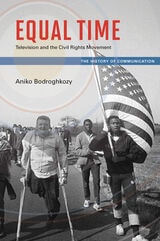
Equal Time
Television and the Civil Rights MovementAniko Bodroghkozy
University of Illinois Press, 2013
Erik Satie
Mary E. Davis
Reaktion Books, 2007
A composer who dabbled in the Dada movement, a Bohemian “gymnopédiste” of fin-de-siècle Montmartre, and a legendary dresser known as “The Velvet Gentleman,” Erik Satie cut a unique figure among early twentieth-century European composers. Yet his legacy has largely languished in the shadows of Stravinsky, Debussy, and Ravel. Mary E. Davis now brings Satie to life in this fascinating new biography.
Satie redefined the composer’s art, devising new methods of artistic expression that melded ordinary and rarified elements of words, visual art, and music. Davis argues that Satie’s modernist aesthetic was grounded in the contradictions of his life—such as enrolling in the conservative Schola Cantorum after working as a cabaret performer—and is reflected in his irreverent essays, drawn art, and music. Erik Satie explores how the composer was embraced by avant-garde artists and fashionable Parisian elite, and how his experiences inspired him to create the musical style of Neoclassicism. Satie also employed the power of the image through his infamous fashion statements, Davis contends, and became part of a nascent celebrity culture.
A cogent and informative portrait, Erik Satie upends the accepted history of modernist music and restores the composer to his rightful pioneering status.
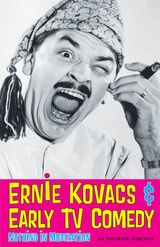
Ernie Kovacs & Early TV Comedy
Nothing in ModerationBy Andrew Horton
University of Texas Press, 2010
Among the pioneers of television, Ernie Kovacs was one of the most original and imaginative comedians. His zany, irreverent, and surprising humor not only entertained audiences throughout the 1950s and early 1960s, but also inspired a host of later comedies and comedians, including Monty Python, David Letterman, much of Saturday Night Live, Rowan and Martin's Laugh-In, Captain Kangaroo, and even Sesame Street. Kovacs created laughter through wildly creative comic jokes, playful characterizations, hilarious insights, and wacky experiments. "Nothing in moderation," his motto and epitaph, sums up well Kovacs's wholehearted approach to comedy and life.
In this book, Andrew Horton offers the first sustained look at Ernie Kovacs's wide-ranging and lasting contributions to the development of TV comedy. He discusses in detail Kovacs's work in New York, which included The Ernie Kovacs Show (CBS prime time 1952–1953), The Ernie Kovacs Show (NBC daytime variety 1956–1957), Tonight (NBC late-night comedy/variety 1956-1957), and a number of quiz shows. Horton also looks at Kovacs's work in Los Angeles and in feature film comedy. He vividly describes how Kovacs and his comic co-conspirators created offbeat characters and zany situations that subverted expectations and upended the status quo. Most of all, Horton demonstrates that Kovacs grasped the possibility for creating a fresh genre of comedy through the new medium of television and exploited it to the fullest.
Essential Film History
The Evolution of Movie StorytellingCharles Ramírez Berg and John Bruns
University of Texas Press, 2026
A guide to the fundamentals of understanding film history, filmmaking, and film appreciation.
Film is not just a medium; it is also a language—and a global one at that. Essential Film History describes how this language emerged and how it has matured over the course of more than 125 years. Beginning with the experiments of the late nineteenth century, and tracking the development of cinematic storytelling, commercial distribution, and audience reception into the era of digital recording, Charles Ramírez Berg and John Bruns offer a comprehensive course in both the history and artistry of film.
Essential Film History breaks cinematic language into three core components: image, sound, and narrative. Between the 1890s and 1940s, this audiovisual language both consolidated and spread, becoming comprehensible worldwide. Since then, filmmakers have adapted and extended the language of cinema to suit an ever-growing range of aesthetic and narrative projects, from documentaries and full-length animation to avant-garde and made-for-TV movies. Covering major figures, studios, and events as well as key technological and sociopolitical developments, Essential Film History is an indispensable guide to the evolution of cinematic style.

Estado Vegetal
Performance and Plant-ThinkingGiovanni Aloi
University of Minnesota Press, 2023
Interdisciplinary essays on Manuela Infante’s award-winning play explore the relationship between critical plant studies and performance art in the Anthropocene
Since its first staging in 2016, Estado Vegetal, Manuela Infante’s riveting piece of experimental performance art, has expanded philosophical thinking into a fully-fledged artistic inquiry of nonanthropocentric being. Through Infante’s polyvocal monologue, acted with impetus by Marcela Salinas, plants are charged with an agency capable of uprooting culturally grounded conceptions of the world in the face of incommensurable trauma and loss.
This first book dedicated to Infante’s plant-focused performance features eight essays by scholars, poets, and artists whose practices draw from research fields as disparate as new materialism, anthropogenic feminism, queer studies, and speculative realism. Including an interview with Infante, the full playscript, and stills from the performance, Estado Vegetal: Performance and Plant-Thinking reveals the roles that plants in art can play in productively reconfiguring human–nonhuman relations within current anthropogenic perspectives.
Infante’s performance is a perfect case study and reference point for anyone interested in exploring the complexities of plant-thinking through alternative and experimental avenues. Furthermore, this book is at once a critical plant studies primer and an artistic problematization of the philosophical questions that have been central to the latest multidisciplinary discussions on plant-being.
Contributors: Maaike Bleeker, Utrecht U; Lucy Cotter, Portland State U; Prudence Gibson, UNSW Sydney; Michael Marder, U of the Basque Country; Dawn Sanders, U of Gothenburg; Catriona Sandilands, York U; Sibila Sotomayor Van Rysseghem, colectivo LASTESIS; Mandy-Suzanne Wong.
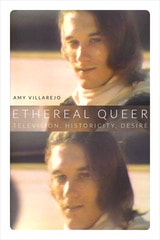
Ethereal Queer
Television, Historicity, DesireAmy Villarejo
Duke University Press, 2013
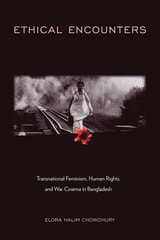
Ethical Encounters
Transnational Feminism, Human Rights, and War Cinema in BangladeshElora Halim Chowdhury
Temple University Press, 2022
Ethical Encounters is an exploration of the intersection of feminism, human rights, and memory to illuminate how visual practices of recollecting violent legacies in Bangladeshi cinema can conjure a global cinematic imagination for the advancement of humanity.
By examining contemporary, women-centered Muktijuddho cinema—features and documentaries that focus on the Bangladesh Liberation War of 1971—Elora Chowdhury shows how these films imagine, disrupt, and reinscribe a gendered nationalist landscape of trauma, freedom, and agency. Chowdhury analyzes Bangladeshi feminist films including Meherjaan, and Itihaash Konna (Daughters of History), as well as socially-engaged films by activist-filmmakers including Jonmo Shathi (Born Together), and Shadhinota (A Certain Liberation), to show how war films of Bangladesh can generate possibilities for gender justice.
Chowdhury argues that justice-driven films are critical to understanding and negotiating the layered meanings and consequences of catastrophic human suffering yet at the same time they hint at subjectivities and identities that are not reducible to the politics of suffering. Rather, they are key to creating an alternative and disruptive archive of feminist knowledge—a sensitive witnessing, responsible spectatorship, and just responsibility across time, and space.
Drawing on Black and transnational feminist critiques, Chowdhury explores questions around women’s place, social roles, and modes of participation in war as well as the visual language through which they become legible as victims/subjects of violence and agents of the nation. Ethical Encounters illuminates the possibilities of film as a site to articulate an ethics that acknowledges a founding violence of the birth of a nation, recuperates it even if in fragments, and imagines differently the irreconcilable relationship between humanity, liberty, and justice.
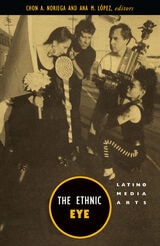
Ethnic Eye
Latino Media ArtsChon Noriega
University of Minnesota Press, 1996
The first in-depth treatment of Latino film and video.
This groundbreaking volume is the first to examine the range of Latino media arts, from independent feature production to documentary to experimental video. The essays explore the work of Chicano, Puerto Rican, Cuban American, and Latino film and video artists and address avant-garde practices, queer media, and performance art as well as more conventional film and video representations.
Contributors to The Ethnic Eye provide close readings of a wide variety of films and videos, including Stand and Deliver, American Me, Bedhead, El Mariachi, Carmelita Tropicana, Improper Conduct, Welcome to America’s Finest Tourist Plantation, Border Brujo, Mérida Proscrita, and Spitfire. The essays are unified by a concern with the creation of a common ground for Latino media arts, one that is pan-ethnic rather than narrowly transcribed by race, ethnicity, or national heritage. The volume also provides the first in-depth treatment of such artists as Robert Rodriquez, Ela Troyano, Raphael Montañez Ortiz, and Frances Salomé España. Eclectic in the range of media artists and works considered, The Ethnic Eye is unique in its inclusion of site-specific public art, as well as performance-based works. Contributors: Marcos Becquer; Charles Ramírez Berg, U of Texas; C. Ondine Chavoya; Marvin D’Lugo, Clark U; Claire F. Fox, Stanford U; Ilene S. Goldman; Carmen Huaco-Nuzum, U of California, Davis; Lillian Jiménez; Alisa Lebow; Scott MacDonald, Utica College; José Esteban Muñoz, New York U; Frances Negrón-Muntaner; Kathleen Newman, U of Iowa; Christopher Ortiz.