Results by title
783 books match the query 'History & Theory' and 23 start with e
Earthly Plenitudes
A Study on Sovereignty and LaborBruno Gullì
Temple University Press, 2016
Gullì first reviews approaches to sovereignty by philosophers as varied as Gottfried Leibniz and Georges Bataille, and then looks at concrete examples where the alliance of sovereignty and capital cracks under the potency of living labor. He examines contingent academic labor as an example of the super-exploitation of labor, which has become a global phenomenon, and as such, a clear threat to the sovereign logic of capital. Gullì also looks at disability to assert that a new measure of humanity can only be found outside the schemes of sovereignty, productivity, efficiency, and independence, through care and caring for others, in solidarity and interdependence.
Eating Anxiety
The Perils of Food PoliticsChad Lavin
University of Minnesota Press, 2013
Debates about obesity are really about the meaning of responsibility. The trend toward local foods reflects the changing nature of space due to new communication technologies. Vegetarian theory capitalizes on biotechnology’s challenge to the meaning of species. And food politics, as this book makes powerfully clear, is actually about the political anxieties surrounding globalization.
In Eating Anxiety, Chad Lavin argues that our culture’s obsession with diet, obesity, meat, and local foods enacts ideological and biopolitical responses to perceived threats to both individual and national sovereignty. Using the occasion of eating to examine assumptions about identity, objectivity, and sovereignty that underwrite so much political order, Lavin explains how food functions to help structure popular and philosophical understandings of the world and the place of humans within it. He introduces the concept of digestive subjectivity and shows how this offers valuable resources for rethinking cherished political ideals surrounding knowledge, democracy, and power.
Exploring discourses of food politics, Eating Anxiety links the concerns of food—especially issues of sustainability, public health, and inequality—to the evolution of the world order and the possibilities for democratic rule. It forces us to question the significance of consumerist politics and—simultaneously—the relationship between politics and ethics, public and private.
Edges of the State
John Protevi
University of Minnesota Press, 2019
Using philosophical and scientific work to engage the perennial question of human nature
This book takes a look at the formation, and edges, of states: their breakdowns and attempts to repair them, and their encounters with non-state peoples. It draws upon anthropology, political philosophy, neuroscience, evolutionary biology, child developmental psychology, and other fields to look at states as projects of constructing “bodies politic,” where the civic and the somatic intersect. John Protevi asserts that humans are predisposed to “prosociality,” or being emotionally invested in social partners and patterns. With readings from Jean-Jacques Rousseau and James C. Scott; a critique of the assumption of widespread pre-state warfare as a selection pressure for the evolution of human prosociality and altruism; and an examination of the different “economies of violence” of state and non-state societies, Edges of the State sketches a notion of prosocial human nature and its attendant normative maxims.
Forerunners: Ideas First
Short books of thought-in-process scholarship, where intense analysis, questioning, and speculation take the lead
Education, Justice, and Democracy
Edited by Danielle Allen and Rob Reich
University of Chicago Press, 2013
Electoral Incentives in Congress
Jamie L. Carson and Joel Sievert
University of Michigan Press, 2018

Empire in Denial
The Politics of State-BuildingDavid Chandler
Pluto Press, 2006
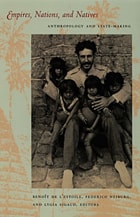
Empires, Nations, and Natives
Anthropology and State-MakingBenoît de L Estoile, Federico Neiburg and Lygia Sigaud, eds.
Duke University Press, 2005
The contributors—social and cultural anthropologists from the Americas and Europe—report on both historical and contemporary processes. Moving beyond controversies that cast the relationship between scholarship and politics in binary terms of complicity or autonomy, they bring into focus a dynamic process in which states, anthropological knowledge, and population groups themselves are mutually constructed. Such a reflexive endeavor is an essential contribution to a critical anthropological understanding of a changing world.
Contributors: Alban Bensa, Marcio Goldman, Adam Kuper, Benoît de L’Estoile, Claudio Lomnitz, David Mills, Federico Neiburg, João Pacheco de Oliveira, Jorge Pantaleón, Omar Ribeiro Thomaz, Lygia Sigaud, Antonio Carlos de Souza Lima, Florence Weber
End of the Nation-State
Jean-Marie Guehenno
University of Minnesota Press, 2000
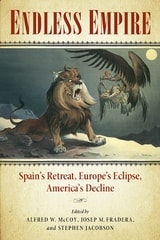
Endless Empire
Spain's Retreat, Europe's Eclipse, America's DeclineEdited by Alfred W. McCoy, Josep M. Fradera, and Stephen Jacobson
University of Wisconsin Press, 2012
- erosion of economic and fiscal strength needed for military power on a global scale
- misuse of military power through micro-military misadventures
- breakdown of alliances among major powers
- weakened controls over the subordinate elites critical for any empire’s exercise of global power
- insufficient technological innovation to sustain global force projection.
Ends in Sight
Marx/Fukuyama/Hobsbawm/AndersonGregory Elliott
Pluto Press, 2008
Gregory Elliott argues that Marx is central to all three accounts and that, along with the Manifesto, they form a quartet of analyses of the results and prospects of capitalism and socialism, which are of enduring significance for the Left.
Senses of an Ending provides a readable survey of key historical and political thinkers that will appeal to anyone interested in modern political thought.
Equaliberty
Political EssaysÉtienne Balibar
Duke University Press, 2014
Eric Voegelin and the Continental Tradition
Explorations in Modern Political ThoughtEdited by Lee Trepanier & Steven F. McGuire
University of Missouri Press, 2011
Eric Voegelin and the Foundations of Modern Political Science
Barry Cooper
University of Missouri Press, 1999
This important new work is a major analysis of the foundation of Eric Voegelin's political science. Barry Cooper maintains that the writings Voegelin undertook in the 1940s provide the groundwork for the brilliant book that is one of his best known, The New Science of Politics. At the time of that book's publication, however, few were aware of the enormous knowledge and accomplished scholarship that lay behind its illuminating, although sometimes baffling, formulations.
By focusing on several of the key chapters in Voegelin's eight- volume History of Political Ideas, especially the studies of Bodin, Vico, and Schelling, Cooper shows how those studies provide the basis for Voegelin's thought. Investigating Voegelin's study of Oriental influences on Western political "ideas," especially Mongol constitutional law, and his study of Toynbee, Cooper seeks to demonstrate the vast range of materials Voegelin used.
Cooper contends that, as with other great thinkers, political crisis, specifically the world war of 1939-1945, stimulated Voegelin's intellectual and spiritual achievement. He provides an analysis of Voegelin's immediate concern with the course of World War II, his ability to understand those dramatic events in a large context, and his ability to provide an insightful account of the causes, the significance, and the consequences of the spiritual and political disorder that was evident all around him.
In Eric Voegelin and the Foundations of Modern Political Science, Cooper makes the connection between Voegelin's political writings of the 1940s and the meditative interpretations that began to appear with the publication of Anamnesis and with the later volumes of Order and History much more intelligible than does any existing discussion of Voegelin. Scholars in intellectual history and political science will benefit enormously from this valuable new addition to Voegelin studies.
Eric Voegelin and the Problem of Christian Political Order
Jeffrey C. Herndon
University of Missouri Press, 2007
Although some critics of Eric Voegelin’s later work have faulted his failure to deal with the historical Jesus and to address the implications of Christianity for social and political life, the recent publication of Voegelin’s History of Political Ideas has allowed a more complete assessment of his position regarding the Christian political order. This book addresses that criticism through an analysis of Voegelin’s early work.
In Eric Voegelin and the Problem of Christian Political Order, Jeffrey C. Herndon analyzes the development of Voegelin’s thought regarding the origins of Christianity in the person of Jesus, the development of the church in the works of Paul, and the relationship between an immanent institutional order symbolizing the divine presence and the struggle for social and political order. Focusing on the tension between a spiritual phenomenon based on Pauline faith and the institutionalization of that experience in the church, Herndon offers one of the first examinations of the relationship of the History of Political Ideas to Voegelin’s larger body of work.
In his wide-ranging study, Herndon explores Voegelin’s examination of the problem of Christian political order from the inception of Christianity through the Great Reformation. He also presents a clarification of Voegelin’s theory of civilizational foundation and of Voegelin’s philosophy of history with regard to Christianity and Western political order.
Herndon addresses not only the nagging problem in Voegelin scholarship regarding his relationship with the historical Jesus but also the “Pauline compromises with the world” that enabled Christianity to become the instrument by which the West was civilized. He also shows that Voegelin’s interpretation of the historical pressures released by the Great Reformation is important to an understanding of his later work regarding the negative effect of Christian symbols in the creation of ideological disorder.
Eric Voegelin and the Problem of Christian Political Order clarifies issues in Voegelin studies regarding the intersection between political theory and Christian concerns, addressing the relation of religious experience to the public sphere of political life in the West and helping to explain Voegelin’s contention that the death of the spirit is the price of progress. It offers scholars a perspective heretofore lacking in Voegelin scholarship and a clearer view of Voegelin’s understanding of the Christian dispensation and its influence on the course of Western development, history, and philosophy.
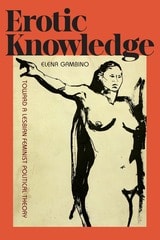
Erotic Knowledge
Toward a Lesbian Feminist Political TheoryElena Gambino
Duke University Press, 2026

Essays on Kant's Political Philosophy
Edited by Howard Lloyd Williams
University of Chicago Press, 1992
overshadowed by his compatriots Hegel and Marx. With his
strong defense of the rights of the person and his deep
insight into the strengths and weaknesses of modern society
Kant, possibly more than any other political thinker,
anticipated the problems of the late twentieth century.
Kant's political philosophy, wedded as it is to rights,
reform and gradual progress, is emerging from the shadows
cast by Hegelian and Marxist thinking about the state.
In this volume, thirteen distinguished contributors from the
United States, Canada, Britain, and Germany cast light on
important aspects of Kant's liberal thinking. Key topics
covered include Kant's liberal reformism, his relation with
Hegel, his attitude to women, the use of reason, revolution,
Kant's optimism and his moral and legal rigorism.
Howard Williams is a reader in political theory in the
Department of International Politics, University College of
Wales, Aberystwyth. His previous publications include
Kant's Political Philosophy, Concepts of
Ideology, and Hegel, Heraclitus, and Marx's
Dialectic.
Essays on Liberalism and the Economy, Volume 18
F. A. Hayek
University of Chicago Press, 2022
Across seventeen volumes to date, the University of Chicago Press’s Collected Works of F. A. Hayek series has anthologized the diverse and prolific writings of the Austrian economist synonymous with classical liberalism. Essays on Liberalism and the Economy traces the author’s long and evolving writings on the cluster of beliefs he championed most: liberalism, its core tenets, and how its tradition represents the best hope for Western civilization.
This volume contains material from almost the entire span of Hayek’s career, the earliest from 1931 and the last from 1984. The works were written for a variety of purposes and audiences, and they include—along with conventional academic papers—encyclopedia entries, after-dinner addresses, a lecture for graduate students, a book review, newspaper articles, and letters to the editors of national newspapers. While many are available elsewhere, two have never appeared in print, and two others have not been published in English.
The varied formats collected here are enriched by Hayek’s changing voice at different stages of his life. Some of the pieces resonate as high-minded and noble; some are meant as cuts to “intellectuals” (a pejorative term when used by Hayek) like Keynes and Galbraith. All serve to distill important threads of his worldview.
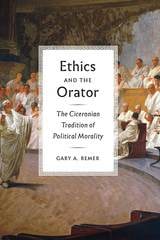
Ethics and the Orator
The Ciceronian Tradition of Political MoralityGary A. Remer
University of Chicago Press, 2017
Remer’s study is distinct from other works on political morality in that it turns to Cicero, not Aristotle, as the progenitor of an ethical rhetorical perspective. Contrary to many, if not most, studies of Cicero since the mid-nineteenth century, which have either attacked him as morally indifferent or have only taken his persuasive ends seriously (setting his moral concerns to the side), Ethics and the Orator demonstrates how Cicero presents his ideal orator as exemplary not only in his ability to persuade, but in his capacity as an ethical person. Remer makes a compelling case that Ciceronian values—balancing the moral and the useful, prudential reasoning, and decorum—are not particular only to the philosopher himself, but are distinctive of a broader Ciceronian rhetorical tradition that runs through the history of Western political thought post-Cicero, including the writings of Quintilian, John of Salisbury, Justus Lipsius, Edmund Burke, the authors of The Federalist, and John Stuart Mill.
Ethics of Citizenship
Immigration and Group Rights in GermanyWilliam A. Barbieri Jr.
Duke University Press, 1998
Although some of Germany’s foreign workers have gradually attained a degree of social and economic legitimacy, Barbieri explains how they remain effectively excluded from true German citizenship. Describing how this exclusion has occurred and assessing current attitudes toward political membership in Germany, he argues for a just and democratic policy toward the tax-paying, migrant worker minority, one that would combine the extension of the individual rights of citizenship with the establishment of certain group rights. Through a dissection of ongoing public “membership debates” over issues such as suffrage, dual citizenship, and immigration and refugee policy, Barbieri identifies a range of competing responses to the question of who “belongs” in Germany. After critiquing these views, he proposes an alternative ethic of membership rooted in an account of domination and human rights that seeks to balance individual and group rights within the context of a commitment to democracy and equal citizenship.
Indispensable for scholars of German studies, Ethics of Citizenship also raises questions that will attract moral philosophers, constitutional scholars, and those interested in the continuing, global problems associated with migration.
Ethnic Federalism
The Ethiopian Experience in Comparative PerspectiveDavid Turton
Ohio University Press, 2006
Since 1991, Ethiopia has gone further than any other country in using ethnicity as the fundamental organizing principle of a federal system of government. And yet this pioneering experiment in “ethnic federalism” has been largely ignored in the growing literature on democratization and ethnicity in Africa and on the accommodation of ethnic diversity in democratic states. Ethnic Federalism brings a much-needed comparative dimension to the discussion of this experiment in Ethiopia.
Ethnic Federalism closely examines aspects of the Ethiopean case and asks why the use of territorial decentralism to accommodate ethnic differences has been generally unpopular in Africa, while it is growing in popularity in the West.
The book includes case studies of Nigerian and Indian federalism and suggests how Ethiopia might learn from both the failures and successes of these older federations. In the light of these broader issues and cases, it identifies the main challenges facing Ethiopia in the next few years, as it struggles to bring political practice into line with constitutional theory and thereby achieve a genuinely federal division of powers.
Europe and Its Shadows
Coloniality after EmpireHamid Dabashi
Pluto Press, 2019
Frantz Fanon’s assessment that 'Europe is literally the creation of the Third World' is still true today; but in more than one sense for the colonial has always been embedded in the capital, and the capital within the colonial. As the condition of coloniality shifts, so have the dividing lines between coloniser and colonised, and this shift calls for a reappraisal of our understanding of nationalism, xenophobia and sectarianism as the dangerous indices of the emerging worlds.
As the far-right populists captivate minds across Europe and Brexit upsets the balance of power in the European Union, this book, from a major scholar of postcolonial thought, is a timely and transformative intervention.
Europe's Indians
Producing Racial Difference, 1500–1900Vanita Seth
Duke University Press, 2010
Explaining the East Asian Peace
A Research StoryStein Tønnesson
National University of Singapore Press, 2017