143 books match the query 'History of doctrines' and 3 start with e
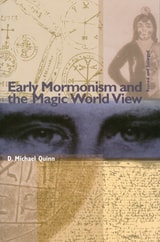
cover of Early Mormonism and the Magic World View

Early Mormonism and the Magic World View

D. Michael Quinn

Signature Books, 1987

In this ground-breaking book, D. Michael Quinn masterfully reconstructs an earlier age, finding ample evidence for folk magic in nineteenth-century New England, as he does in Mormon founder Joseph Smith’s upbringing. Quinn discovers that Smith’s world was inhabited by supernatural creatures whose existence could be both symbolic and real. He explains that the Smith family’s treasure digging was not unusual for the times and is vital to understanding how early Mormons interpreted developments in their history in ways that differ from modern perceptions. Quinn’s impressive research provides a much-needed background for the environment that produced Mormonism.

This thoroughly researched examination into occult traditions surrounding Smith, his family, and other founding Mormons cannot be understated. Among the practices no longer a part of Mormonism are the use of divining rods for revelation, astrology to determine the best times to conceive children and plant crops, the study of skull contours to understand personality traits, magic formula utilized to discover lost property, and the wearing of protective talismans. Ninety-four photographs and illustrations accompany the text. 
[more]
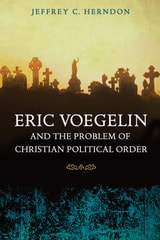
cover of Eric Voegelin and the Problem of Christian Political Order

Eric Voegelin and the Problem of Christian Political Order

Jeffrey C. Herndon

University of Missouri Press, 2007

  Although some critics of Eric Voegelin’s later work have faulted his failure to deal with the historical Jesus and to address the implications of Christianity for social and political life, the recent publication of Voegelin’s History of Political Ideas has allowed a more complete assessment of his position regarding the Christian political order. This book addresses that criticism through an analysis of Voegelin’s early work.

            In Eric Voegelin and the Problem of Christian Political Order, Jeffrey C. Herndon analyzes the development of Voegelin’s thought regarding the origins of Christianity in the person of Jesus, the development of the church in the works of Paul, and the relationship between an immanent institutional order symbolizing the divine presence and the struggle for social and political order. Focusing on the tension between a spiritual phenomenon based on Pauline faith and the institutionalization of that experience in the church, Herndon offers one of the first examinations of the relationship of the History of Political Ideas to Voegelin’s larger body of work.

            In his wide-ranging study, Herndon explores Voegelin’s examination of the problem of Christian political order from the inception of Christianity through the Great Reformation. He also presents a clarification of Voegelin’s theory of civilizational foundation and of Voegelin’s philosophy of history with regard to Christianity and Western political order.

            Herndon addresses not only the nagging problem in Voegelin scholarship regarding his relationship with the historical Jesus but also the “Pauline compromises with the world” that enabled Christianity to become the instrument by which the West was civilized. He also shows that Voegelin’s interpretation of the historical pressures released by the Great Reformation is important to an understanding of his later work regarding the negative effect of Christian symbols in the creation of ideological disorder.

            Eric Voegelin and the Problem of Christian Political Order clarifies issues in Voegelin studies regarding the intersection between political theory and Christian concerns, addressing the relation of religious experience to the public sphere of political life in the West and helping to explain Voegelin’s contention that the death of the spirit is the price of progress. It offers scholars a perspective heretofore lacking in Voegelin scholarship and a clearer view of Voegelin’s understanding of the Christian dispensation and its influence on the course of Western development, history, and philosophy.
[more]
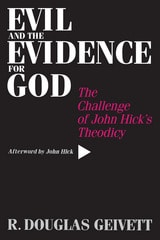
cover of Evil & the Evidence For God: The Challenge of John Hick's Theodicy

Evil & the Evidence For God

The Challenge of John Hick's Theodicy

R. Geivett

Temple University Press, 1995

"By appealing to recent scientific opinion that the universe may well have had an absolute beginning, Geivett develops an interesting, forceful argument for the rationality of belief in God. He then expounds the Augustinian free will theodicy and defends it against Hick's criticisms." --William L. Rowe How to reconcile the existence of evil with the belief in a benevolent God has long posed a philosophical problem to the system of Christian theism. John Hick's book, Evil and the Love of God, is perhaps the best known work to redress this difficulty in modern terms. Sharing Hick's interest in responding to the question of evil, R. Douglas Geivett constructs his own new "theodicy for today." But Geivett departs from Hick by embracing the Augustinian tradition of free will and returning the responsibility for evil to human beings themselves. Reviews "Moving from a comparison of the Irenaean and Augustinian traditions in theodicy to a powerfully original critique of Hick's influential 'soul-making' theodicy, Geivett presents a richly developed natural theology drawing on contemporary scientific opinion in support of an ex nihilo creation. Geivett's writing on natural theology is lucid and informed, honestly engaging many of that tradition's critics....This work is notable for its exceptionally thorough documentation and references, making it a valuable sourcebook for reflection on God and evil. A stimulating afterword by Hick himself significantly enriches this book's provocative analyses." --Religious Studies Review "Geivett details a natural theology and develops a way of understanding the existence of evil that places the fact of evil within, rather than in opposition to, a theistic view. Both the natural theology and the theodicy are rich and complex." --Keith E. Yandell, University of Wisconsin "In this interesting and worthwhile work, Geivett's statement of arguments in natural theology is fuller and fairer than that given by Hick in his writings. This book is an outstanding contribution to the field." --Richard L. Purtill, Western Washington University Contents Preface Part I: Two Traditions 1. The Problem of Evil 2. The Augustinian Tradition 3. John Hick's Theodicy Part II: Religious Epistemology 4. The Value of Natural Theology 5. The Danger of Dismissing Natural Theology 6. The Possibility of Natural Theology, Part 1: The Argument for a Non-Natural Reality 7. The Possibility of Natural Theology, Part 2: Personality, Power, and Providence 8. Explanation and Religious Ambiguity Part III: Theodicy Proper 9. John Hick's View of Divine Purpose 10. The Augustinian View of Divine Purpose 11. Free Will and Evil 12. Evil and the Afterlife Afterword by John Hick Notes Index About the Author(s) R. Douglas Geivett is Associate Professor of Philosophy at Biola University in La Mirada, California.
[more]