Results by title
405 books match the query 'Human Geography' and 13 start with e
Earth Shapers
How We Mapped and Mastered the World, from the Panama Canal to the Baltic WayMaxim Samson
University of Chicago Press, 2025
Mountains, meridians, rivers, and borders—these are some of the features that divide the world on our maps and in our minds. But geography is far less set in stone than we might believe, and, as Maxim Samson’s Earth Shapers contends, in our relatively short time on this planet, humans have become experts at fundamentally reshaping our surroundings.
From the Qhapaq Ñan, the Inca’s “great road,” and Mozambique’s colonial railways to a Saudi Arabian smart city, and from Korea’s sacred Baekdu-daegan mountain range and the Great Green Wall in Africa to the streets of Chicago, Samson explores how we mold the world around us. And how, as we etch our needs onto the natural landscape, we alter the course of history. These fascinating stories of connectivity show that in our desire to make geographical connections, humans have broken through boundaries of all kinds, conquered treacherous terrain, and carved up landscapes. We crave linkages, and though we do not always pay attention to the in-between, these pathways—these ways of “earth shaping,” in Samson’s words—are key to understanding our relationship with the planet we call home.
An immense work of cultural geography touching on ecology, sociology, history, and politics, Earth Shapers argues that, far from being constrained by geography, we are instead its creators.
Earth Shapers
How We Mapped and Mastered the World, from the Panama Canal to the Baltic WayMaxim Samson
University of Chicago Press, 2025
The globetrotting story of how humans have harnessed the geographical landscape and written ourselves onto our surroundings.
Mountains, meridians, rivers, and borders—these are some of the features that divide the world on our maps and in our minds. But geography is far less set in stone than we might believe, and, as Maxim Samson’s Earth Shapers contends, in our relatively short time on this planet, humans have become experts at fundamentally reshaping our surroundings.
From the Qhapaq Ñan, the Inca’s “great road,” and Mozambique’s colonial railways to a Saudi Arabian smart city, and from Korea’s sacred Baekdu-daegan mountain range and the Great Green Wall in Africa to the streets of Chicago, Samson explores how we mold the world around us. And how, as we etch our needs onto the natural landscape, we alter the course of history. These fascinating stories of connectivity show that in our desire to make geographical connections, humans have broken through boundaries of all kinds, conquered treacherous terrain, and carved up landscapes. We crave linkages, and though we do not always pay attention to the in-between, these pathways—these ways of “earth shaping,” in Samson’s words—are key to understanding our relationship with the planet we call home.
An immense work of cultural geography touching on ecology, sociology, history, and politics, Earth Shapers argues that, far from being constrained by geography, we are instead its creators.

Edgar Allan Poe - American Writers 89
University of Minnesota Pamphlets on American WritersRoger Asselineau
University of Minnesota Press, 1970
Edgar Allan Poe - American Writers 89 was first published in 1970. Minnesota Archive Editions uses digital technology to make long-unavailable books once again accessible, and are published unaltered from the original University of Minnesota Press editions.
Edges of Care
Living and Dying in No Man’s LandNoam Leshem
University of Chicago Press, 2025
“No man’s land” invokes stretches of barren landscape, twisted barbed wire, desolation, and the devastation of war. But this is not always the reality. According to Noam Leshem in Edges of Care, the term also reveals radical abandonment by the state. From the Northern Sahara to the Amazon rainforests, people around the world find themselves in places that have been stripped of sovereign care. Leshem is committed to defining these spaces and providing a more intimate understanding of this urgent political reality.
Based on nearly a decade of research in some of the world’s most challenging conflict zones, Edges of Care offers a profound account of abandoned lives and lands, and how they endure and sometimes thrive once left to fend for themselves. Leshem interrogates no man’s land as a site of radical uncaring: abandoned by a sovereign power in a relinquishment of responsibility for the space or anyone inside it. To understand the ramifications of such uncaring, Leshem takes readers through a diverse series of abandoned places, including areas in Palestine, Syria, Colombia, Sudan, and Cyprus. He shows that no man’s land is not empty of life, but almost always inhabited and, in fact, often generative of new modes of being. Beautifully written and evocative, Edges of Care reveals the unexamined complexities and political dynamics hidden within and around places governed by callous indifference.
Elsewhere
How the US Food System Cultivates, Consumes, and Conceals Its ViolenceStian Rice
West Virginia University Press, 2026
Elsewhere argues that you can make all of the “smart” food choices you want and follow Michael Pollan to the letter, but that won’t end the violence in the food system. Eating is an act of violence. With every life-sustaining meal and food purchase, we shorten the lives of farmers, laborers, animals, the planet, and ourselves. This isn’t a symptom of a broken food system, but a feature of a working one: our capitalist food system doesn’t cause harm accidentally, it does so because it has to. To keep generating wealth, the system moves its violence around, away from privileged producers and consumers and into forgettable elsewheres: reservations, prisons, distant islands, killing floors, inner cities, rural hinterlands, and war-torn countries.
This shell-game is not new. Elsewhere examines the 250-year history of the US food system to uncover how the country used abundance to enrich some and exploit others; how it captured, colonized, and reorganized territory to conceal its harms; and why decades of technological innovation, environmental awareness, and consumer consciousness haven’t staunched these self-inflicted wounds. Elsewhere invites us to ask different questions about the food system: where does its violence come from, where does it go, and how can we nurture a food system that first does no harm.
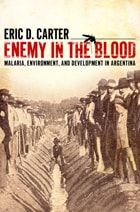
Enemy in the Blood
Malaria, Environment, and Development in ArgentinaEric D. Carter
University of Alabama Press, 2012
Tracing the Fight Against Malaria and the Making of Modern Argentina.
Enemy in the Blood: Malaria, Environment, and Development in Argentina examines the dramatic yet mostly forgotten history of malaria control in northwest Argentina. Carter traces the evolution of malaria science and policy in Argentina from the disease’s emergence as a social problem in the 1890s to its effective eradication by 1950. Malaria-control proponents saw the campaign as part of a larger project of constructing a modern identity for Argentina. Insofar as development meant building a more productive, rational, and hygienic society, the perceptions of a culturally backwards and disease-ridden interior prevented Argentina from joining the ranks of “modern” nations. The path to eradication, however, was not easy due to complicated public health politics, inappropriate application of foreign malaria control strategies, and a habitual misreading of the distinctive ecology of malaria in the northwest, especially the unique characteristics of the local mosquito vector. Homegrown scientific expertise, a populist public health agenda, and an infusion of new technologies eventually brought a rapid end to malaria’s scourge, if not the cure for regional underdevelopment.
Enemy in the Blood sheds light on the often neglected history of northwest Argentina’s interior, adds to critical perspectives on the history of development and public health in modern Latin America, and demonstrates the merits of integrative social-environmental research.
Enigma of Ethnicity
Another American DilemmaWilbur Zelinsky
University of Iowa Press, 2000
Zelinsky begins by examining the ways in which “ethnic groups” and “ethnicity” have been defined; his own definitions then become the basis for the rest of his study. He next focuses on the concepts of heterolocalism—the possibility that an ethnic community can exist without being physically merged—and personal identity—the relatively recent idea that one can concoct one's own identity. In his final chapter, which is also his most provocative, he concentrates on the multifaceted phenomenon of multiculturalism and its relationship to ethnicity. Throughout he includes a close look at African Americans, Hispanics, and Jews as well as such less-studied groups as suburbanized Japanese, Cubans in Washington, Koreans, Lithuanian immigrants in Chicago, Estonians in New Jersey, Danish Americans in Seattle, and Finns.
Reasonable, nonpolemical, and straightforward, Zelinsky's text is invaluable for readers wanting an in-depth overview of the literature on ethnicity in the United States as well as a well-thought-out understanding of the meanings and dynamics of ethnic groups, ethnicity, and multiculturalism.

Equality in the City
Imaginaries of the Smart FutureEdited by Susan Flynn and Graham Cairns
Intellect Books, 2022
Equality in the City engenders a timely debate about what future cities might look like and what their concerns should be. Using a multi-disciplinary perspective, it features acclaimed scholars whose work investigates the proposed networked, digital technologies that ostensibly affect planning policies, control infrastructures, and deliver and manage city services and systems. The contributors offer insights into how future cities might be envisaged, planned, and executed in order to be more equal.
Erotic Cartographies
Decolonization and the Queer Caribbean ImaginationKrystal Nandini Ghisyawan
Rutgers University Press, 2022
Everyday Equalities
Making Multicultures in Settler Colonial CitiesRuth Fincher
University of Minnesota Press, 2019
A timely new look at coexisting without assimilating in multicultural cities
If city life is a “being together of strangers,” what forms of being together should we strive for in cities with ethnic and racial diversity? Everyday Equalities seeks evidence of progressive political alternatives to racialized inequality that are emerging from everyday encounters in Los Angeles, Melbourne, Sydney, and Toronto—settler colonial cities that, established through efforts to dispossess and eliminate indigenous societies, have been destinations for waves of immigrants from across the globe ever since.
Everyday Equalities finds such alternatives being developed as people encounter one another in the process of making a home, earning a living, moving around the city, and forming collective actions or communities. Here four leading scholars in critical urban geography come together to deliver a powerful and cohesive message about the meaning of equality in contemporary cities. Drawing on both theoretical reflection and urban ethnographic research, they offer the formulation “being together in difference as equals” as a normative frame to reimagine the meaning and pursuit of equality in today’s urban multicultures.
As the examples in Everyday Equalities indicate, much emotional labor, combined with a willingness to learn from each other, negotiate across differences, and agitate for change goes into constructing environments that foster being together in difference as equals. Importantly, the authors argue, a commitment to equality is not only a hope for a future city but also a way of being together in the present.
Everyday Las Vegas
Local Life in a Tourist TownRex J. Rowley
University of Nevada Press, 2014
Rowley considers such topics as why people move to Las Vegas, the nature of their work and personal lives, the impact of growth and rapid change, and interaction with the overwhelmingly touristic side of the city. He also considers the benefits and perils of living in a nonstop twenty-four-hour city rich in entertainment options and easy access to gambling, drugs, and other addictions. His examination includes the previously unstudied role of neighborhood casinos patronized by locals rather than tourists and the impact that a very mobile population has on schools, churches, and community life.
Rowley considers the very different ways people perceive a place as insiders or outsiders, a dichotomy that arises when tourism is a mainstay of the local economy. His work offers insights into what Las Vegas can teach us about other cities and American culture in general. It also contributes to our understanding of how people relate to places and how the personality of a place influences the lives of people who live there.

Exoticism and the Culture of Exploration, Volume 26
Robert P. Maccubbin and Christa Knellwolf, eds.
Duke University Press, 0
Contributors. Geraldine Barnes, Alexandra Cook, David Culpin, John Greene, Suzanne Kiernan, Christa Knellwolf, Adrian Mitchell, Lisa O’Connell, David Paxman, Ali Uzay Peker, Glynis Ridley, Nicholas Rogers, Walter Veit
Exploring The Beloved Country
American Society And CultureWilbur Zelinsky
University of Iowa Press, 1994
For fifty years geographer Wilbur Zelinsky has charted the social, cultural, and historical map of the American experience. A self-confessed incurable landscape voyeur, he has produced order and pattern from massive amounts of data, zestfully finding societal meaning in the terra incognita of our postmodern existence. Now he has gathered his most original and exciting explorations into a volume that captures the nature and dynamics of this remarkable phenomenon we call the United States of America. Each the product of Zelinsky's joyous curiosity, these energetic essays trace the innermost contours of our bewildering American reality.