Results by title
85 books match the query 'Humanities' and 2 start with e
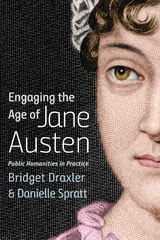
Engaging the Age of Jane Austen
Public Humanities in PracticeBridget Draxler and Danielle Spratt
University of Iowa Press, 2018
Humanities scholars, in general, often have a difficult time explaining to others why their work matters, and eighteenth-century literary scholars are certainly no exception. To help remedy this problem, literary scholars Bridget Draxler and Danielle Spratt offer this collection of essays to defend the field’s relevance and demonstrate its ability to help us better understand current events, from the proliferation of media to ongoing social justice battles.
The result is a book that offers a range of approaches to engaging with undergraduates, non-professionals, and broader publics into an appreciation of eighteenth-century literature. Essays draw on innovative projects ranging from a Jane Austen reading group held at the public library to students working with an archive to digitize an overlooked writer’s novel.
Reminding us that the eighteenth century was an exhilarating age of lively political culture—marked by the rise of libraries and museums, the explosion of the press, and other platforms for public intellectual debates—Draxler and Spratt provide a book that will not only be useful to eighteenth-century scholars, but can also serve as a model for other periods as well. This book will appeal to librarians, archivists, museum directors, scholars, and others interested in digital humanities in the public life.
Contributors: Gabriela Almendarez, Jessica Bybee, Nora Chatchoomsai, Gillian Dow, Bridget Draxler, Joan Gillespie, Larisa Good, Elizabeth K. Goodhue, Susan Celia Greenfield, Liz Grumbach, Kellen Hinrichsen, Ellen Jarosz, Hannah Jorgenson, John C. Keller, Naz Keynejad, Stephen Kutay, Chuck Lewis, Nicole Linton, Devoney Looser, Whitney Mannies, Ai Miller, Tiffany Ouellette, Carol Parrish, Paul Schuytema, David Spadafora, Danielle Spratt, Anne McKee Stapleton, Jessica Stewart, Colleen Tripp, Susan Twomey, Nikki JD White, Amy Weldon
Entanglements, or Transmedial Thinking about Capture
Rey Chow
Duke University Press, 2012
These questions are dispersively heterologous yet mutually implicated. This paradoxical character of their discursive relations is what Rey Chow intends with the word "entanglements," by which she means, first, an enmeshment of topics: the mediatized image in modernist reflexivity; captivation and identification; victimhood; the place of East Asia in globalized Western academic study. Beyond enmeshment, she asks, can entanglements be phenomena that are not defined by affinity or proximity? Might entanglements be about partition and disparity rather than about conjunction and similarity?
Across medial forms (including theater, film, narrative, digitization, and photographic art), and against more popular trends of declaring things and people to be in flux, Chow proposes conceptual frames that foreground instead aesthetic, ontological, and sentient experiences of force, dominance, submission, fidelity, antagonism, masochism, letting-go, and the attraction to self-annihilation. Boundary, trap, capture, captivation, sacrifice, and mimesis: these riveting terms serve as analytic pressure points in her readings, articulating perversity, madness, and terror to pursuits of freedom.