Results by title
72 books match the query 'Indian authors' and 3 start with e
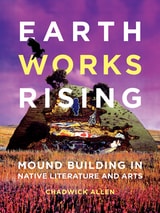
Earthworks Rising
Mound Building in Native Literature and ArtsChadwick Allen
University of Minnesota Press, 2022
A necessary reexamination of Indigenous mounds, demonstrating their sustained vitality and vibrant futurity by centering Native voices
Typically represented as unsolved mysteries or ruins of a tragic past, Indigenous mounds have long been marginalized and misunderstood. In Earthworks Rising, Chadwick Allen issues a compelling corrective, revealing a countertradition based in Indigenous worldviews. Alongside twentieth- and twenty-first-century Native writers, artists, and intellectuals, Allen rebuts colonial discourses and examines the multiple ways these remarkable structures continue to hold ancient knowledge and make new meaning—in the present and for the future.
Earthworks Rising is organized to align with key functional categories for mounds (effigies, platforms, and burials) and with key concepts within mound-building cultures. From the Great Serpent Mound in Ohio to the mound metropolis Cahokia in Illinois to the generative Mother Mound in Mississippi, Allen takes readers deep into some of the most renowned earthworks. He draws on the insights of poets Allison Hedge Coke and Margaret Noodin, novelists LeAnne Howe and Phillip Carroll Morgan, and artists Monique Mojica and Alyssa Hinton, weaving in a personal history of earthwork encounters and productive conversation with fellow researchers.
Spanning literature, art, performance, and built environments, Earthworks Rising engages Indigenous mounds as forms of “land-writing” and as conduits for connections across worlds and generations. Clear and compelling, it provokes greater understanding of the remarkable accomplishments of North America’s diverse mound-building cultures over thousands of years and brings attention to new earthworks rising in the twenty-first century.
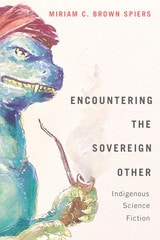
Encountering the Sovereign Other
Indigenous Science FictionMiriam C. Brown Spiers
Michigan State University Press, 2021
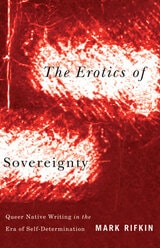
Erotics of Sovereignty
Queer Native Writing in the Era of Self-DeterminationMark Rifkin
University of Minnesota Press, 2012
In 1970 the Nixon administration inaugurated a new era in federal Indian policy. No more would the U.S. government seek to deny and displace Native peoples or dismantle Native governments; from now on federal policy would promote “the Indian’s sense of autonomy without threatening his sense of community.”
In The Erotics of Sovereignty, Mark Rifkin offers a telling perspective on what such a policy of self-determination has meant and looks at how contemporary queer Native writers use representations of sensation to challenge official U.S. accounts of Native identity. Rifkin focuses on four Native writers—Qwo-Li Driskill (Cherokee), Deborah Miranda (Esselen), Greg Sarris (Graton Rachería), and Chrystos (Menominee)—approaching their fiction and poetry as forms of political theory.
Rifkin shows how the work of these queer or two-spirit Native writers affirms the significance of the erotic as an exercise of individual and community sovereignty. In this way, we come to see how their work contests the homophobic, sexist, and exclusivist policies and attitudes of tribal communities as well as those of the nation-state.