Results by title
200 books match the query 'Indians of Mexico' and 7 start with e
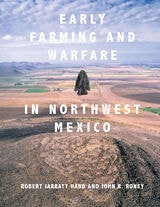
Early Farming and Warfare in Northwest Mexico
Robert J. Hard and John R. Roney
University of Utah Press, 2019
This volume presents the multiyear archaeological investigations of Cerro Juanaqueña and related sites in northwestern Chihuahua, Mexico. These remarkable terraced hilltop settlements represent a series of watershed developments, including substantial dependence on agriculture and early experiments with village living, fortified settlements, collective labor, and communal architecture. Part of a larger, regional development, they parallel changes in northern Sonora and southern Arizona. The emergence of large fortified agricultural villages at 1300 BC—before the use of ceramics—was an unexpected discovery that changed how archaeologists view early agriculture in this region.
The authors place their work in a regional and theoretical context, providing detailed analyses of radiocarbon dates, structures, features, and artifacts. Authors Hard and Roney, and their contributors, present innovative analyses of plant and animal remains, ground stone, chipped stone, and landscape evolution. Through comparisons with a global cross-cultural probe of hilltop sites and a detailed examination of the features and artifacts of Cerro Juanaqueña, Hard and Roney argue that these cerros de trincheras sites are the earliest fortified defensive sites in the region. Readers with interests in ancient agriculture, warfare, village formation, and material culture will find this to be a foundational volume.
The authors place their work in a regional and theoretical context, providing detailed analyses of radiocarbon dates, structures, features, and artifacts. Authors Hard and Roney, and their contributors, present innovative analyses of plant and animal remains, ground stone, chipped stone, and landscape evolution. Through comparisons with a global cross-cultural probe of hilltop sites and a detailed examination of the features and artifacts of Cerro Juanaqueña, Hard and Roney argue that these cerros de trincheras sites are the earliest fortified defensive sites in the region. Readers with interests in ancient agriculture, warfare, village formation, and material culture will find this to be a foundational volume.
[more]
Early Formative Pottery of the Valley of Oaxaca
Kent V. Flannery and Joyce Marcus with technical ceramic analysis by William O. Payne
University of Michigan Press, 1994
Using more than 300 illustrations, the authors present an encyclopedic analysis of the many types of pottery found in the Oaxaca Valley in the Early Formative period. From details of sherd profiles and tempers to discussions of the growth of various villages, this volume is an exhaustively thorough treatment of the topic and represents decades of archaeological fieldwork in the region.
[more]
Ejidos and Regions of Refuge in Northwestern Mexico
Edited by N. Ross Crumrine and Phil C. Weigand
University of Arizona Press, 1987
The ten essays in this volume present case studies of different cultural groups in northwestern Mexico, analyzed through the concepts of enclaves and regions of refugee initially proposed by Edward Spicer and Gonzalo Aguirre Beltran.
[more]
Excavation at San José Mogote 1
The Household ArchaeologyKent V. Flannery and Joyce Marcus with a multidimensional scaling of houses by Robert G. Reynolds
University of Michigan Press, 2005
San José Mogote, an early village and chiefly center in Mexico’s Oaxaca Valley, was excavated over a fifteen-year period. This volume reports in detail on every Early and Middle Formative house recovered, including a complete inventory of artifacts, features, plants, animal bones, and craft raw materials by house, with extensive piece-plotting of items on house floors and dooryards.
[more]
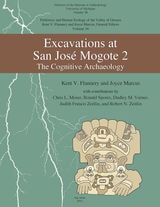
Excavations at San José Mogote 2
The Cognitive ArchaeologyKent V. Flannery and Joyce Marcus with contributions by Chris L. Moser, Ronald Spores, Dudley M. Varner, Judith Francis Zeitlin, and Robert N. Zeitlin
University of Michigan Press, 2005
San José Mogote is a 60-70 ha Formative site in the northern Valley of Oaxaca, Mexico, which was occupied for a thousand years before the city of Monte Albán was founded. Filling 432 pages and utilizing more than 400 photographs and line drawings, this book describes in detail more than 35 public buildings, including men’s houses, one-room temples, a performance platform, two-room state temples, a ballcourt, and two types of palaces.
[more]
Excavations at Santo Domingo Tomaltepec
Evolution of a Formative Community in the Valley of Oaxaca, MexicoMichael E. Whalon
University of Michigan Press, 1981
In 1974, Michael E. Whalen excavated the Formative site of Tomaltepec, a village with houses, public buildings, and a large cemetery. Here he reports on the results of the excavation and provides a regional perspective on Formative period development in the Valley of Oaxaca.
[more]
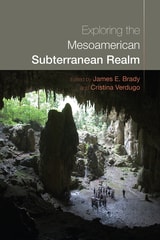
Exploring the Mesoamerican Subterranean Realm
James E. Brady
University Press of Colorado, 2025
Exploring the Mesoamerican Subterranean Realm brings together recent work and interpretations on the use of underground cavities by Mesoamerica’s pre-Columbian cultures, demonstrating their invaluable cultural purpose. Case studies from across the region investigate the ways in which these highly charged points in the sacred landscape were the focus of countless political and religious activities.
The volume expands the study of caves to focus on the broader realm of subterranean space, introducing the concept of the constructed subterranean, a space in which the Maya deliberately created sacred landmarks through excavation. Chapters critically examine chultuns, previously thought to be subterranean storage chambers, and sascaberas, previously considered mines, demonstrating that the traditional archaeological models are deeply flawed. A wealth of data on both features is used to envision a new sacred landscape filled with thousands of subterranean sacred landmarks. Natural caves are also examined; a survey conducted around the ancient site of Yaxchilan considers the obvious importance of large stalagmites set up in the site core as monuments. Long-distance pilgrimages to these caves fundamentally reevaluates the nature of pilgrimage and reveals an economic and political importance that structured settlement and activities around the pilgrimage sites. Finally, evidence is analyzed to show that the human bones recovered from Midnight Terror Cave, Belize, were the result of human sacrifice.
Dealing equally with the archaeology of both natural and constructed subterranean spaces, Exploring the Mesoamerican Subterranean Realm challenges preconceived notions of these spaces and their meanings, dramatically shifting the field’s focus and extending the understanding of the critical importance of this “dark side” of archaeology.
[more]