Results by title
338 books match the query 'Indigenous Studies' and 5 start with e
Early Tahiti As the Explorers Saw It, 1767–1797
Edwin N. Ferdon
University of Arizona Press, 1981
For thirty years before the coming of the European missionaries, European explorers were able to observe Tahitian society as it had existed for centuries. Now Edwin Ferdon, Polynesian archaeologist and veteran of Thor Heyerdah's expedition to Easter Island, has interwoven their records to show us in fascinating detail what that society was like.
[more]

Emergency
Reading the Popol Vuh in a Time of CrisisEdgar Garcia
University of Chicago Press, 2022
Nine short essays exploring the K’iche’ Maya story of creation, the Popol Vuh.
Written during the lockdown in Chicago in the depths of the COVID-19 pandemic, these essays consider the Popol Vuh as a work that was also written during a time of feverish social, political, and epidemiological crisis as Spanish missionaries and colonial military deepened their conquest of indigenous peoples and cultures in Mesoamerica. What separates the Popol Vuh from many other creation texts is the disposition of the gods engaged in creation. Whereas the book of Genesis is declarative in telling the story of the world’s creation, the Popol Vuh is interrogative and analytical: the gods, for example, question whether people actually need to be created, given the many perfect animals they have already placed on earth.
Emergency uses the historical emergency of the Popol Vuh to frame the ongoing emergencies of colonialism that have surfaced all too clearly in the global health crisis of COVID-19. In doing so, these essays reveal how the authors of the Popol Vuh—while implicated in deep social crisis—nonetheless insisted on transforming emergency into scenes of social, political, and intellectual emergence, translating crisis into creativity and world creation.
[more]
Enduring Seeds
Native American Agriculture and Wild Plant ConservationGary Paul Nabhan; Forewords by Wendell Berry and Miguel Altieri
University of Arizona Press, 2002
As biological diversity continues to shrink at an alarming rate, the loss of plant species poses a threat seemingly less visible than the loss of animals but in many ways more critical. In this book, one of America's leading ethnobotanists warns about our loss of natural vegetation and plant diversity while providing insights into traditional Native agricultural practices in the Americas.
Gary Paul Nabhan here reveals the rich diversity of plants found in tropical forests and their contribution to modern crops, then tells how this diversity is being lost to agriculture and lumbering. He then relates "local parables" of Native American agriculture—from wild rice in the Great Lakes region to wild gourds in Florida—that convey the urgency of this situation and demonstrate the need for saving the seeds of endangered plants. Nabhan stresses the need for maintaining a wide gene pool, not only for the survival of these species but also for the preservation of genetic strains that can help scientists breed more resilient varieties of other plants.
Enduring Seeds is a book that no one concerned with our environment can afford to ignore. It clearly shows us that, as agribusiness increasingly limits the food on our table, a richer harvest can be had by preserving ancient ways.
This edition features a new foreword by Miguel Altieri, one of today's leading spokesmen for sustainable agriculture and the preservation of indigenous farming methods.
[more]
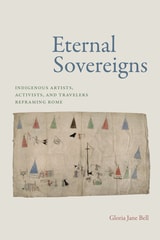
Eternal Sovereigns
Indigenous Artists, Activists, and Travelers Reframing RomeGloria Jane Bell
Duke University Press, 2024
In 1925, Pius XI staged the Vatican Missionary Exposition in Rome’s Vatican City. Offering a narrative of the Catholic Church’s beneficence to a global congregation, the exposition displayed thousands of cultural belongings stolen from Indigenous communities, which were seen by one million pilgrims. Gloria Jane Bell’s Eternal Sovereigns offers critical revision to that story. Bell reveals the tenacity, mobility, and reception of Indigenous artists, travelers, and activists in 1920s Rome. Animating these conjunctures, the book foregrounds competing claims to sovereignty from Indigenous and papal perspectives. Bell deftly juxtaposes the “Indian Museum” of nineteenth-century sculptor Ferdinand Pettrich, acquired by the Vatican, with the oeuvre of Indigenous artist Edmonia Lewis. Focusing on Turtle Island, Bell analyzes Indigenous cultural belongings made by artists from nations including Cree, Lakota, Anishinaabe, Nipissing, Kanien’kehá:ka, Wolastoqiyik, and Kwakwaka’wakw. Drawing on years of archival research and field interviews, Bell provides insight into the Catholic Church’s colonial collecting and its ongoing ethnological display practices. Written in a voice that questions the academy’s staid conventions, the book reclaims Indigenous belongings and other stolen treasures that remain imprisoned in the stronghold of the Vatican Museums.
[more]
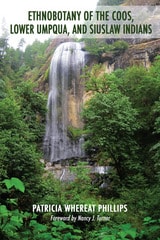
Ethnobotany of the Coos, Lower Umpqua, and Siuslaw Indians
Patricia Whereat-Phillips
Oregon State University Press, 2016
Myrtlewood is most often thought of as beautiful wood for woodworking, but to Native people on the southern Oregon coast it was an important source of food. The roasted nuts taste like bitter chocolate, coffee, and burnt popcorn. The roots of Skunk Cabbage provided another traditional food source, while also serving as a medicine for colds. In tribal mythology, the leaves of Skunk Cabbage were thought to be tents where the Little People sheltered.
Very little has been published until now on the ethnobotany of western Oregon indigenous peoples. Ethnobotany of the Coos, Lower Umpqua, and Siuslaw Indians documents the use of plants by these closely-related coastal tribes, covering a geographical area that extends roughly from Cape Perpetua on the central coast, south to the Coquille River, and from the Coast Range west to the Pacific shore. With a focus on native plants and their traditional uses, it also includes mention of farming crops, as well as the highly invasive Himalayan blackberry, which some Oregon coast Indians called the "white man's berry."
The cultures of the Coos Bay, Lower Umpqua and Siuslaw are distinct from the Athabaskan speaking people to the south, and the Alsea to the north. Today, many tribal members are reviving ancient arts of basket weaving and woodworking, and many now participate in annual intertribal canoe events. Ethnobotany of the Coos, Lower Umpqua, and Siuslaw Indians contributes to this cultural renaissance by filling an important gap in the historical record. It is an invaluable resource for anyone who wishes to learn about the indigenous cultures of the central and southern Oregon coast, as well as those who are interested in Pacific Northwest plants and their cultural uses.
[more]