Results by title
89 books match the query 'Interpersonal relations' and 2 start with e

Ethical Excellence
Philosophers, Psychologists, and Real-Life Exemplars Show Us How to Achieve ItHeidi M. Giebel
Catholic University of America Press, 2021
Why do some people achieve ethical excellence while others fail? For example, how did Gloria Lewis overcome a lifetime of difficulty and go on to found a non-profit focused on feeding the homeless while Danny Starrett, despite a seemingly ideal childhood, became a rapist and murderer? Why did some Germans rescue their Jewish neighbors while others stood by?
One recent study found that four personal variables, taken together, differentiated Nazi-era bystanders from rescuers with startling 96.1% accuracy: social responsibility, altruistic moral reasoning, empathic concern, and risk-taking—traits related to ethical excellences (virtues) like justice, benevolence, and courage. Drawing from the combined wisdom of classical Socratic and Confucian philosophy, recent work in psychology, and the lived experience of recognized moral heroes, the book focuses on how each of us can work toward ethical excellence, becoming more like Lewis and neighbor-rescuers than like Starrett and Nazi-era bystanders.
The ancient Socratic and Confucian philosophical traditions offer surprisingly sophisticated advice regarding moral education. Because research in psychology helps us assess the feasibility of cultivating virtue in ourselves and those we influence, Ethical Excellence focuses on combining sound philosophical analysis of ethical virtue and related concepts with relevant empirical research on how these concepts are manifested and developed in everyday practice. Willpower, for example, contributes to development of temperance or moderation, grit relates to perseverance, and empathy is connected to benevolence.
Finally, the study of ethically exceptional people—moral heroes or exemplars—serves as living proof that ethical excellence is possible, and exemplars can provide inspiration to attempt it ourselves and guidance regarding how to do so successfully. Relevant stories and excerpts from the author’s own interviews with award-winning ethical exemplars complement the use of philosophical virtue theory and psychological research on virtue-relevant practice. Together, these three approaches—philosophy, psychology, and biography—help to triangulate” ethical excellence and its achievement, presenting a much clearer and more complete picture than we can get from any one of these methods alone.
[more]
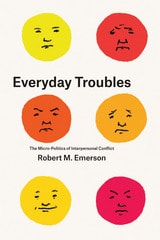
Everyday Troubles
The Micro-Politics of Interpersonal ConflictRobert M. Emerson
University of Chicago Press, 2015
From roommate disputes to family arguments, trouble is inevitable in interpersonal relationships. In Everyday Troubles, Robert M. Emerson explores the beginnings and development of the conflicts that occur in our relationships with the people we regularly encounter—family members, intimate partners, coworkers, and others—and the common responses to such troubles.
To examine these issues, Emerson draws on interviews with college roommates, diaries documenting a wide range of irritation with others, conversations with people caring for family members suffering from Alzheimer’s, studies of family interactions, neighborly disputes, and other personal accounts. He considers how people respond to everyday troubles: in non-confrontational fashion, by making low-visibility, often secretive, changes in the relationship; more openly by directly complaining to the other person; or by involving a third party, such as friends or family. He then examines how some relational troubles escalate toward extreme and even violent responses, in some cases leading to the involvement of outside authorities like the police or mental health specialists.
By calling attention to the range of possible reactions to conflicts in interpersonal relationships, Emerson also reminds us that extreme, even criminal actions often result when people fail to find ways to deal with trouble in moderate, non-confrontational ways. Innovative and insightful, Everyday Troubles is an illuminating look at how we deal with discord in our relationships.
[more]