173 books match the query 'Ireland' and 5 start with e

cover of Economists Papers, 1750-1950: A Guide to Archive and other Manuscript Sources for the History of British and Irish Economic Thought

Economists Papers, 1750-1950

A Guide to Archive and other Manuscript Sources for the History of British and Irish Economic Thought

R. P. Sturges

Duke University Press, 1975
The object of this volume is to provide scholars undertaking research in the history of British economic thought with a systematic listing of the available sources of manuscript material. It is the first work of its kind, and is based on extensive search inquiry into the scattered public and private sources of personal papers and correspondence of British economists. Over one hundred and fifty listings are printed here. They include numerous lesser figures as well as the most distinguished contributors to the varied literature of economics in the period since 1700. The Guide should, therefore, be of interest not only to specialist historians of economics but also to those concerned with the wider role of economic ideas in political debate and the formation of public opinion.
[more]
cover of Elections in Australia, Ireland, and Malta under the Single Transferable Vote: Reflections on an Embedded Institution

Elections in Australia, Ireland, and Malta under the Single Transferable Vote

Reflections on an Embedded Institution

Shaun Bowler and Bernard Grofman, Editors

University of Michigan Press, 2000
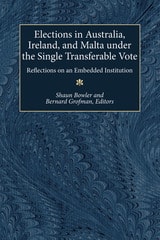
The Single Transferable Vote, or STV, is often seen in very positive terms by electoral reformers, yet relatively little is known about its actual workings beyond one or two specific settings. This book gathers leading experts on STV from around the world to discuss the examples they know best, and represents the first systematic cross-national study of STV. Furthermore, the contributors collectively build an understanding of electoral systems as institutions embedded within a wider social and political context, and begins to explain the gap between analytical models and the actual practice of elections in Australia, Ireland, and Malta. Rather than seeing electoral institutions in purely mechanical terms, the collection of essays in this volume shows that the effects of electoral system may be contingent rather than automatic. On the basis of solid empirical evidence, the volume argues that the same political system can, in fact, have quite different effects under different conditions.
Contributors to the volume are Shaun Bowler, David Farrell, Michael Gallagher, Bernard Grofman, Wolfgang Hirczy, Colin Hughes, J. Paul Johnston, Michael Laver, Malcom Mackerras, Michael Maley, Michael Marsh, Ian McAllister, and Ben Reilly.
Shaun Bowler is Professor of Political Science, University of California, Riverside. Bernard Grofman is Professor of Political Science, University of California, Irvine.
[more]
cover of Emergency Writing: Irish Literature, Neutrality, and the Second World War

Emergency Writing

Irish Literature, Neutrality, and the Second World War

Anna Teekell

Northwestern University Press, 2018

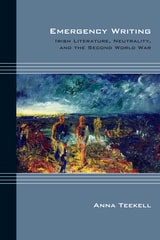
Taking seriously Ireland’s euphemism for World War II, “the Emergency,” Anna Teekell’s Emergency Writing asks both what happens to literature written during a state of emergency and what it means for writing to be a response to an emergency.
 
Anchored in close textual analysis of works by Samuel Beckett, Elizabeth Bowen, Flann O’Brien, Louis MacNeice, Denis Devlin, and Patrick Kavanagh, and supported by archival material and historical research, Emergency Writing shows how Irish late modernism was a response to the sociopolitical conditions of a newly independent Irish Free State and to a fully emerged modernism in literature and art. What emerges in Irish writing in the wake of Independence, of the Gaelic Revival, of Yeats and of Joyce, is a body of work that invokes modernism as a set of discursive practices with which to counter the Free State’s political pieties.
 
Emergency Writing provides a new approach to literary modernism and to the literature of conflict, considering the ethical dilemma of performing neutrality—emotionally, politically, and rhetorically—in a world at war.
[more]
cover of England, Ireland, and the Insular World: Textual and Material Connections in the Early Middle Ages

England, Ireland, and the Insular World

Textual and Material Connections in the Early Middle Ages

Mary Clayton

Arizona Center for Medieval and Renaissance Studies, 2017

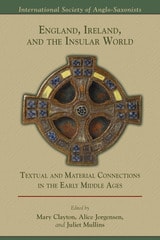
ISAS Dublin 2013. England, Ireland and the Insular World: Textual and Material Connections in the Early Middle Ages is a collection of twelve essays related to the theme of the 2013 conference of the International Society of Anglo-Saxonists, ‘Insular Cultures’. Contributors cover a broad range of topics, from early medieval agriculture in Ireland and England, to sculpture, manuscript illumination and script, homilies, hagiography, aristocratic gift-giving, relics, calendars, Beowulf, and Anglo-Saxon perceptions of the Celtic peoples, considering connections, parallels and differences between Anglo-Saxon England and its insular neighbors. The volume will be of interest to all those working on Early Medieval history, literature, archaeology, liturgy, art, and manuscripts.
[more]
cover of Enigmas of Sacrifice: A Critique of Joseph M. Plunkett and the Dublin Insurrection of 1916

Enigmas of Sacrifice

A Critique of Joseph M. Plunkett and the Dublin Insurrection of 1916

W. J. Mc Cormack

Michigan State University Press, 2016

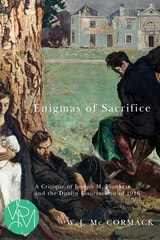
Enigmas of Sacrifice: A Critique of Joseph M. Plunkett and the Dublin Insurrection of 1916 is the first critical study of the religious poet and militarist Joseph M. Plunkett, who was executed with the other leaders of the Dublin insurrection of 1916. Through Plunkett the author gains access to areas of nationalist thought that were more often assumed or repressed than publicly formulated. In this eye-opening book, W. J. Mc Cormack explores and analyzes Plunkett’s brief life, work, and influence, beginning with his wealthy but dysfunctional family, irregular Jesuit education, and self-canceling sexuality. Mc Cormack continues through Plunkett’s active phase when amateur theatricals and a magazine editorship brought him into the emergent neonationalist discourse of early twentieth-century Ireland. Finally, the author arrives at Holy Week 1916, when Plunkett masterminded the forgery of official documentation in order to provoke and justify the insurrection he planned. Mc Cormack analyzes Plunkett’s significant texts and provides context through critical perspectives on his milieu. Enigmas of Sacrifice is unique in its effort to understand a major figure of Irish nationalism in terms that reach beyond political identity.
[more]