477 books match the query 'Italy' and 8 start with e
cover of Early Medieval Italy: Central Power and Local Society 400-1000

Early Medieval Italy

Central Power and Local Society 400-1000

Chris Wickham

University of Michigan Press, 1989

This book presents a picture of the history of Italy between 400 and 1000, probably the six centuries least known in all Italian history. Early medieval Italy was the victim of many invasions and had a long succession of different Germanic rulers: Ostrogoths, Lombards, Franks, Germans, as well as the provincial administrations of the various Byzantine enclaves in Italy. Despite this, the structures of the Italian state persisted with considerable uniformity from the sixth to the ninth and tenth centuries, when they began to break apart under the pressure of other social forces. The real variations of early medieval Italian history came not in the histories of the Italian states, but in the different developments of the Italian regions, with all their contrasts---between city and country, mountain and plain, agriculture and pastoralism, landlord and tenant: regions kept apart by the difficult communications of a fairly mountainous country. In the end the Italian state could not hold the disparate forces together and Italy sprang apart.
 
Chris Wickham chronicles these developments, describing political, economic, and social history as well as the regional history of southern Italy before showing how these forces combined as the state collapsed in the tenth century. This is the first time that the years between the Roman Empire and the rise of the Communes as a whole have been presented in the English language, making this book invaluable reading for all students of medieval Europe.
[more]
cover of Echoes of Women's Voices: Music, Art, and Female Patronage in Early Modern Florence

Echoes of Women's Voices

Music, Art, and Female Patronage in Early Modern Florence

Kelley Harness

University of Chicago Press, 2006

Aristocratic women exerted unprecedented political and social influence in Florence throughout the late sixteenth and early seventeenth centuries. During this period, female members of the powerful Medici family governed the city for the first and only time in its history. These women also helped shape the city's artistic life, commissioning works of music, art, and theater that were inscribed with their own concerns and aspirations. Echoes of Women's Voices examines the patronage of individuals and institutions, particularly convents, which have remained, until now, largely neglected by scholars.

Through commissions, patrons sought to promote a vision of the world and their place in it. The unique social norms, laws, educational backgrounds, and life experiences of female patrons meant the expression of a worldview that differed significantly from that of their male counterparts. Joining exceptional archival research with telling analysis of significant examples of music, art, and drama, Kelley Harness challenges the prevailing view that Florence saw a political and artistic decline during this period. She argues convincingly that the female domination of these years brought forth artistic patronage that was both continuous and well-conceived.

[more]
cover of Egyptian Oedipus: Athanasius Kircher and the Secrets of Antiquity

Egyptian Oedipus

Athanasius Kircher and the Secrets of Antiquity

Daniel Stolzenberg

University of Chicago Press, 2013
A contemporary of Descartes and Newton, Athanasius Kircher, S. J. (1601/2–80), was one of Europe’s most inventive and versatile scholars in the baroque era. He published more than thirty works in fields as diverse as astronomy, magnetism, cryptology, numerology, geology, and music. But Kircher is most famous—or infamous—for his quixotic attempt to decipher the Egyptian hieroglyphs and reconstruct the ancient traditions they encoded. In 1655, after more than two decades of toil, Kircher published his solution to the hieroglyphs, Oedipus Aegyptiacus, a work that has been called “one of the most learned monstrosities of all times.” Here Daniel Stolzenberg presents a new interpretation of Kircher’s hieroglyphic studies, placing them in the context of seventeenth-century scholarship on paganism and Oriental languages.
           
Situating Kircher in the social world of baroque Rome, with its scholars, artists, patrons, and censors, Stolzenberg shows how Kircher’s study of ancient paganism depended on the circulation of texts, artifacts, and people between Christian and Islamic civilizations. Along with other participants in the rise of Oriental studies, Kircher aimed to revolutionize the study of the past by mastering Near Eastern languages and recovering ancient manuscripts hidden away in the legendary libraries of Cairo and Damascus. The spectacular flaws of his scholarship have fostered an image of Kircher as an eccentric anachronism, a throwback to the Renaissance hermetic tradition. Stolzenberg argues against this view, showing how Kircher embodied essential tensions of a pivotal phase in European intellectual history, when pre-Enlightenment scholars pioneered modern empirical methods of studying the past while still working within traditional frameworks, such as biblical history and beliefs about magic and esoteric wisdom.
[more]
cover of Engineering the Eternal City: Infrastructure, Topography, and the Culture of Knowledge in Late Sixteenth-Century Rome

Engineering the Eternal City

Infrastructure, Topography, and the Culture of Knowledge in Late Sixteenth-Century Rome

Pamela O. Long

University of Chicago Press, 2018

Between the catastrophic flood of the Tiber River in 1557 and the death of the “engineering pope” Sixtus V in 1590, the city of Rome was transformed by intense activity involving building construction and engineering projects of all kinds. Using hundreds of archival documents and primary sources, Engineering the Eternal City explores the processes and people involved in these infrastructure projects—sewers, bridge repair, flood prevention, aqueduct construction, the building of new, straight streets, and even the relocation of immensely heavy ancient Egyptian obelisks that Roman emperors had carried to the city centuries before.
 
This portrait of an early modern Rome examines the many conflicts, failures, and successes that shaped the city, as decision-makers tried to control not only Rome’s structures and infrastructures but also the people who lived there. Taking up visual images of the city created during the same period—most importantly in maps and urban representations, this book shows how in a time before the development of modern professionalism and modern bureaucracies, there was far more wide-ranging conversation among people of various backgrounds on issues of engineering and infrastructure than there is in our own times. Physicians, civic leaders, jurists, cardinals, popes, and clerics engaged with painters, sculptors, architects, printers, and other practitioners as they discussed, argued, and completed the projects that remade Rome.
[more]
cover of Evicted from Eternity: The Restructuring of Modern Rome

Evicted from Eternity

The Restructuring of Modern Rome

Michael Herzfeld

University of Chicago Press, 2009

Modern Rome is a city rife with contradictions. Once the seat of ancient glory, it is now often the object of national contempt. It plays a significant part on the world stage, but the concerns of its residents are often deeply parochial. And while they live in the seat of a world religion, Romans can be vehemently anticlerical. These tensions between the past and the present, the global and the local, make Rome fertile ground to study urban social life, the construction of the past, the role of religion in daily life, and how a capital city relates to the rest of the nation.

Michael Herzfeld focuses on Rome’s historic Monti district and the wrenching dislocation caused by rapid economical, political, and social change. Evicted from Eternity tells the story of the gentrification of Monti—once the architecturally stunning home of a community of artisans and shopkeepers now displaced by an invasion of rapacious real estate speculators, corrupt officials, dithering politicians, deceptive clerics, and shady thugs. As Herzfeld picks apart the messy story of Monti’s transformation, he ranges widely over many aspects of life there and in the rest of the city, richly depicting the uniquely local landscape of globalization in Rome.
[more]
cover of Evocations of Italy

Evocations of Italy

Pavel Pavlovic Muratov and Lena Lencek (Trans.)

Northwestern University Press, 2026

A collector’s edition of a world-historical classic
 
In 1907, Pavel Muratov, a budding littérateur and art connoisseur from Moscow, set off for Italy with his wife, three friends, and a dozen books on the Italian Renaissance. This journey, the first of over a dozen he would make in a decade, inspired an obsession with the country’s art and culture that would produce, in the words of Clive James, “one of the most dazzling books of its type ever written.” First published in Russian between 1911 and 1924, Evocations of Italy(Obrazy Italii) chronicles Muratov’s encounters with the art, myth, and land of Italy. A classic of the Silver Age, it built on the tradition of Italian travelogues by Goethe, Stendhal, John Ruskin, and Henry James and defined the idea of Italy for generations of Russian artists and writers. Finally available in English, this three-volume collector's edition illuminates the personalities, conditions, and dreams that gave us the Italian Renaissance. At once intimate and authoritative, and here richly illustrated with photographs that echo Muratov’s shimmering juxtapositions of image and sensation, Evocations of Italy is as timely and compelling a guide today as it was a hundred years ago.
 
[more]
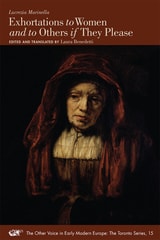
cover of Exhortations to Women and to Others If They Please

Exhortations to Women and to Others If They Please

Lucrezia Marinella

Iter Press, 2012

With this translation of Marinella’s Exhortations to Women and to Others if They Please we can now read another crucial text from her extensive body of work, one that signals a radical ideological shift from her best known text, The Nobility and Excellence of Women; we can thus enjoy a fuller picture of the author and her opinions. Only three copies of Exhortations have been located in any library, and in the absence of a critical edition this translation will prove to be a point of reference for scholars and students alike. Benedetti’s thorough introduction situates Marinella and her works within early seventeenth-century Venetian culture and the Counter-Reformation more broadly, in a way that is profoundly influenced by philology and is also theoretically sound.
—Maria Galli Stampino
Associate Professor of French and Italian
University of Miami

[more]
cover of Ezra Pound and the Monument of Culture: Text, History, and the Malatesta Cantos

Ezra Pound and the Monument of Culture

Text, History, and the Malatesta Cantos

Lawrence S. Rainey

University of Chicago Press, 1991

In the summer of 1922, Ezra Pound viewed the church of San Francesco in Rimini, Italy, for the first time. Commonly known as the Tempio Malatestiano, the edifice captured his imagination for the rest of his life. Lawrence S. Rainey here recounts an obsession that links together the whole of Pound's poetic career and thought.

Written by Pound in the months following his first visit, the four poems grouped as "The Malatesta Cantos" celebrate the church and the man who sponsored its construction, Sigismondo Malatesta. Upon receiving news of the building's devastation by Allied bombings in 1944, Pound wrote two more cantos that invoked the event as a rallying point for the revival of fascist Italy. These "forbidden" cantos were excluded from collected editions of his works until 1987. Pound even announced an abortive plan in 1958 to build a temple inspired by the church, and in 1963, at the age of eighty, he returned to Rimini to visit the Tempio Malatestiano one last, haunting time.

Drawing from hundreds of unpublished materials, Rainey explores the intellectual heritage that surrounded the church, Pound's relation to it, and the interpretation of his work by modern critics. The Malatesta Cantos, which have been called "one of the decisive turning-points in modern poetics" and "the most dramatic moment in The Cantos," here engender an intricate allegory of Pound's entire career, the central impulses of literary modernism, the growth of intellectual fascism, and the failure of critical culture in the twentieth century. Included are two-color illustrations from the 1925 edition of Pound's cantos and numerous black-and-white photographs.
[more]