412 books match the query 'Japan' and 11 start with e
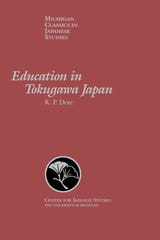
cover of Education in Tokugawa Japan

Education in Tokugawa Japan

R. P. Dore

University of Michigan Press, 1992
“This careful and important study of the development of the varied types of education in the last two and a half centuries of feudalism in Japan under the Tokugawa dictatorship (1600–1868) is more than a history of premodern education. It is also an intellectual history and a history of the educational philosophy of the writers of that period. Basing his work on extensive Japanese primary sources, the author has selected and organized his material well; thus his study fills an important gap in our knowledge of Japanese history.” —Hugh Borton, Haverford College, American Historical Review 71, no. 4 (July 1966): 1410–11.
“There is no other book like it. . . . Readers already familiar with earlier books by Ronald Dore will rightly have guessed that we have been given yet another tour de force. Utilizing a remarkable amount of primary source material and discussing its implications with his customary grace and clarity, the author deals with the educational institutions for both samurai and commoner and the curricula of the bewildering variety of schools of Japan from the beginning of the 17th century through the Meiji Restoration in 1868. Yet this is in no sense a book of restricted interest, for it has as much to say to the student of sociocultural change as to the Japan specialist.” —R. J. Smith, Cornell University, American Anthropologist 68, no. 4 (August 1966), 1086–87.
[more]
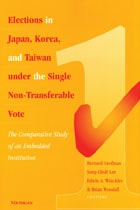
cover of Elections in Japan, Korea, and Taiwan under the Single Non-Transferable Vote: The Comparative Study of an Embedded Institution

Elections in Japan, Korea, and Taiwan under the Single Non-Transferable Vote

The Comparative Study of an Embedded Institution

Bernard Grofman, Sung-Chull Lee, Edwin A. Winckler, and Brian Woodall, Editors

University of Michigan Press, 1999
In recent years there has been a marked resurgence of interest in the effects of electoral laws on important aspects of politics such as party competition. In this volume, a distinguished group of scholars looks at the impact of one set of electoral rules--the single non-transferable vote--on electoral competition in Japan, Korea and Taiwan. Under this plan citizens are allowed one vote even though there is more than one seat to be filled. In comparative studies of the adoption and rejection of the single nontransferable vote and the consequences of its use across different settings, the contributors explore the differences in the operation and effects of the application of the same rule in different countries. Arguing that any single feature of a political system is embedded in a political structure and cannot be understood in isolation, the authors demonstrate how the same rule can have different consequences depending on the context in which it operates. The contributors offer fresh insights into the comparative study of political institutions as well as into the operation of particular electoral rules.
In addition to the editors, the contributors include Kathleen Bawn, John Boland, Jean-Marie Bouissou, Gary Cox, John Fu-Sheng Hsieh, Arend Lijphart, Emerson Niou, Steven R. Reed, and Frances Rosenbluth, among others.
Bernard Grofman is Professor of Political Science, University of California at Irvine. Edwin A. Winckler is at the East Asian Institute, Columbia University. Brian Woodall is Assistant Professor in the School of International Affairs, Georgia Institute of Technology. Sung-Chull Lee is Assistant Professor of Political Science, University of California at Irvine.
[more]
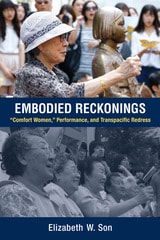
cover of Embodied Reckonings: “Comfort Women,” Performance, and Transpacific Redress

Embodied Reckonings

“Comfort Women,” Performance, and Transpacific Redress

Elizabeth W. Son

University of Michigan Press, 2018

Embodied Reckonings examines the political and cultural aspects of contemporary performances that have grappled with the history of the “comfort women,” the Japanese military’s euphemism for the sexual enslavement of girls and young women—mostly Korean—in the years before and during World War II. Long silent, in the early 1990s these women and their supporters initiated varied performance practices—protests, tribunals, theater, and memorial-building projects—to demand justice for those affected by state-sponsored acts of violence. The book provides a critical framework for understanding how actions designed to bring about redress can move from the political and legal aspects of this concept to its cultural and social possibilities.

Based on extensive archival and ethnographic research, the study argues for the central role of performance in how Korean survivors, activists, and artists have redressed the histories—and erasures—of this sexual violence. Merging cultural studies and performance theory with a transnational, feminist analysis, the book illuminates the actions of ordinary people, thus offering ways of reconceptualizing legal and political understandings of redress that tend to concentrate on institutionalized forms of state-based remediation.
[more]
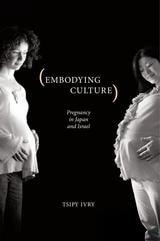
cover of Embodying Culture: Pregnancy in Japan and Israel

Embodying Culture

Pregnancy in Japan and Israel

Ivry, Tsipy

Rutgers University Press, 2009

Embodying Culture is an ethnographically grounded exploration of pregnancy in two different cultures—Japan and Israel—both of which medicalize pregnancy. Tsipy Ivry focuses on "low-risk" or "normal" pregnancies, using cultural comparison to explore the complex relations among ethnic ideas about procreation, local reproductive politics, medical models of pregnancy care, and local modes of maternal agency.

The ethnography pieces together the voices of pregnant Japanese and Israeli women, their doctors, their partners, the literature they read, and depicts various clinical encounters such as ultrasound scans, explanatory classes for amniocentesis, birthing classes, and special pregnancy events.

The emergent pictures suggest that although experiences of pregnancy in Japan and Israel differ, pregnancy in both cultures is an energy-consuming project of meaning-making— suggesting that the sense of biomedical technologies are not only in the technologies themselves but are assigned by those who practice and experience them.
[more]
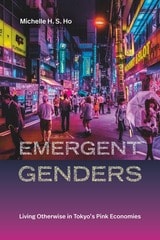
cover of Emergent Genders: Living Otherwise in Tokyo's Pink Economies

Emergent Genders

Living Otherwise in Tokyo's Pink Economies

Michelle H. S. Ho

Duke University Press, 2025

In Emergent Genders, Michelle H. S. Ho traces the genders manifesting alongside Japanese popular culture in Akihabara, an area in Tokyo renowned for the fandom and consumption of anime, manga, and games. Drawing on ethnographic fieldwork in josō and dansō cafe-and-bars, establishments where male-to-female and female-to-male crossdressing is prevalent, Ho shows how their owners, employees, and customers creatively innovate what she calls emergent genders—new practices, categories, and ways of being stemming from the simultaneous fracturing, contestations, and (re)imaginations of older forms of gender and sexual variance in Japan. Such emergent genders initiate new markets for alternative categories of expression and subjectivity to thrive in a popular cultural hub like Akihabara instead of Tokyo’s gay and lesbian neighborhood of Shinjuku Ni-chōme. By rethinking identitarian models of gender and sexuality, reconfiguring the significance of capitalism for trans studies and queer theory, and decentering theoretical frameworks incubated in a predominantly United States academic context, Ho offers new ways of examining how trans and gender nonconforming individuals may survive and flourish under capitalism.
[more]
cover of Encounter with Zen: writings on poetry and Zen

Encounter with Zen

writings on poetry and Zen

Lucien. Stryk

Ohio University Press, 1981
[more]
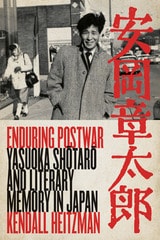
cover of Enduring Postwar: Yasuoka Shotaro and Literary Memory in Japan

Enduring Postwar

Yasuoka Shotaro and Literary Memory in Japan

Kendall Heitzman

Vanderbilt University Press, 2019

Yasuoka Shotaro (1920–2013) was perfectly situated to become Japan's premier chronicler of the Showa period (1926–89). Over fifty years as a writer, Yasuoka produced stories, novels, plays, and essays, as well as monumental histories that connected his own life to those of his ancestors. He was also the only major Japanese writer to live in the American South during the Civil Rights Movement, when he spent most of an academic year at Vanderbilt University in Nashville. In 1977, he translated Alex Haley's Roots into Japanese.

For a long period, Yasuoka was at the center of the Japanese literary establishment, serving on prize committees and winning the major literary prizes of the era: the Akutagawa, the Noma, the Yomiuri, and the Kawabata. But what makes Yasuoka fascinating as a writer is the way that he consciously, deliberately resisted accepted narratives of modern Japanese history through his approach to personal and collective memory.

In Enduring Postwar, the first literary and biographical study of Yasuoka in English, Kendall Heitzman explores the element of memory in Yasuoka's work in the context of his life and evolving understanding of postwar Japan.
[more]
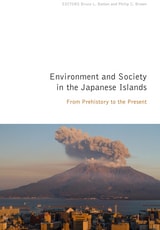
cover of Environment and Society in the Japanese Islands: From Prehistory to the Present

Environment and Society in the Japanese Islands

From Prehistory to the Present

Bruce L. Batten

Oregon State University Press, 2015

Over the long course of Japan’s history, its people profited from their rich natural environment while simultaneously facing significant environmental challenges. Over time, they have altered their natural environment in numerous ways, from landscape modification to industrial pollution. How has the human-nature relationship changed over time in Japan? How does Japan’s environmental history compare with that of other countries, or that of the world as a whole?

Environment and Society in the Japanese Islands attempts to answer these questions through a series of case studies by leading Japanese and Western historians, geographers, archaeologists, and climatologists. These essays, on diverse topics from all periods of Japanese history and prehistory, are unified by their focus on the key concepts of “resilience” and “risk mitigation.” Taken as a whole, they place Japan’s experience in global context and call into question the commonly presumed division between pre-modern and modern environmental history.

Primarily intended for scholars and students in fields related to Japan or environmental history, these accessibly-written essays will be valuable to anyone wishing to learn about the historical roots of today’s environmental issues or the complex relationship between human society and the natural environment.
[more]
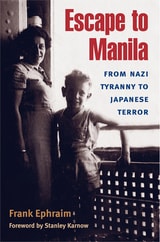
cover of Escape to Manila: From Nazi Tyranny to Japanese Terror

Escape to Manila

From Nazi Tyranny to Japanese Terror

Frank Ephraim. Foreword by Stanley A. Karnow

University of Illinois Press, 2002

A harrowing account of Jewish refugees in the Philippines

With the rise of Nazism in the 1930s more than a thousand European Jews sought refuge in the Philippines, joining the small Jewish population of Manila. When the Japanese invaded the islands in 1941, the peaceful existence of the barely settled Jews filled with the kinds of uncertainties and oppression they thought they had left behind.

In this book Frank Ephraim, who fled to Manila with his parents, gathers the testimonies of thirty-six refugees, who describe the difficult journey to Manila, the lives they built there upon their arrival, and the events surrounding the Japanese invasion. Combining these accounts with historical and archival records, Manila newspapers, and U.S. government documents, Ephraim constructs a detailed account of this little-known chapter of world history.
[more]
cover of Essays on the Modern Japanese Church: Christianity in Meiji Japan

Essays on the Modern Japanese Church

Christianity in Meiji Japan

Yamaji Aizan; Translated by Graham Squires, with Introductory Essays by Graham Squires and A. Hamish Ion

University of Michigan Press, 2000
Essays on the Modern Japanese Church (Gendai Nihon kyokai shiron), published in 1906, was the first Japanese-language history of Christianity in Meiji Japan. Yamaji Aizan’s firsthand account describes the reintroduction of Christianity to Japan—its development, rapid expansion, and decline—and its place in the social, political, and intellectual life of the Meiji period. Yamaji’s overall argument is that Christianity played a crucial role in shaping the growth and development of modern Japan.
Yamaji was a strong opponent of the government-sponsored “emperor-system ideology,” and through his historical writing he tried to show how Japan had a tradition of tolerance and openness at a time when government-sponsored intellectuals were arguing for greater conformity and submissiveness to the state on the basis of Japanese “national character.”
Essays is important not only in terms of religious history but also because it highlights broad trends in the history of Meiji Japan. Introductory chapters explore the significance of the work in terms of the life and thought of its author and its influence on subsequent interpretations of Meiji Christianity.
[more]
cover of Exporting Japan: Politics of Emigration to Latin America

Exporting Japan

Politics of Emigration to Latin America

Toake Endoh

University of Illinois Press, 2008

Exporting Japan examines the domestic origins of the Japanese government's policies to promote the emigration of approximately three hundred thousand native Japanese citizens to Latin America between the 1890s and the 1960s. This imperialist policy, spanning two world wars and encompassing both the pre-World War II authoritarian government and the postwar conservative regime, reveals strategic efforts by the Japanese state to control its populace while building an expansive nation beyond its territorial borders.

Toake Endoh compellingly argues that Japan's emigration policy embodied the state's anxieties over domestic political stability and its intention to remove marginalized and radicalized social groups by relocating them abroad. Documenting the disproportionate focus of the southwest region of Japan as a source of emigrants, Endoh considers the state's motivations in formulating emigration policies that selected certain elements of the Japanese population for "export." She also recounts the situations migrants encountered once they reached Latin America, where they were often met with distrust and violence in the "yellow scare" of the pre-World War II period.

[more]