Results by title
496 books match the query 'Jewish' and 15 start with e
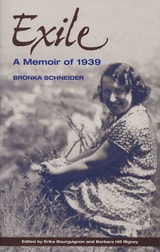
EXILE
A MEMOIR OF 1939Bronka Schneider Edited with forewords by Erika Bourguignon and Barbara Hill Rigney
The Ohio State University Press, 1998
Bronka Schneider and her husband, Joseph, were two of the thirty thousand Austrian Jews admitted as refugees to Great Britain between March 1938 and 2 September 1939. It was not until 1960, however, that Schneider wrote her memoir about the year she spent as a housekeeper, with Joseph as a butler, in a Scottish castle.
Schneider tells of daily encounters—with her employers, the English lady and her husband, a retired British civil servant who had spent many years in India; the village locals; other refugees; and a family of evacuees from the slums of Glasgow.
The editors have divided this memoir into chapters, adding headlines from the London Times as epigraphs. These headlines, reporting the escalating events of World War II, are in stark contrast to daily activities of the residents of this isolated region of Scotland. A commentary by Erika Bourguignon provides historical, political, and cultural background of this period.

Early Medieval Jewish Policy in Western Europe
Bernard S. Bachrach
University of Minnesota Press, 1977
Early Medieval Jewish Policy in Western Europe was first published in 1977. Minnesota Archive Editions uses digital technology to make long-unavailable books once again accessible, and are published unaltered from the original University of Minnesota Press editions.
This is the first study of early medieval Jewish policy in the West which examines the nature of this policy from the perspective and aims of its formulators. As the author points out, most specialists in Jewish history have been dominated by what the historian Salo Baron has called the "lachrymose conception,' a view which emphasized persecution and suffering as a fundamental theme of Jewish history. Professor Bachrach challenges this view and attacks what he calls the myth of Christian church domination of the early medieval world.
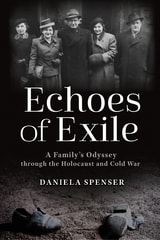
Echoes of Exile
A Family’s Odyssey through the Holocaust and Cold WarDaniela Spenser
University of Alabama Press, 2025
A sweeping exploration of survival, resilience, and the fate of one family amid Europe’s most turbulent century.
Echoes of Exile reveals the seismic disruptions of twentieth-century European history through the intimate lens of one family’s struggle to survive. Setting out to record the life of her mother, Ruth, Daniela Spenser unearthed personal facts and stories that additionally illuminate the shared traumas and experiences of millions of Czech, Polish, and German Jews who died in the Holocaust, as well as the stories of those who survived and lived under Communism and the Cold War. Her resulting work is a fascinating hybrid that combines family letters and interviews with deeply researched political history spanning from the collapse of the Austro-Hungarian Empire to the fall of the Berlin Wall.
Spenser’s fascinating work reveals the difficult choices her mother and family faced, the tests to their loves and loyalties, and the lingering scars of exile. More than a family history, it weaves personal and historical narratives with mundane and momentous threads to create a fresh, distinctive fabric. Spenser recovers fragments of the past that contribute to a map of the present and possibilities for the future. An engrossing account of survival, resilience, and the enduring human spirit amid the maelstrom of Europe’s savage twentieth century, Echoes of Exile will interest readers who value firsthand accounts of significant events and who seek to understand the complexities of survival, identity, and political change through intimate, lived experiences.
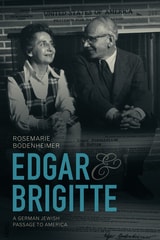
Edgar and Brigitte
A German Jewish Passage to AmericaRosemarie Bodenheimer
University of Alabama Press, 2016
The couple’s encounters with the strange new dynamics of race, religion, and the workplace in their new American home offer a compelling account of the struggles that faced many immigrants with deep German roots. It is also an intimate portrait of a now-vanished German Jewish culture as it played out in the lives of Bodenheimer’s parents and her grandparents from the 1920s to the late 1960s, a story of emigration, assimilation, and the private struggles that accompany those forced shifts in orientation.
The Bodenheimers’ letters and journals offer engaging perspectives into their personal lives that retrospective memories cannot match. Braiding intimate biography together with history and memoir, Edgar and Brigitte will appeal both to historians of the European Jewish diaspora and to readers interested in the struggles and resilience of people whose lives were upended by Hitler.
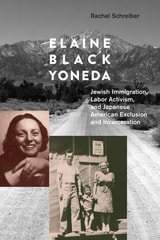
Elaine Black Yoneda
Jewish Immigration, Labor Activism, and Japanese American Exclusion and IncarcerationRachel Schreiber
Temple University Press, 2022
During World War II, Elaine Black Yoneda, the daughter of Russian Jewish immigrants, spent eight months in a concentration camp—not in Europe, but in California. She did this voluntarily and in solidarity, insisting on accompanying her husband, Karl, and their son, Tommy, when they were incarcerated at the Manzanar Relocation Center. Surprisingly, while in the camp, Elaine and Karl publicly supported the United States’ decision to exclude Japanese Americans from the coast.
Elaine Black Yoneda is the first critical biography of this pioneering feminist and activist. Rachel Schreiber deftly traces Yoneda’s life as she became invested in radical politics and interracial and interethnic activism. In her work for the International Labor Defense of the Communist Party, Yoneda rose to the rank of vice president. After their incarceration, Elaine and Karl became active in the campaigns to designate Manzanar a federally recognized memorial site, for redress and reparations to Japanese Americans, and in opposition to nuclear weapons.
Schreiber illuminates the ways Yoneda’s work challenged dominant discourses and how she reconciled the contradictory political and social forces that shaped both her life and her family’s. Highlighting the dangers of anti-immigrant and anti-Asian xenophobia, Elaine Black Yoneda recounts an extraordinary life.
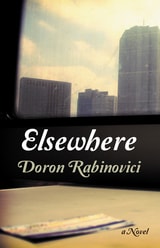
Elsewhere
Doron Rabinovici
Haus Publishing, 2010
A complex and moving novel about modern Jewish identity, Elsewhere takes aim at a number of sensitive issues, including nationalism, Zionism, collective guilt, the Holocaust, and Israel itself. As heartfelt and surprising as it is hilarious, it pokes fun at the things we care about in order to get at what really matters.
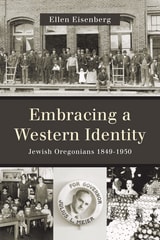
Embracing a Western Identity
Jewish Oregonians, 1849-1950Ellen Eisenberg
Oregon State University Press, 2015
In Embracing a Western Identity, Ellen Eisenberg places Jewish history in the larger context of western narratives, challenging the traditional view that the “authentic” North American Jewish experience stems from New York. The westward paths of Jewish Oregonians and their experiences of place shaped the communities, institutions, and identities they created, distinguishing them from other American Jewish communities. Eisenberg traces the Oregon Jewish experience from its pioneer beginnings in the mid-nineteenth century to the highly concentrated Portland communities of the mid-twentieth century.
Drawing on extensive archival resources at the Oregon Jewish Museum, this historical commentary explores patterns of migration and settlement, the place of Jews in the state’s ethnic landscape, their engagement in politics, the development of institutions, and their relationship to Zionism. Departing from familiar treatments of the Jewish experience, Embracing a Western Identity provides a critical look at the impact of place and opportunity upon the identities of migrants both as Oregonians and as American Jews. Readers and scholars interested in western history—religious, ethnic, expansionist, and otherwise—will enjoy Eisenberg’s accessible writing style and rich photograph collection.
Enter These Gates
Meditations for the Days of AweAlden Solovy
Central Conference of American Rabbis, 2024
FINALIST: NEXT GENERATION INDIE BOOK AWARDS (Spirituality category)
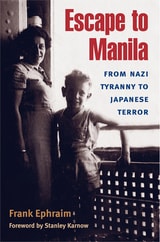
Escape to Manila
From Nazi Tyranny to Japanese TerrorFrank Ephraim. Foreword by Stanley A. Karnow
University of Illinois Press, 2002
A harrowing account of Jewish refugees in the Philippines
With the rise of Nazism in the 1930s more than a thousand European Jews sought refuge in the Philippines, joining the small Jewish population of Manila. When the Japanese invaded the islands in 1941, the peaceful existence of the barely settled Jews filled with the kinds of uncertainties and oppression they thought they had left behind.
In this book Frank Ephraim, who fled to Manila with his parents, gathers the testimonies of thirty-six refugees, who describe the difficult journey to Manila, the lives they built there upon their arrival, and the events surrounding the Japanese invasion. Combining these accounts with historical and archival records, Manila newspapers, and U.S. government documents, Ephraim constructs a detailed account of this little-known chapter of world history.
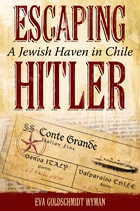
Escaping Hitler
A Jewish Haven in ChileEva Goldschmidt Wyman
University of Alabama Press, 2013
A family’s flight from Nazi terror to an unexpected refuge in Chile.
Escaping Hitler is the personal story of Eva Wyman and her family’s escape from Nazi Germany to Chile in the sociohistorical context of 1930s and 1940s, a time when the Chilean Nazi party had an active presence in the country’s major institutions.
Based primarily on interviews with German Jewish refugees and family correspondence, Eva Goldschmidt Wyman provides an intimate account of Jews in Germany in the 1930s as Nazi controls tightened and family members were taken to Riga concentration camp. Wyman recounts Kristallnacht in Stuttgart, where her father was principal of the Jewish school, his imprisonment in Dachau, and his release and immigration to Great Britain. Escaping Hitler details the family’s escape from Germany and subsequent life in Chile, providing an intimate look at daily life on the steam ship Conte Grande during the voyage from Italy to Chile in 1939, Nazi espionage and anti-Semitic activity in Chile, and the Nazi influence in South America in general.
Recounted in an intimate and personal style, Escaping Hitler immerses the reader in an extraordinary chapter of contemporary Jewish history both inside Germany and South America.
Every Last Breath
A Memoir of Two IllnessesJoanne Jacobson
University of Utah Press, 2020
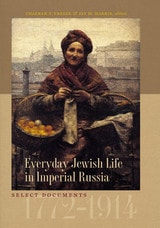
Everyday Jewish Life in Imperial Russia
Select Documents, 1772–1914Edited by ChaeRan Y. Freeze and Jay M. Harris
Brandeis University Press, 2013
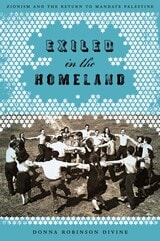
Exiled in the Homeland
Zionism and the Return to Mandate PalestineBy Donna Robinson Divine
University of Texas Press, 2009
Offering a new perspective on Zionism, Exiled in the Homeland draws on memoirs, newspaper accounts, and archival material to examine closely the lives of the men and women who immigrated to Palestine in the early twentieth century. Rather than reducing these historic settlements to a single, unified theme, Donna Robinson Divine's research reveals an extraordinary spectrum of motivations and experiences among these populations.
Though British rule and the yearning for a Jewish national home contributed to a foundation of solidarity, Exiled in the Homeland presents the many ways in which the message of emigration settled into the consciousness of the settlers. Considering the benefits and costs of their Zionist commitments, Divine explores a variety of motivations and outcomes, ranging from those newly arrived immigrants who harnessed their ambition for the goal of radical transformation to those who simply dreamed of living a better life. Also capturing the day-to-day experiences in families that faced scarce resources, as well as the British policies that shaped a variety of personal decisions on the part of the newcomers, Exiled in the Homeland provides new keys to understanding this pivotal chapter in Jewish history.
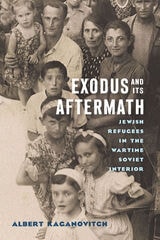
Exodus and Its Aftermath
Jewish Refugees in the Wartime Soviet InteriorAlbert Kaganovitch
University of Wisconsin Press, 2023
Albert Kaganovitch reconstructs the conditions that gave rise to this upsurge in antisemitic sentiment and provides new statistical data on the number of Jewish refugees who lived in the Urals, Siberia, and Middle Volga areas. The book’s insights into the regional distribution and concentration of these émigrés offer a behind-the-scenes look at the largest and most intensive Jewish migration in history.
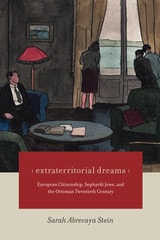
Extraterritorial Dreams
European Citizenship, Sephardi Jews, and the Ottoman Twentieth CenturySarah Abrevaya Stein
University of Chicago Press, 2016
Sarah Abrevaya Stein traces the experiences of Mediterranean Jewish women, men, and families who lived through a tumultuous series of wars, border changes, genocides, and mass migrations, all in the shadow of the collapse of the Ottoman Empire and the ascendance of the modern passport regime. Moving across vast stretches of Europe, the Middle East, Asia, and the Americas, she tells the intimate stories of people struggling to find a legal place in a world ever more divided by political boundaries and competing nationalist sentiments. From a poor youth who reached France as a stowaway only to be hunted by the Parisian police as a spy to a wealthy Baghdadi-born man in Shanghai who willed his fortune to his Eurasian Buddhist wife, Stein tells stories that illuminate the intertwined nature of minority histories and global politics through the turbulence of the modern era.