Results by title
50 books match the query 'Justice, Administration of' and 3 start with e
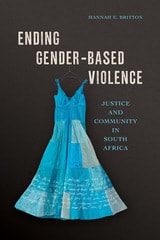
Ending Gender-Based Violence
Justice and Community in South AfricaHannah E. Britton
University of Illinois Press, 2020
Hannah E. Britton examines the reasons gendered violence persists in relationship to social inequalities even after women assume political power. Venturing into South African communities, Britton invites service providers, religious and traditional leaders, police officers, and medical professionals to address gender-based violence in their own words. Britton finds the recent turn toward carceral solutions—with a focus on arrests and prosecutions—fails to address the complexities of the problem and looks at how changing specific community dynamics can defuse interpersonal violence. She also examines how place and space affect the implementation of policy and suggests practical ways policymakers can support street level workers.
Clear-eyed and revealing, Ending Gender-Based Violence offers needed tools for breaking cycles of brutality and inequality around the world.
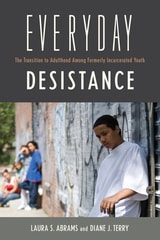
Everyday Desistance
The Transition to Adulthood Among Formerly Incarcerated YouthAbrams, Laura S.
Rutgers University Press, 2017
In Everyday Desistance, Laura Abrams and Diane J. Terry examine the lives of young people who spent considerable time in and out of correctional institutions as adolescents. These formerly incarcerated youth often struggle with the onset of adult responsibilities at a much earlier age than their more privileged counterparts. In the context of urban Los Angeles, with a large-scale gang culture and diminished employment prospects, further involvement in crime appears almost inevitable. Yet, as Abrams and Terry point out, these formerly imprisoned youth are often quite resilient and can be successful at creating lives for themselves after months or even years of living in institutions run by the juvenile justice system.
This book narrates the day-to-day experiences of these young men and women, focusing on their attempts to surmount the challenges of adulthood, resisting a return to criminal activity, and formulating long-term goals for a secure adult future.
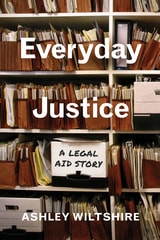
Everyday Justice
A Legal Aid StoryAshley Wiltshire
Vanderbilt University Press, 2022
Those surviving on low incomes often see the legal system as an oppressive force stacked against them. Everyday Justice is about lawyers trying to make the law work for these people. This book traces the development and evolution of legal aid in Middle Tennessee from the late 1960s to the turn of the millennium, as told by Ashley Wiltshire, who worked for the Legal Aid Society of Middle Tennessee and the Cumberlands in all its incarnations for four decades, beginning a year after its inception.
Set in the context of the legal aid movement in the United States—beginning as a part of the social awakening in the post–Civil War era, continuing with volunteer efforts in the first part of the twentieth century, and coming to fruition beginning with the OEO Office of Legal Services grants of the 1960s as part of the War on Poverty—Everyday Justice is a story of Nashville, which levied an extended period of opposition because of prevailing cultural and religious views on race and poverty.