527 books match the query 'Labor' and 12 start with e
cover of Earthly Plenitudes: A Study on Sovereignty and Labor

Earthly Plenitudes

A Study on Sovereignty and Labor

Bruno Gullì

Temple University Press, 2016

A fierce critique of productivity and sovereignty in the world of labor and everyday life, Bruno Gullì’s Earthly Plenitudes asks, can labor exist without sovereignty and without capitalism? He introduces the concept of dignity of individuation to prompt a rethinking of categories of political ontology. Dignity of individuation stresses the notion that the dignity of each and any individual being lies in its being individuated as such; dignity is the irreducible and most essential character of any being. Singularity is a more universal quality.

Gullì first reviews approaches to sovereignty by philosophers as varied as Gottfried Leibniz and Georges Bataille, and then looks at concrete examples where the alliance of sovereignty and capital cracks under the potency of living labor. He examines contingent academic labor as an example of the super-exploitation of labor, which has become a global phenomenon, and as such, a clear threat to the sovereign logic of capital. Gullì also looks at disability to assert that a new measure of humanity can only be found outside the schemes of sovereignty, productivity, efficiency, and independence, through care and caring for others, in solidarity and interdependence.

[more]
cover of Easy Living: The Rise of the Home Office

Easy Living

The Rise of the Home Office

Elizabeth A Patton

Rutgers University Press, 2020
How did Americans come to believe that working at home is feasible, productive, and desirable? Easy Living examines how the idea of working within the home was constructed and disseminated in popular culture and mass media during the twentieth century. Through the analysis of national magazines and newspapers, television and film, and marketing and advertising materials from the housing, telecommunications, and office technology industries, Easy Living traces changing concepts about what it meant to work in the home. These ideas reflected larger social, political-economic, and technological trends of the times. Elizabeth A. Patton reveals that the notion of the home as a space that exists solely in the private sphere is a myth, as the social meaning of the home and its market value in relation to the public sphere are intricately linked.
[more]
cover of Economic Turbulence: Is a Volatile Economy Good for America?

Economic Turbulence

Is a Volatile Economy Good for America?

Clair Brown, John Haltiwanger, and Julia Lane

University of Chicago Press, 2006

Every day, in every sector of our economy, a business shuts down while another starts up, jobs are created while others are cut, and workers are hired while others are laid off. This constant flux, or turbulence, is a defining characteristic of our free market system, yet it mostly inspires angst about unemployment, loss of earnings, and the overall competitiveness of corporations. But is this endless cycle of fluctuation really so bad for America? Might something positive be going on in the economy as a result of it?

In this penetrating work, three esteemed economists seek to answer these questions by exploring the real impact of volatility on American workers and businesses alike. According to the authors, while any number of events--shifts in consumer demand, changes in technology, mergers and acquisitions, or increased competition--can contribute to economic turbulence, our economy as a whole is, by and large, stronger for it, because these processes of creation and destruction make it more flexible and adaptable. The authors also acknowledge and document the adverse consequences of this turbulence on different groups of workers and firms and discuss the resulting policy challenges. Basing their argument on an up-close look into the dealings and practices of five key industries—financial services, retail food services, trucking, semiconductors, and software—the authors demonstrate the positive effects of turbulence on career paths, employee earnings, and firm performance.

The first substantial attempt to disentangle and make clear the complexities of this phenomenon in the United States, Economic Turbulence will be viewed as a major achievement and the centerpiece of any discussion on the subject for years to come.
[more]
cover of Economies of Praise: Value, Labor, and Form in Seventeenth-Century English Poetry

Economies of Praise

Value, Labor, and Form in Seventeenth-Century English Poetry

Ryan Netzley

Northwestern University Press, 2024

Reevaluates early modern poems of praise as, paradoxically, challenging an artistic economy that values exchange and productivity
 
Early modern poems of praise typically insist that they do not have a purpose or enact real labor beyond their effortless listing of laudable qualities. And yet the poets discussed in this study, including Ben Jonson, Andrew Marvell, Anne Bradstreet, Lucy Hutchinson, and John Milton, hint at an alternative aesthetic economy at work in their verse. Poetic praise, it turns out, might show us a social world outside the organizing principle of exchange.
 
In Economies of Praise: Value, Labor, and Form in Seventeenth‑Century English Poetry, Ryan Netzley explores how poems of praise imagine alternatives to market and gift economies and point instead to a self-contained aesthetic economy that works against a more expansive and productivist understanding of literary art. By depicting exchange as inconsequential, unproductive, and redundant rather than a necessary constituent of social order, these poems model for modern readers a world without the imperative to create, appraise, and repeatedly demonstrate one’s own value.
[more]
cover of Egalitarian Capitalism: Jobs, Incomes, and Growth in Affluent Countries

Egalitarian Capitalism

Jobs, Incomes, and Growth in Affluent Countries

Lane Kenworthy

Russell Sage Foundation, 2004

Declining participation in labor unions, the movement toward a service-based economy, and increased globalization have cast doubt on the extent to which welfare states can continue to stem inequality in market economies over the long-term. Does the new economy render existing models of social assistance obsolete? Do traditional welfare states hamper economic and employment growth, thereby worsening the plight of the poor? Lane Kenworthy offers a rigorous empirical analysis of these questions in Egalitarian Capitalism. The book examines sixteen industrialized countries in North America, Western Europe, and Scandinavia—each with different approaches to assisting the poor—to see how successful each has been in developing its economy and curbing inequality over the past twenty years. Kenworthy finds that inequality grew in almost all of these countries, from the most progressive to the least. Using simple but powerful statistical tests, he assesses the theory that inequality is necessary to improve economic growth and reduce poverty. He finds no necessary trade-off between equality and economic growth but discovers some evidence that high minimum wages dampen employment growth in private sector services. Kenworthy suggests that without greater private sector employment, public supports may be unable to adequately sustain living standards for the poor. An equitable growth strategy necessitates a balance of policy options: Creating jobs is aided by loose employment regulation, low payroll taxes, and, in some cases, lower real wages for workers at the bottom of the income spectrum. However, high employment is also facilitated by a system that "makes work pay" with earnings subsidies, workplace flexibilities, financial support for those who are between jobs or unable to work, and universal health and child care coverage. Kenworthy suggests that these strategies, though generally presented as mutually exclusive, could be effectively combined to create a robust, fair economy. Egalitarian Capitalism addresses fundamental questions of national policy with rigorous scholarship and a clarity that makes it accessible to any reader interested in the alleged trade-off between social equity and market efficiency. The book analyzes the viability of traditional welfare regimes and offers sustainable options that can promote egalitarian societies without hampering economic progress. A Volume in the American Sociological Association's Rose Series in Sociology
[more]
cover of Embodied Engineering: Gendered Labor, Food Security, and Taste in Twentieth-Century Mali

Embodied Engineering

Gendered Labor, Food Security, and Taste in Twentieth-Century Mali

Laura Ann Twagira

Ohio University Press, 2021

Foregrounding African women’s ingenuity and labor, this pioneering case study shows how women in rural Mali have used technology to ensure food security through the colonial period, environmental crises, and postcolonial rule. By advocating for an understanding of rural Malian women as engineers, Laura Ann Twagira rejects the persistent image of African women as subjects without technological knowledge or access and instead reveals a hidden history about gender, development, and improvisation. In so doing, she also significantly expands the scope of African science and technology studies. Using the Office du Niger agricultural project as a case study, Twagira argues that women used modest technologies (such as a mortar and pestle or metal pots) and organized female labor to create, maintain, and reengineer a complex and highly adaptive food production system. While women often incorporated labor-saving technologies into their work routines, they did not view their own physical labor as the problem it is so often framed to be in development narratives. Rather, women’s embodied techniques and knowledge were central to their ability to transform a development project centered on export production into an environmental resource that addressed local taste and consumption needs.
[more]
cover of Emily Dickinson and the Labor of Clothing

Emily Dickinson and the Labor of Clothing

Daneen Wardrop

University of New Hampshire Press, 2009

Daneen Wardrop's Emily Dickinson and the Labor of Clothing begins by identifying and using the dating tools of fashion to place the references to clothing in Dickinson's letters and poems, and to locate her social standing through examining her fashion choices in the iconic daguerreotype. In addition to detailing the poetics of fashion in Dickinson's work, the author argues that close examination of Dickinson and fashion cannot be separated from the changing ways that garments were produced during the nineteenth century, embracing issues of domestic labor, the Lowell textile mills, and the Amherst industry of the Hills Hat Factory located almost next door to Dickinson's Homestead. The recent retrieval of clothing from approximately thirty trunks found in the attic of the Evergreens house, which formerly belonged to Dickinson's brother and sister-in-law, further enhances this remarkable and original interdisciplinary work.
[more]
cover of End of the Line: Autoworkers and the American Dream

End of the Line

Autoworkers and the American Dream

Edited by Richard Feldman and Michael Betzold

University of Illinois Press, 1988

"This marvelous book captures in a most poignant and accurate way what life is like for the millions who still make up the 'blue collar' backbone of American industry."--Barry Bluestone, author of The Deindustrialization of America
 
"A richly detailed, well-crafted portrait of a cross section of autoworkers in the midst of an identity crisis and a crisis gripping the U.S. auto industry."--Frank Hammer, President, United Auto Workers Local 909
 
[more]
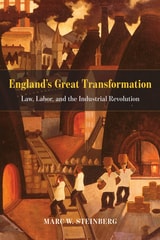
cover of England's Great Transformation: Law, Labor, and the Industrial Revolution

England's Great Transformation

Law, Labor, and the Industrial Revolution

Marc W. Steinberg

University of Chicago Press, 2016

With England’s Great Transformation, Marc W. Steinberg throws a wrench into our understanding of the English Industrial Revolution, largely revising the thesis at heart of Karl Polanyi’s landmark The Great Transformation. The conventional wisdom has been that in the nineteenth century, England quickly moved toward a modern labor market where workers were free to shift from employer to employer in response to market signals. Expanding on recent historical research, Steinberg finds to the contrary that labor contracts, centered on insidious master-servant laws, allowed employers and legal institutions to work in tandem to keep employees in line.

Building his argument on three case studies—the Hanley pottery industry, Hull fisheries, and Redditch needlemakers—Steinberg employs both local and national analyses to emphasize the ways in which these master-servant laws allowed employers to use the criminal prosecutions of workers to maintain control of their labor force. Steinberg provides a fresh perspective on the dynamics of labor control and class power, integrating the complex pathways of Marxism, historical institutionalism, and feminism, and giving readers a subtle yet revelatory new understanding of workplace control and power during England’s Industrial Revolution.
[more]
cover of Equality for Contingent Faculty: Overcoming the Two-Tier System

Equality for Contingent Faculty

Overcoming the Two-Tier System

Keith Hoeller

Vanderbilt University Press, 2014

Vice President Joseph Biden has blamed tuition increases on the high salaries of college professors, seemingly unaware of the fact that there are now over one million faculty who earn poverty-level wages teaching off the tenure track. The Chronicle of Higher Education ran a story entitled "From Graduate School to Welfare: The PhD Now Comes with Food Stamps." Today three-fourths of all faculty are characterized as "contingent instructional staff," a nearly tenfold increase from 1975.


Equality for Contingent Faculty brings together eleven activists from the United States and Canada to describe the problem, share case histories, and offer concrete solutions. The book begins with three accounts of successful organizing efforts within the two-track system. The second part describes how the two-track system divides the faculty into haves and have-nots and leaves the majority without the benefit of academic freedom or the support of their institutions. The third part offers roadmaps for overcoming the deficiencies of the two-track system and providing equality for all professors, regardless of status or rank.
[more]
cover of Expanding Class: Power and Everyday Politics in Industrial Communities, The Netherlands 1850–1950

Expanding Class

Power and Everyday Politics in Industrial Communities, The Netherlands 1850–1950

Don Kalb

Duke University Press, 1998

Expanding Class is the study and story of industrial class relations in North Brabant, a Catholic province of The Netherlands, over a hundred-year period. In examining the lives of workers in one of Europe’s more idiosyncratic industrial regions, Don Kalb affirms the utility of class analysis while responding to the cultural critics who have encouraged a movement away from this focus in labor history. In so doing, Expanding Class advances an interdisciplinary historical anthropology of working-class formation. Basing his analysis on oral as well as archival sources, Kalb reveals a dynamic relationship between capitalist industrialization, locality, and cultural class identities.
Expanding Class compares Brabant’s quaint central shoemaking district to its electrical boomtown Eindhoven, home of the enormous Philips Corporation. It introduces the concept of "flexible familism," a sociological phenomenon in which family daughters were employed to facilitate a cheap and ample labor force. Industrialists manipulated and fostered flexible familism to ensure the discipline and loyalty of the working-class community. By using the industrial Netherlands as a paradigm, Kalb reveals new and productive ways to examine class construction and the development of labor history in other countries over the past thirty years, steering a path between the two schools of thought—cultural and economic—that have dominated labor history discussions in recent years.
[more]
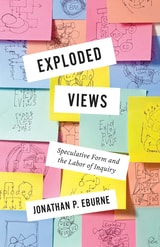
cover of Exploded Views: Speculative Form and the Labor of Inquiry

Exploded Views

Speculative Form and the Labor of Inquiry

Jonathan Eburne

University of Minnesota Press, 2025

Idiosyncratic essays use their “exploded” forms to examine how inquiry functions

Insect galls, time, memory systems, orgone energy, and a bookstore that doesn’t yet exist. These disparate topics have persistently fascinated scholar Jonathan P. Eburne, yet each defied his previous efforts at classification through scholarly writing, resulting in five essays suspended in process. In Exploded Views, Eburne returns to these essays with the metaphorical tool of the exploded-view diagram, expanding them into entirely new, hybrid forms that unpack their inspirations and trace the wayward paths they followed.

An experiment into the nature of inquiry that spelunks, rather than shies from, the rabbit holes of scholarly curiosity, each essay gives way to sidelights and dilations to reveal the palimpsest of knowledge hiding beneath the surface of the academic form. A book about process—the process of turning ideas into things, and vice versa, as well as the particular tendency for research, scholarly inquiry, and critical writing to come apart and go awry—Exploded Views is a refreshing exploration of how the tools of creative critical thinking work at their most basic level.

Reflecting on the methods of scholarly knowledge production and the contextual factors that shape new ideas, Eburne boldly replaces the seamlessness of the finished manuscript with the friction and even messiness of the incomplete, inviting readers to think in new and invigorating ways.

[more]