Results by title
128 books match the query 'Language and languages' and 3 start with e

Essay on the Origin of Languages and Writings Related to Music
Jean Jacques Rousseau
Dartmouth College Press, 2009
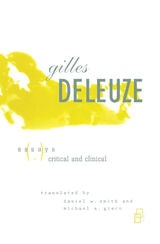
Essays Critical And Clinical
Gilles Deleuze
University of Minnesota Press, 1997
The final work of this essential thinker.
Essays Critical and Clinical is the final work of the late Gilles Deleuze, one of the most important and vital figures in contemporary philosophy. It includes essays, all newly revised or published here for the first time, on such diverse literary figures as Herman Melville, Walt Whitman, D. H. Lawrence, T. E. Lawrence, Samuel Beckett, Leopold von Sacher-Masoch, Alfred Jarry, and Lewis Carroll, as well as philosophers such as Plato, Spinoza, Kant, Nietzsche, and Heidegger.
For Deleuze, every literary work implies a way of living, a form of life, and must be evaluated not only critically but also clinically. As Proust said, great writers invent a new language within language, but in such a way that language in its entirety is pushed to its limit or its own “outside.” This outside of language is made up of affects and precepts that are not linguistic, but which language alone nonetheless makes possible. In Essays Critical and Clinical, Deleuze is concerned with the delirium-the process of Life-that lies behind this invention, as well as the loss that occurs, the silence that follows, when this delirium becomes a clinical state. Taken together, these eighteen essays present a profoundly new approach to literature by one of the greatest twentieth-century philosophers.
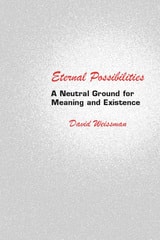
Eternal Possibilities
A Neutral Ground for Meaning and ExistenceDavid Weissman
Southern Illinois University Press, 1977
Eternal Possibilities: A Neutral Ground for Meaning and Existence builds on David Weissman's earlier Dispositional Properties and makes a signal contribution to the study of metaphysics. Here, broadening and enriching the point of view adopted in his earlier work, Weissman cites and criticizes a large number of theories proposed by authors from Plato to Wittgenstein and others exploring language theory and metaphysics.
Students of Wittgenstein will be especially interested in Mr. Weissman's critical examination of Wittgenstein's claim in the Tractatus that possibilities are the facts for logic. Weissman proposes a modal theory of properties: they exist in the first instance as possibilities. He argues that a sentence is meaningful if it signifies a property or complex of properties existing as a possible, and true if that possible is instantiated. The status of possibilities and their relation to actual states of affairs are considered in detail.