Results by title
75 books match the query 'Latin' and 5 start with e
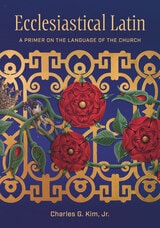
Ecclesiastical Latin
A Primer on the Language of the ChurchCharles G. Kim, Jr.
Catholic University of America Press, 2024

Ecclesiastical Latin
An Answer Key and CommentaryCharles G. Kim Jr.
Catholic University of America Press, 2026
Elementary Classical Greek, Revised Edition
Frederick Williams
Southern Illinois University Press, 2004
Now in paperback for the first time, Elementary Classical Greek is a trusted handbook for learning the language that does not presuppose a knowledge of Latin. Based on the premise that average American students can learn the language, the lessons are thorough but not pedantic, simple but not superficial, and the textbook has been proven in the classroom and for independent learners.
Elementary Classical Greek stresses a clear and orderly presentation of the language, accompanied by individual sentences or short passages that illustrate grammar, give practice in reading, and help build vocabulary. Drawing on decades of experience teaching classical Greek, Frederick Williams presents a text in which grammatical explanations are clear, succinct, and correct and the selected readings are varied, interesting, and useful. Included in the nearly one-hundred reading passages are excerpts from Plato’s Ion and Republic, Aristophanes’s Clouds, and Paul’s first letter to the Corinthians.
The popular textbook is designed for a course meeting for two semesters. There are twenty-four lessons in all, with appendixes on prepositions, Greek numbers, and the Greek verb, plus Greek-English and English-Greek vocabularies, a grammatical index of subjects, and a list of Greek authors cited. Selected readings are presented first in simple, then more complex, language until the reader is led to the actual words of the ancient author—all within the same lesson. This elementary device helps bridge many of the difficult gaps between modern English and ancient Greek.
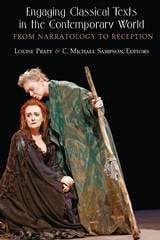
Engaging Classical Texts in the Contemporary World
From Narratology to ReceptionLouise Pratt and C. Michael Sampson, Editors
University of Michigan Press, 2018
This volume considers perennial favorites of classical literature—the Iliad and Odyssey, Greek tragedy, Roman comedy, the Argonautica, and Ovid’s Metamorphoses—and their influence on popular entertainment from Shakespeare’s plays to Hollywood’s toga films. It also engages with unusual and intriguing texts across the centuries, including a curious group of epigrams by Artemidorus found on the island sanctuary of Thera, mysterious fragments of two Aeschylean tragedies, and modern-day North African novels. These essays engage an array of theoretical approaches from other fields—narratology, cognitive literary theory, feminist theory, New Historicist approaches to gender and sexuality, and politeness theory—without forsaking more traditional philological methods. A new look at hospitality in the Argonautica shows its roots in the changed historical circumstances of the Hellenistic world. The doubleness of Helen and her phantom in Euripides’ Helen is even more complex than previously noted. Particularly illuminating is the recurrent application of reception studies, yielding new takes on the ancient reception of Homer by Apollonius and of Aeschylus by Macrobius, the reception of Plautus by Shakespeare, and more contemporary examples from the worlds of cinema and literature.
Students and scholars of classics will find much in these new interpretations and approaches to familiar texts that will expand their intellectual horizons. Specialists in other fields, particularly English, comparative literature, film studies, and gender and sexuality studies, will also find these essays directly relevant to their work.
English Words from Latin and Greek Elements
Donald M. Ayers; Revised by Thomas D. Worthen
University of Arizona Press, 1986
Since its first publication in 1965, English Words from Latin and Greek Elements by Donald M. Ayers has empowered thousands of students to expand their vocabulary by uncovering the classical roots embedded in modern English. Now in its enduring second edition, this trusted resource proves that vocabulary is most effectively learned through understanding—not memorization.
Why dedicate an entire book to this approach? Because Ayers goes beyond the basics. Students are introduced to a broad spectrum of Latin and Greek roots, encounter new vocabulary in meaningful context, and reinforce their learning through targeted exercises. This method equips learners with lifelong tools to decode unfamiliar words and deepen their command of English.
Written for English learners—not classical language scholars—this book requires no prior knowledge of Latin or Greek. It’s proven effective across high school and college classrooms, and adaptable for both remedial and accelerated programs.