Results by title
276 books match the query 'Legal History' and 8 start with e
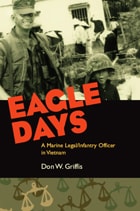
Eagle Days
A Marine Legal/Infantry Officer in VietnamDonald W. Griffis
University of Alabama Press, 2007
A rare Vietnam memoir from the crossroads of combat and military justice.
Much has been written about America’s war in Vietnam, and an enduring and troubling subtext is the composition of the body of soldiers that made up the U.S. troop deployment: from the initially well-trained and disciplined group of largely elite units that served in the mid-sixties to what has been termed an “armed mob” by the end of that decade and into the early 1970s. Drug use, insubordination, racial antagonism that often became violent, theft and black market dealing, and even “fragging” (murder of officers and senior noncoms by disgruntled troops) marred the record of the U.S. military presence. Don Griffis served in the twin roles of legal officer charged at various times with the task of both defending and prosecuting servicemen, while at the same time leading combat patrols in “search and destroy” missions against the Viet Cong and North Vietnamese enemy. Eagle Days is a remarkable account of Griffis’ personal record of experiencing what the military should do best—meet, engage, and defeat the enemy—and what it becomes when esprit de corps, discipline, and a sense of purpose decay.
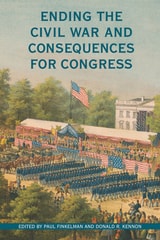
Ending the Civil War and Consequences for Congress
Paul Finkelman
Ohio University Press, 2019
The social changes and human and economic costs of the Civil War led to profound legal and constitutional developments after it ended, not least of which were the Fourteenth and Fifteenth Amendments and the many laws devised to protect the civil rights of newly freed African Americans. These amendments and laws worked for a while, but they were ineffective or ineffectively enforced for more than a century.
In Ending the Civil War and the Consequences for Congress, contributors explore how the end of the war both continued the trauma of the conflict and enhanced the potential for the new birth of freedom that Lincoln promised in the Gettysburg Address. Collectively, they bring their multidisciplinary expertise to bear on the legal, economic, social, and political aspects of the aftermath of the war and Reconstruction era. The book concludes with the reminder of how the meaning of the war has changed over time. The Civil War is no longer the “felt” history it once was, Clay Risen reminds us, and despite the work of many fine scholars it remains contested.
Contributors: Jenny Bourne, Carole Emberton, Paul Finkelman, Lorien Foote, William E. Nelson, Clay Risen, Anne Sarah Rubin, and Peter Wallenstein
Everyday Justice
A Legal Aid StoryAshley Wiltshire
Vanderbilt University Press, 2022
Those surviving on low incomes often see the legal system as an oppressive force stacked against them. Everyday Justice is about lawyers trying to make the law work for these people. This book traces the development and evolution of legal aid in Middle Tennessee from the late 1960s to the turn of the millennium, as told by Ashley Wiltshire, who worked for the Legal Aid Society of Middle Tennessee and the Cumberlands in all its incarnations for four decades, beginning a year after its inception.
Set in the context of the legal aid movement in the United States—beginning as a part of the social awakening in the post–Civil War era, continuing with volunteer efforts in the first part of the twentieth century, and coming to fruition beginning with the OEO Office of Legal Services grants of the 1960s as part of the War on Poverty—Everyday Justice is a story of Nashville, which levied an extended period of opposition because of prevailing cultural and religious views on race and poverty.
Everyday Justice
A Legal Aid StoryAshley Wiltshire
Vanderbilt University Press, 2022
Those surviving on low incomes often see the legal system as an oppressive force stacked against them. Everyday Justice is about lawyers trying to make the law work for these people. This book traces the development and evolution of legal aid in Middle Tennessee from the late 1960s to the turn of the millennium, as told by Ashley Wiltshire, who worked for the Legal Aid Society of Middle Tennessee and the Cumberlands in all its incarnations for four decades, beginning a year after its inception.
Set in the context of the legal aid movement in the United States—beginning as a part of the social awakening in the post–Civil War era, continuing with volunteer efforts in the first part of the twentieth century, and coming to fruition beginning with the OEO Office of Legal Services grants of the 1960s as part of the War on Poverty—Everyday Justice is a story of Nashville, which levied an extended period of opposition because of prevailing cultural and religious views on race and poverty.
Everyman's Constitution
Historical Essays on the Fourteenth Amendment, the "Conspiracy Theory," and American ConstitutionalismHoward Jay Graham
Wisconsin Historical Society Press, 1968
Everyone against Us
Public Defenders and the Making of American JusticeAllen Goodman
University of Chicago Press, 2023
As a public defender, Allen Goodman faced cross-examination from family and friends every day: How could he work to help criminals? How could he live with himself? Presumed guilty by association, Goodman quickly learned that people didn’t really want an answer; they wanted a justification, perhaps even an apology. Ever the idealist, Goodman answered anyway: Everyone deserves justice.
Everyone against Us is Goodman’s testimony of his life as a public defender. In it, he documents his efforts to defend clients, both guilty and innocent, against routine police abuse, prosecutorial misconduct, and unjust sentencing. To work in criminal justice, Goodman shows, is to confront and combat vivid human suffering, of both victims and perpetrators. From sex trafficking, murder, and abuse to false conviction, torture, and systemic racism, Goodman describes the daily experiences that both rattled his worldview and motivated him to work ever harder. Part memoir, part exposé, Everyone against Us is the moving story of an embattled civil servant who staves off the worst abuses of the criminal justice system, at great personal cost.
Executing Freedom
The Cultural Life of Capital Punishment in the United StatesDaniel LaChance
University of Chicago Press, 2016
That question is at the heart of Executing Freedom, a powerful, wide-ranging examination of the place of the death penalty in American culture and how it has changed over the years. Drawing on an array of sources, including congressional hearings and campaign speeches, true crime classics like In Cold Blood, and films like Dead Man Walking, Daniel LaChance shows how attitudes toward the death penalty have reflected broader shifts in Americans’ thinking about the relationship between the individual and the state. Emerging from the height of 1970s disillusion, the simplicity and moral power of the death penalty became a potent symbol for many Americans of what government could do—and LaChance argues, fascinatingly, that it’s the very failure of capital punishment to live up to that mythology that could prove its eventual undoing in the United States.

Expanding Intellectual Property
Copyrights and Patents in 20th Century Europe and beyondAugusta Dimou
Central European University Press, 2017