Results by title
320 books match the query 'Legal status, laws, etc' and 10 start with e

Elder Brother and the Law of the People
Contemporary Kinship and Cowessess First NationRobert Alexander Innes
University of Manitoba Press, 2013
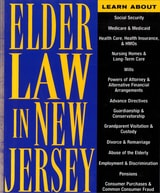
Elder Law in New Jersey
Finding Solutions for Legal ProblemsDueker, Alice K.
Rutgers University Press, 1999
In New Jersey, one in five residents is over the age of 65. The Garden State’s legal and healthcare systems are becoming increasingly complex, making it more difficult than ever for seniors to understand their rights and take advantage of available assistance and services.
Elder Law in New Jersey provides important, practical information to New Jersey residents, especially older adults who have become entangled in an incomprehensible web of healthcare and social security bureaucracies, younger adults who are caregivers to elderly parents, and middle-class citizens who fear the debilitating physical and financial effects of chronic illness.
The legal problems most often encountered by seniors can involve frustrating losses of control over nearly all aspects of their lives. Attorney Alice Dueker, who specializes in elder law, explains complex legal issues in easily understood language. She looks at:
· various ways to obtain and pay for healthcare, including nursing home care
· how to create a will
· how to address and avoid internal family disputes, including child custody, marriage, divorce, grandparent visitation rights, and elder abuse
· employment issues such as age and disability discrimination, as well as pensions
· problems of consumer fraud
· housing issues for both tenants and homeowners
She provides contact information for agencies and programs that provide free or low cost services for seniors, and resources for locating attorneys.
Elder law is state specific, so New Jersey residents will find this book especially helpful and applicable to their own lives.
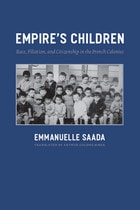
Empire's Children
Race, Filiation, and Citizenship in the French ColoniesEmmanuelle Saada
University of Chicago Press, 2012
Europe’s imperial projects were often predicated on a series of legal and scientific distinctions that were frequently challenged by the reality of social and sexual interactions between the colonized and the colonizers.When Emmanuelle Saada discovered a 1928 decree defining the status of persons of mixed parentage born in French Indochina—the métis—she found not only a remarkable artifact of colonial rule, but a legal bombshell that introduced race into French law for the first time. The decree was the culmination of a decades-long effort to resolve the “métis question”: the educational, social, and civil issues surrounding the mixed population. Operating at the intersection of history, anthropology, and law, Empire’s Children reveals the unacknowledged but central role of race in the definition of French nationality.
Through extensive archival work in both France and Vietnam, and a close reading of primary and secondary material from the Pacific islands and sub-Saharan and North Africa, Saada has created in Empire’s Children an original and compelling perspective on colonialism, law, race, and culture from the end of the nineteenth century until decolonization.
Employment, Disability, and the Americans with Disabilities Act
Issues in Law, Public Policy, and ResearchPeter David Blanck
Northwestern University Press, 2000

Envisioning Global LGBT Human Rights
(Neo)colonialism, Neoliberalism, Resistance and HopeEdited by Nancy Nicol, Adrian Jjuuko, Richard Lusimbo, Nick Mulé, Susan Ursel, Amar Wahab, and Phyllis Waugh
University of London Press, 2018
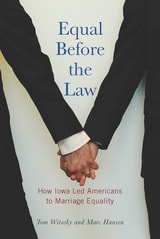
Equal Before the Law
How Iowa Led Americans to Marriage EqualityTom Witosky, Marc Hansen
University of Iowa Press, 2015
The court’s decision in Varnum v. Brien made Iowa only the third state in the nation to permit same-sex couples to wed—moderate, midwestern Iowa, years before such left-leaning coastal states as California and New York. And unlike the earlier decisions in Massachusetts and Connecticut, Varnum v. Brien was unanimous and unequivocal. It catalyzed the unprecedented and rapid shift in law and public opinion that continues today.
Equal Before the Law tells the stories behind this critical battle in the fight for marriage equality and traces the decision’s impact. The struggle began in 1998 with the easy passage of Iowa’s Defense of Marriage Act and took a turn, surprising to many, in 2005, when six ordinary Iowa couples signed on to Lambda Legal’s suit against the law. Their triumph in 2009 sparked a conservative backlash against the supreme court justices, three of whom faced tough retention elections that fall.
Longtime, award-winning reporters Tom Witosky and Marc Hansen talked with and researched dozens of key figures, including opponent Bob Vander Plaats, proponents Janelle Rettig and Sharon Malheiro, attorneys Roger Kuhle, Dennis Johnson, and Camilla Taylor, and politicians Matt McCoy, Mary Lundby, and Tom Vilsack, who had to weigh their careers against their convictions. Justice Mark Cady, who wrote the decision, explains why the court had to rule in favor of the plaintiffs. At the center of the story are the six couples who sacrificed their privacy to demand public respect for their families.
Through these voices, Witosky and Hansen show that no one should have been surprised by the 2009 decision. Iowans have a long history of leadership on civil rights. Just a year after Iowa became a state, its citizens adopted as their motto the phrase, “Our liberties we prize and our rights we will maintain.” And they still do today.

Equal Play
Title IX and Social ChangeNancy Hogshead-Makar
Temple University Press, 2007
One of the least-understood issues in federal sports policy, Title IX of the Educational Amendments of 1972 reflects the nation's aspirational belief that girls and boys, women and men, deserve equal educational opportunities in athletics. Equal Play shows how this ideal has been implemented-and thwarted-by actions in every branch of the federal government.
This reader addresses issues in sports before Title IX and the backlash that has resulted from the policy being instituted. The editors have collected the best scholarly writing on the landmark events of the last four decades and couples these with new original essays, primary documents from court cases, administrative regulations, and relevant supporting sources. The result is the most comprehensive single-volume work on the subject.
Equal Play includes essays by many well-known sports journalists who discuss how government actions have shaped, supported, and hindered the goal of gender equality in school athletics. They discuss the history of women in sports, analyze the meaning of "equal opportunity" for female athletes, and examine shifts in arguments for and against Title IX. Equal Play will interest anyone who is concerned with gender issues in American athletics and the growth of college sports.
Contributors include: Susan Cahn, Donna de Varona, Julie Foudy, Jessica Gavora, Bil Gilbert, Christine Grant, Mariah Burton Nelson, Gary R. Roberts, Don Sabo, Larry Schwartz, Michael Sokolove, Welch Suggs, Nancy Williamson, and the editors.
Equality for Same-Sex Couples
The Legal Recognition of Gay Partnerships in Europe and the United StatesYuval Merin
University of Chicago Press, 2002
Merin begins by providing a historical overview of the transformation of marriage from antiquity to the present. He then identifies and critically compares four principal models for the legal regulation and recognition of same-sex partnerships: civil marriage, registered partnership, domestic partnership, and cohabitation. Merin concludes that all of the models except civil marriage discriminate against gays and lesbians just as the "separate but equal" doctrine discriminated against African Americans; thus, so-called alternatives to marriage, even if they provide the same rights and benefits as marriage, are inherently unequal and therefore unconstitutional.

Exiled Home
Salvadoran Transnational Youth in the Aftermath of ViolenceSusan Bibler Coutin
Duke University Press, 2016

Extraterritorial Dreams
European Citizenship, Sephardi Jews, and the Ottoman Twentieth CenturySarah Abrevaya Stein
University of Chicago Press, 2016
Sarah Abrevaya Stein traces the experiences of Mediterranean Jewish women, men, and families who lived through a tumultuous series of wars, border changes, genocides, and mass migrations, all in the shadow of the collapse of the Ottoman Empire and the ascendance of the modern passport regime. Moving across vast stretches of Europe, the Middle East, Asia, and the Americas, she tells the intimate stories of people struggling to find a legal place in a world ever more divided by political boundaries and competing nationalist sentiments. From a poor youth who reached France as a stowaway only to be hunted by the Parisian police as a spy to a wealthy Baghdadi-born man in Shanghai who willed his fortune to his Eurasian Buddhist wife, Stein tells stories that illuminate the intertwined nature of minority histories and global politics through the turbulence of the modern era.