Results by title
85 books match the query 'Literature and history' and 4 start with e
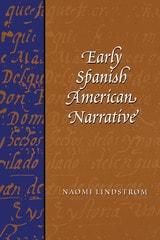
Early Spanish American Narrative
By Naomi Lindstrom
University of Texas Press, 2004
The world discovered Latin American literature in the twentieth century, but the roots of this rich literary tradition reach back beyond Columbus's discovery of the New World. The great pre-Hispanic civilizations composed narrative accounts of the acts of gods and kings. Conquistadors and friars, as well as their Amerindian subjects, recorded the clash of cultures that followed the Spanish conquest. Three hundred years of colonization and the struggle for independence gave rise to a diverse body of literature—including the novel, which flourished in the second half of the nineteenth century.
To give everyone interested in contemporary Spanish American fiction a broad understanding of its literary antecedents, this book offers an authoritative survey of four centuries of Spanish American narrative. Naomi Lindstrom begins with Amerindian narratives and moves forward chronologically through the conquest and colonial eras, the wars for independence, and the nineteenth century. She focuses on the trends and movements that characterized the development of prose narrative in Spanish America, with incisive discussions of representative works from each era. Her inclusion of women and Amerindian authors who have been downplayed in other survey works, as well as her overview of recent critical assessments of early Spanish American narratives, makes this book especially useful for college students and professors.
Eighteenth-Century Contexts
Historical Inquiries in Honor of Philip HarthHoward D. Weinbrot
University of Wisconsin Press, 2001
Eighteenth-Century Contexts offers a lively array of essays that consider literary, intellectual, political, theological, and cultural aspects of the years 1650–1800, in the British Isles and Europe. At the center of the book is Jonathan Swift; several essays delve into his poetry, his similarities to Bernard Mandeville, his response to Anthony Collins’s Discourse of Free-Thinking, and the relationship between his Gulliver’s Travels and Thomas More’s Utopia. Other essays discuss Alexander Pope, eighteenth-century music and poetry, William Congreve, James Boswell, Samuel Richardson, and women’s novels of the eighteenth century.

England in 1819
The Politics of Literary Culture and the Case of Romantic HistoricismJames Chandler
University of Chicago Press, 1998
"1819? At first sight, it might not seem a 'hot date'; but as James Chandler argues in his powerful book, it would be a mistake to overlook a year of such exceptional political conflagration and literary pyrotechnics in British history. Chandler's study is a wide-ranging, enormously ambitious, densely packed, closely argued work."—John Brewer, New Republic
"The book's largest argument, and the source of its considerable revelations, is that late twentieth-century practices of cultural history-writing have their roots in the peculiar Romantic historicism born in post-Waterloo Britain."—Jon Klancher, Times Literary Supplement
"A monumental work of scholarship."—Terry Eagleton, The Independent
Ethics and the Dynamic Observer Narrator
Reckoning with Past and Present in German LiteratureKatra A. Byram
The Ohio State University Press, 2015
Ethics and the Dynamic Observer Narrator contributes to scholarship on both narrative theory and the historical and cultural context of German and Austrian literary studies. Narrative theory, according to Byram, should understand this form to register complex interactions between history and narrative form. Byram also juxtaposes new readings of works by Textor, Storm, and Raabe from the nineteenth century with analyses of twentieth-century works by Grass, Handke, and Sebald, ultimately reframing our understanding of literary Vergangenheitsbewältigung, or the struggle to come to terms with the past. Overall, Byram shows that neither the problem of reckoning with the past nor the dynamic observer form is unique to Germany’s post-WWII era. Both are products of the dynamics of modern identity, surfacing whenever critical change separates what was from what is.