Results by title
156 books match the query 'Los Angeles' and 5 start with e
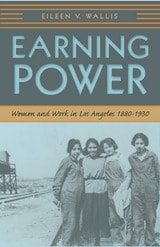
Earning Power
Women and Work in Los Angeles, 1880-1930Eileen Wallis
University of Nevada Press, 2010
The half-century between 1880 and 1930 saw rampant growth in many American cities and an equally rapid movement of women into the work force. In Los Angeles, the city not only grew from a dusty cow town to a major American metropolis but also offered its residents myriad new opportunities and challenges.Earning Power examines the role that women played in this growth as they attempted to make their financial way in a rapidly changing world. Los Angeles during these years was one of the most ethnically diverse and gender-balanced American cities. Moreover, its accelerated urban growth generated a great deal of economic, social, and political instability. In Earning Power, author Eileen V. Wallis examines how women negotiated issues of gender, race, ethnicity, and class to gain access to professions and skilled work in Los Angeles. She also discusses the contributions they made to the region’s history as political and social players, employers and employees, and as members of families. Wallis reveals how the lives of women in the urban West differed in many ways from those of their sisters in more established eastern cities. She finds that the experiences of women workers force us to reconsider many assumptions about the nature of Los Angeles’s economy, as well as about the ways women participated in it. The book also considers how Angelenos responded to the larger national social debate about women’s work and the ways that American society would have to change in order to accommodate working women. Earning Power is a major contribution to our understanding of labor in the urban West during this transformative period and of the crucial role that women played in shaping western cities, economies, society, and politics.
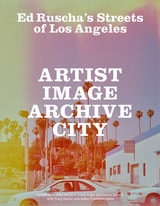
Ed Ruscha's Streets of Los Angeles
Artist, Image, Archive, CityAndrew Perchuk
J. Paul Getty Trust, The, 2025
In 1966, Ed Ruscha drove a car rigged with a motorized camera to capture Los Angeles’ most iconic street: Sunset Boulevard. He created a time capsule of its famed facades, beginning a sixty-year-long commitment to documenting the changing urban landscape of postwar Los Angeles. The Streets of Los Angeles project that comprises these photographs is likely the most comprehensive artistic record of any city, with over 900,000 images of major thoroughfares. Ruscha’s photographs constitute an unparalleled visual chronicle of both iconic and everyday sites in L.A., including popular music venues, neighborhood restaurants, and billboards promoting Hollywood’s latest blockbusters.
In this volume, scholars from disciplines such as urban planning, cultural geography, architecture, art history, and musicology explore the Streets of Los Angeles Archive as a rich repository for analyzing Ruscha’s practice and the city’s visual culture. Using his photographs and new data visualizations, the authors consider what it means to interpret an archive mostly accessible through digital technologies, and they demonstrate how histories of art have been indelibly reshaped since the advent of the information age in the 1960s.
This publication was created using Quire™, a multiformat publishing tool from Getty. The free online edition of this open-access publication is available at www.getty.edu/publications/ruscha/ and includes video, data visualizations, and zoomable illustrations. Free PDF and EPUB downloads of the book are also available.
Ethnic Los Angeles
Roger Waldinger
Russell Sage Foundation, 1996

Everyday Desistance
The Transition to Adulthood Among Formerly Incarcerated YouthAbrams, Laura S.
Rutgers University Press, 2017
In Everyday Desistance, Laura Abrams and Diane J. Terry examine the lives of young people who spent considerable time in and out of correctional institutions as adolescents. These formerly incarcerated youth often struggle with the onset of adult responsibilities at a much earlier age than their more privileged counterparts. In the context of urban Los Angeles, with a large-scale gang culture and diminished employment prospects, further involvement in crime appears almost inevitable. Yet, as Abrams and Terry point out, these formerly imprisoned youth are often quite resilient and can be successful at creating lives for themselves after months or even years of living in institutions run by the juvenile justice system.
This book narrates the day-to-day experiences of these young men and women, focusing on their attempts to surmount the challenges of adulthood, resisting a return to criminal activity, and formulating long-term goals for a secure adult future.
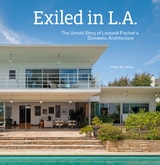
Exiled in L.A.
The Untold Story of Leopold Fischer’s Domestic ArchitectureVolker M. Welter
J. Paul Getty Trust, The, 0
In 1936, Leopold Fischer (1901–1975), in exile from Nazi Germany, arrived in California, where he created a small but distinct oeuvre of mostly domestic architecture. In contrast to his famous peers Rudolph Schindler and Richard Neutra, immigrants whose Southern California buildings are frequently examined—and who, like Fischer, studied with the modernist architect Adolf Loos—Fischer and his California structures have, until now, escaped the attention of architectural history.
Exiled in L.A. examines Fischer’s important, yet overlooked, contributions to Southern California architecture. As the whereabouts of Fischer’s archives remain unknown, Volker M. Welter grounds the designer’s California works in comparison with his pre-exile projects and the compositions of fellow architects in California. In the 1920s, Fischer created experimental working-class housing estates in Germany that pioneered ecological construction and living practices. Comparable to their predecessors, Fischer's California buildings revolve around the “functioning, the organization of a home,” as he defined domestic architecture in 1926. Featuring new photography and detailed architectural plans, this book is an original contribution to the literature on Southern California’s built heritage.