Results by title
124 books match the query 'Macroeconomics' and 7 start with e
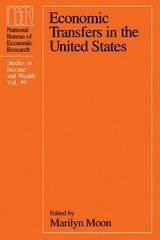
Economic Transfers in the United States
Edited by Marilyn Moon
University of Chicago Press, 1984
In recent years the definition of an economic transfer—a payment to an individual or institution that does not arise out of current productive activity—has been subject to even wider interpretation. This volume addresses that trend and introduces new methods of measuring transfers in the American economy.
Social security, private pension benefits, housing, and health care are traditional kinds of transfers. Accurate measurements of the degree and effect of these and of other, newly interpreted transfers are vital to economic policy making. Though this volume is not directly concerned with policy-making issues, it does impinge on many areas of current public concern; methods of transfer valuation, for example, may affect how we view the status of the aged.
Researchers, policy analysts, and those who compile statistics on which social programs are based on will value the diverse approaches of these ten papers and their accompanying comments. Taken together the essays give great insight into the complexities of defining transfers and provide a wealth of new analytic methods. They were developed from material presented at the Income and Wealth Conference on Social Accounting for Transfers held at Madison, Wisconsin, in 1982.
[more]
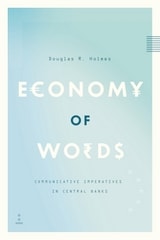
Economy of Words
Communicative Imperatives in Central BanksDouglas R. Holmes
University of Chicago Press, 2013
Markets are artifacts of language—so Douglas R. Holmes argues in this deeply researched look at central banks and the people who run them. Working at the intersection of anthropology, linguistics, and economics, he shows how central bankers have been engaging in communicative experiments that predate the financial crisis and continue to be refined amid its unfolding turmoil—experiments that do not merely describe the economy, but actually create its distinctive features.
Holmes examines the New York District Branch of the Federal Reserve, the European Central Bank, Deutsche Bundesbank, and the Bank of England, among others, and shows how officials there have created a new monetary regime that relies on collaboration with the public to achieve the ends of monetary policy. Central bankers, Holmes argues, have shifted the conceptual anchor of monetary affairs away from standards such as gold or fixed exchange rates and toward an evolving relationship with the public, one rooted in sentiments and expectations. Going behind closed doors to reveal the intellectual world of central banks,Economy of Words offers provocative new insights into the way our economic circumstances are conceptualized and ultimately managed.
Holmes examines the New York District Branch of the Federal Reserve, the European Central Bank, Deutsche Bundesbank, and the Bank of England, among others, and shows how officials there have created a new monetary regime that relies on collaboration with the public to achieve the ends of monetary policy. Central bankers, Holmes argues, have shifted the conceptual anchor of monetary affairs away from standards such as gold or fixed exchange rates and toward an evolving relationship with the public, one rooted in sentiments and expectations. Going behind closed doors to reveal the intellectual world of central banks,Economy of Words offers provocative new insights into the way our economic circumstances are conceptualized and ultimately managed.
[more]
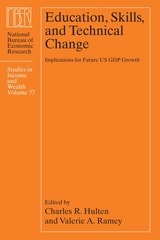
Education, Skills, and Technical Change
Implications for Future US GDP GrowthEdited by Charles R. Hulten and Valerie A. Ramey
University of Chicago Press, 2018
Over the past few decades, US business and industry have been transformed by the advances and redundancies produced by the knowledge economy. The workplace has changed, and much of the work differs from that performed by previous generations. Can human capital accumulation in the United States keep pace with the evolving demands placed on it, and how can the workforce of tomorrow acquire the skills and competencies that are most in demand?
Education, Skills, and Technical Change explores various facets of these questions and provides an overview of educational attainment in the United States and the channels through which labor force skills and education affect GDP growth. Contributors to this volume focus on a range of educational and training institutions and bring new data to bear on how we understand the role of college and vocational education and the size and nature of the skills gap. This work links a range of research areas—such as growth accounting, skill development, higher education, and immigration—and also examines how well students are being prepared for the current and future world of work.
Education, Skills, and Technical Change explores various facets of these questions and provides an overview of educational attainment in the United States and the channels through which labor force skills and education affect GDP growth. Contributors to this volume focus on a range of educational and training institutions and bring new data to bear on how we understand the role of college and vocational education and the size and nature of the skills gap. This work links a range of research areas—such as growth accounting, skill development, higher education, and immigration—and also examines how well students are being prepared for the current and future world of work.
[more]
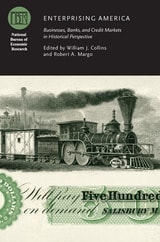
Enterprising America
Businesses, Banks, and Credit Markets in Historical PerspectiveEdited by William J. Collins and Robert A. Margo
University of Chicago Press, 2015
The rise of America from a colonial outpost to one of the world’s most sophisticated and productive economies was facilitated by the establishment of a variety of economic enterprises pursued within the framework of laws and institutions that set the rules for their organization and operation.
To better understand the historical processes central to American economic development, Enterprising America brings together contributors who address the economic behavior of American firms and financial institutions—and the associated legal institutions that shaped their behavior—throughout the nineteenth and early twentieth centuries. Collectively, the contributions provide an account of the ways in which businesses, banks, and credit markets promoted America’s extraordinary economic growth. Among the topics that emerge are the rise of incorporation and its connection to factory production in manufacturing, the organization and operation of large cotton plantations in comparison with factories, the regulation and governance of banks, the transportation revolution’s influence on bank stability and survival, and the emergence of long-distance credit in the context of an economy that was growing rapidly and becoming increasingly integrated across space.
To better understand the historical processes central to American economic development, Enterprising America brings together contributors who address the economic behavior of American firms and financial institutions—and the associated legal institutions that shaped their behavior—throughout the nineteenth and early twentieth centuries. Collectively, the contributions provide an account of the ways in which businesses, banks, and credit markets promoted America’s extraordinary economic growth. Among the topics that emerge are the rise of incorporation and its connection to factory production in manufacturing, the organization and operation of large cotton plantations in comparison with factories, the regulation and governance of banks, the transportation revolution’s influence on bank stability and survival, and the emergence of long-distance credit in the context of an economy that was growing rapidly and becoming increasingly integrated across space.
[more]
Environmental and Energy Policy and the Economy
Volume 1Edited by Matthew J. Kotchen, James H. Stock, and Catherine D. Wolfram
University of Chicago Press Journals, 2020
This volume presents six new papers on environmental/energy economics and policy. Robert Stavins evaluates carbon taxes versus a cap-and-trade mechanism for reducing greenhouse-gas emissions, arguing that specific design features of either instrument can be more consequential than the choice of instrument itself. Lucas Davis and James Sallee show that the exemption of electric vehicles from the gasoline tax is likely to be efficient as long as gasoline prices remain below social marginal costs, even though it results in lower tax revenue. Caroline Flammer analyzes the rapidly growing market for green bonds and highlights the importance of third-party certification to the financial and environmental performance of publically traded companies. Antonio Bento, Mark Jacobsen, Christopher Knittel, and Arthur van Benthem develop a general framework for evaluating the costs and benefits of fuel economy standards and use it to account for the differences between several recent studies of changes in these standards. Nicholas Muller estimates a measure of output in the U.S. economy over the last 60 years that accounts for air pollution damages, and shows that pollution effects are sizable, affect growth rates, and have diminished appreciably over time. Finally, Marc Hafstead and Roberton Williams illustrate methods of accounting for employment effects when evaluating the costs and benefits of environmental regulations.
[more]
Environmental and Energy Policy and the Economy
Volume 2Edited by Matthew J. Kotchen, James H. Stock, and Catherine D. Wolfram
University of Chicago Press Journals, 2020
This volume presents six new papers on environmental and energy economics and related policy issues. Robert Pindyck provides a systematic overview of what is known, and remains unknown, about climate change, along with the implications of uncertainty for climate policy. Shaikh Eskander, Sam Fankhauser, and Joana Setzer offer insights from a comprehensive data set on climate change legislation and litigation across all countries of the world over the past thirty years. Adele Morris, Noah Kaufman, and Siddhi Doshi shine a light on how expected trends in the coal industry will create significant challenges for the local public finance of coal-reliant communities. Joseph Aldy and his collaborators analyze the treatment of co-benefits in benefit-cost analyses of federal clean air regulations. Tatyana Deryugina and her co-authors report on the geographic and socioeconomic heterogeneity in the benefits of reducing particulate matter air pollution. Finally, Oliver Browne, Ludovica Gazze, and Michael Greenstone use detailed data on residential water consumption to evaluate the relative impacts of conservation policies based on prices, restrictions, and public persuasion.
[more]
Environmental and Energy Policy and the Economy
Volume 3Edited by Matthew J. Kotchen, Tatyana Deryugina, and James H. Stock
University of Chicago Press Journals, 2022
This volume presents six new papers on environmental and energy economics and policy in the United States. Rebecca Davis, J. Scott Holladay, and Charles Sims analyze recent trends in and forecasts of coal-fired power plant retirements with and without new climate policy. Severin Borenstein and James Bushnell examine the efficiency of pricing for electricity, natural gas, and gasoline. James Archsmith, Erich Muehlegger, and David Rapson provide a prospective analysis of future pathways for electric vehicle adoption. Kenneth Gillingham considers the consequences of such pathways for the design of fuel vehicle economy standards. Frank Wolak investigates the long-term resource adequacy in wholesale electricity markets with significant intermittent renewables. Finally, Barbara Annicchiarico, Stefano Carattini, Carolyn Fischer, and Garth Heutel review the state of research on the interactions between business cycles and environmental policy.
[more]