Results by title
98 books match the query 'Marginality, Social' and 2 start with e
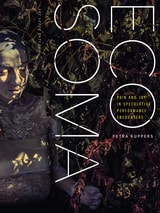
Eco Soma
Pain and Joy in Speculative Performance EncountersPetra Kuppers
University of Minnesota Press, 2022
Modeling a disability culture perspective on performance practice toward socially just futures
In Eco Soma, Petra Kuppers asks readers to be alert to their own embodied responses to art practice and to pay attention to themselves as active participants in a shared sociocultural world. Reading contemporary performance encounters and artful engagements, this book models a disability culture sensitivity to living in a shared world, oriented toward more socially just futures.
Eco soma methods mix and merge realities on the edges of lived experience and site-specific performance. Kuppers invites us to become moths, sprout gills, listen to our heart’s drum, and take starships into crip time. And fantasy is central to these engagements: feeling/sensing monsters, catastrophes, golden lines, heartbeats, injured sharks, dotted salamanders, kissing mammoths, and more. Kuppers illuminates ecopoetic disability culture perspectives, contending that disabled people and their co-conspirators make art to live in a changing world, in contact with feminist, queer, trans, racialized, and Indigenous art projects. By offering new ways to think, frame, and feel “environments,” Kuppers focuses on art-based methods of envisioning change and argues that disability can offer imaginative ways toward living well and with agency in change, unrest, and challenge.
Traditional somatics teach us how to fine-tune our introspective senses and to open up the world of our own bodies, while eco soma methods extend that attention toward the creative possibilities of the reach between self, others, and the land. Eco Soma proposes an art/life method of sensory tuning to the inside and the outside simultaneously, a method that allows for a wider opening toward ethical cohabitation with human and more-than-human others.
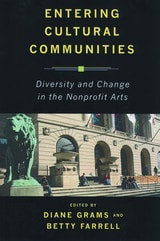
Entering Cultural Communities
Diversity and Change in the Nonprofit ArtsGrams, Diane
Rutgers University Press, 2008
The chapters in this book draw on interviews with leaders, staff, volunteers, and audience members from eighty-five nonprofit cultural organizations to explore how they are trying to increase participation and the extent to which they have been successful. The insiders' accounts point to the opportunities and challenges involved in such efforts, from the reinvention of programs and creation of new activities, to the addition of new departments and staff dynamics, to partnerships with new groups. The authors differentiate between "relational" and "transactional" practices, the former term describing efforts to build connections with local communities and the latter describing efforts to create new consumer markets for cultural products. In both cases, arts leaders report that, although positive results are difficult to measure conclusively, long-term efforts bring better outcomes than short-term activities.
The organizations discussed include large, medium, and small nonprofits located in urban, suburban, and rural areas—from large institutions such as the Smithsonian, the Walker Art Center, the Museum of Fine Arts Houston, and the San Francisco Symphony to many cultural organizations that are smaller, but often known nationally for their innovative work, such as AS220, The Loft Literary Center, Armory Center for the Arts, Appalshop, and the Western Folklife Center.