Results by title
167 books match the query 'Masculinity' and 6 start with e
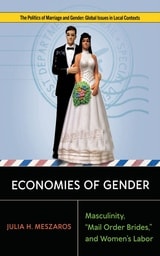
Economies of Gender
Masculinity, "Mail Order Brides," and Women’s LaborJulia H. Meszaros
Rutgers University Press, 2026
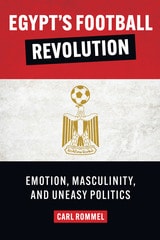
Egypt’s Football Revolution
Emotion, Masculinity, and Uneasy PoliticsBy Carl Rommel
University of Texas Press, 2021
Both a symbol of the Mubarak government’s power and a component in its construction of national identity, football served as fertile ground for Egyptians to confront the regime’s overthrow during the 2011 revolution. With the help of the state, appreciation for football in Egypt peaked in the late 2000s. Yet after Mubarak fell, fans questioned their previous support, calling for a reformed football for a new, postrevolutionary nation.
In Egypt’s Football Revolution, Carl Rommel examines the politics of football as a space for ordinary Egyptians and state forces to negotiate a masculine Egyptian chauvinism. Basing his discussion on several years of fieldwork with fans, players, journalists, and coaches, he investigates the increasing attention paid to football during the Mubarak era; its demise with the 2011 uprisings and 2012 Port Said massacre, which left seventy-two fans dead; and its recent rehabilitation. Cairo’s highly organized and dedicated Ultras fans became a key revolutionary force through their antiregime activism, challenging earlier styles of fandom and making visible entrenched ties between sport and politics. As the appeal of football burst, alternative conceptions of masculinity, emotion, and politics came to the fore to demand or prevent revolution and reform.
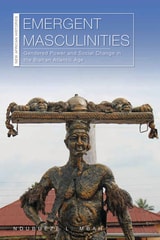
Emergent Masculinities
Gendered Power and Social Change in the Biafran Atlantic AgeNdubueze L. Mbah
Ohio University Press, 2019
In Emergent Masculinities, Ndubueze L. Mbah argues that the Bight of Biafra region’s Atlanticization—or the interaction between regional processes and Atlantic forces such as the slave trade, colonialism, and Christianization—between 1750 and 1920 transformed gender into the primary mode of social differentiation in the region. He incorporates over 250 oral narratives of men and women across a range of social roles and professions with material culture practices, performance traditions, slave ship data, colonial records, and more to reveal how Africans channeled the socioeconomic forces of the Atlantic world through their local ideologies and practices. The gendered struggles over the means of social reproduction conditioned the Bight of Biafra region’s participation in Atlantic systems of production and exchange, and defined the demography of the region’s forced diaspora. By looking at male and female constructions of masculinity and sexuality as major indexes of social change, Emergent Masculinities transforms our understanding of the role of gender in precolonial Africa and fills a major gap in our knowledge of a broader set of theoretical and comparative issues linked to the slave trade and the African diaspora.

Entering Transmasculinity
The Inevitability of Discoursematthew heinz
Intellect Books, 2016
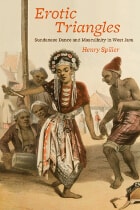
Erotic Triangles
Sundanese Dance and Masculinity in West JavaHenry Spiller
University of Chicago Press, 2010
In West Java, Indonesia, all it takes is a woman’s voice and a drum beat to make a man get up and dance. Every day, men there—be they students, pedicab drivers, civil servants, or businessmen—breach ordinary standards of decorum and succumb to the rhythm at village ceremonies, weddings, political rallies, and nightclubs. The music the men dance to varies from traditional gong ensembles to the contemporary pop known as dangdut, but they consistently dance with great enthusiasm. In Erotic Triangles, Henry Spiller draws on decades of ethnographic research to explore the reasons behind this phenomenon, arguing that Sundanese men use dance to explore and enact contradictions in their gender identities.
Framing the three crucial elements of Sundanese dance—the female entertainer, the drumming, and men’s sense of freedom—as a triangle, Spiller connects them to a range of other theoretical perspectives, drawing on thinkers from Eve Kosofsky Sedgwick, Lévi-Strauss, and Freud to Euclid. By granting men permission to literally perform their masculinity, Spiller ultimately concludes, dance provides a crucial space for both reinforcing and resisting orthodox gender ideologies.

Every Home a Fortress
Cold War Fatherhood and the Family Fallout ShelterThomas Bishop
University of Massachusetts Press, 2020