Results by title
914 books match the query 'Medieval' and 19 start with e

Eadfrith
Scribe of LindisfarneMichelle Treeve
Arizona Center for Medieval and Renaissance Studies, 2014
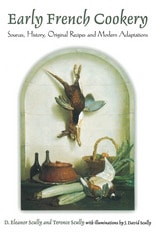
Early French Cookery
Sources, History, Original Recipes and Modern AdaptationsD. Eleanor Scully and Terence Scully
University of Michigan Press, 2002
Chapters include an overview of early French culinary traditions, foodstuffs that were used, and methods of preparation. Early French Cookery also discusses the equipment of the kitchens and dining rooms that were used, and characterizes those who prepared the food and those who consumed it.
The recipes are set out in a modern format, with quantities given in both metric and standard U.S. measurements. Recipes are grouped by category: appetizers, vegetables, fish dishes, desserts, and so forth.
Early French Cookery concludes with a fascinating look at a day in the life of a contemporary master chef at a duke's court. We watch Master Chiquart organize the purchase, storage, preparation, and serving of the food consumed by a duke and his dozens of family members, courtiers, staff and servants--and all done without benefit of grocery stores, refrigeration, labor-saving electric appliances, or running water.
Early French Cookery will be of interest to a wide variety of people, from those who like to hold unusual parties to those who are interested in the economics of the middle ages.
D. Eleanor Scully is an occasional lecturer at the Stratford Chef School and advisor to Wilfrid Laurier University on Medieval and Renaissance cooking and customs. Terence Scully is Professor of French Language and Literature, Wilfrid Laurier University, Waterloo, Ontario.
East Central and Eastern Europe in the Early Middle Ages
Florin Curta, Editor
University of Michigan Press, 2005
Ecstasies
Deciphering the Witches' SabbathCarlo Ginzburg
University of Chicago Press, 1991
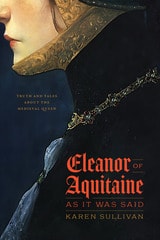
Eleanor of Aquitaine, as It Was Said
Truth and Tales about the Medieval QueenKaren Sullivan
University of Chicago Press, 2023
Much of what we know about Eleanor of Aquitaine, Queen of France and then Queen of England, we know from recorded rumor—gossip often qualified by the curious phrase “it was said,” or the love songs, ballads, and romances that gossip inspired. While we can mine these stories for evidence about the historical Eleanor, Karen Sullivan invites us to consider, instead, what even the most fantastical of these tales reveals about this queen and life as a twelfth-century noblewoman. She reads the Middle Ages, not to impose our current conceptual categories on its culture, but to expose the conceptual categories medieval women used to make sense of their lives. Along the way, Sullivan paints a fresh portrait of this singular medieval queen and the women who shared her world.
Eleanor of Aquitaine
Patron and PoliticianEdited by William W. Kibler
University of Texas Press, 1976
Eleanor of Aquitaine was the wife of two kings, Louis VII of France and Henry II Plantagenet of England, and the mother of two others, Richard the Lionhearted and John Lackland. In her eventful, often stormy life, she not only influenced the course of events in the twelfth century but also encouraged remarkable advances in the literary and fine arts. In this book, experts in five disciplines—history, art history, music, French and English literature—evaluate the influence of Eleanor and her court on history and the arts.
Elizabeth A. R. Brown views Eleanor as having played a significant role as parent and politician, but not as patron. Rebecca A. Baltzer takes a new look at the music of the period that was written by and for Eleanor, her court, and her family. Moshé Lazar reexamines her relationship to the courtly-love literature of the period. Eleanor S. Greenhill and Larry M. Ayres reassess her influence in the realm of art history. Rossell Hope Robbins traces the lines extending from the French courtly literature of Eleanor's period down into fourteenth-century Chaucerian England. The essays reflect divergent but generally complementary assessments of this remarkable woman's influence on her own era and on future times as well.
This volume is the result of a symposium held at the University of Texas in 1973.
Emblemata Hispanica
An Annotated Bibliography of Spanish Emblem Literature to the Year 1700Pedro F. Campa
Duke University Press, 1990
Covered in this bibliography are all emblem books published from the beginning to the end of the Spanish Golden Age, as well as a wide range of secondary sources on relevant subjects, among them mythography, paradoxography, numismatics, fetes, funerals, proverbs, apothegms, antiquarianism, collecting, and pertinent studies in art history and architecture. Providing call numbers for library locations, information on facsimile reprints, and microform editions, the work is extensively indexed—by date and place of publication, by printers and booksellers, by authors and artists, and by dedicatees, as well as by subject.
Emotion and Devotion
The Meaning of Mary in Medieval Religious CulturesMiri Rubin
Central European University Press, 2009
Emperor Charles IV and the Origins of the Great Schism, c. 1375–1378
Dušan Coufal
Karolinum Press, 2025
Reveals how Emperor Charles IV’s efforts to secure the imperial coronation of his son intersect with the early stages of the Great Western Schism.
Emperor Otto I the Great made history in the Holy Roman Empire with a significant dynastic achievement: in 967, he persuaded the pope to crown his son co-emperor in Rome. Two centuries later, another renowned emperor, Frederick Barbarossa, attempted a similar feat, negotiating with four different popes for the coronation of his descendant, but ultimately failed. A lesser-known parallel can be found in the life of Emperor Charles IV of the Luxembourg dynasty in the fourteenth century. After the Papal Curia returned to Rome from Avignon in early 1377, Charles made concerted efforts in Italy, France, and Germany to secure the imperial coronation of his son, Wenceslas. However, this bold ambition coincided with an unprecedented crisis in relations between the "French” cardinals and the newly elected Italian pope, Urban VI. Recognizing that the final chapter of Charles IV’s biography is deeply intertwined with the early history of the Great Western Schism offers a fresh perspective on a subject that has long captivated international scholarship.
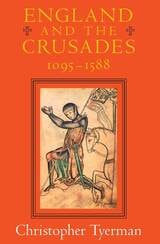
England and the Crusades, 1095-1588
Christopher Tyerman
University of Chicago Press, 1988
Drawing on a wide range of archival, chronicle, and literary evidence, Tyerman brings to life the royal personalities, foreign policy, political intrigue, taxation and fundraising, and the crusading ethos that gripped England for hundreds of years.
"An ambitious task to undertake. . . . Tyerman has done the job not only thoroughly but brilliantly. . . . A highly impressive study, deserving rich praise and wide readership."—Norman Housley, Times Literary Supplement
"Christopher Tyerman has written a wonderful book. . . . [He] manages to confront thorny issues in scholarship and to contribute new perspectives on them."—William Chester Jordan, American Historical Review
"Tyerman provides valuable insights into preaching, recruitment, and the funding and organisation of crusading expeditions. . . . Fascinating new perspectives on English history."—Edward Powell, Sunday Times
"Impressive. . . . Tyerman's research has yielded valuable evidence, and his admirably lucid argument sheds new light on a complex and bloody period in English history."—Virginia Quarterly Review
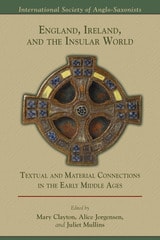
England, Ireland, and the Insular World
Textual and Material Connections in the Early Middle AgesMary Clayton
Arizona Center for Medieval and Renaissance Studies, 2017
ISAS Dublin 2013. England, Ireland and the Insular World: Textual and Material Connections in the Early Middle Ages is a collection of twelve essays related to the theme of the 2013 conference of the International Society of Anglo-Saxonists, ‘Insular Cultures’. Contributors cover a broad range of topics, from early medieval agriculture in Ireland and England, to sculpture, manuscript illumination and script, homilies, hagiography, aristocratic gift-giving, relics, calendars, Beowulf, and Anglo-Saxon perceptions of the Celtic peoples, considering connections, parallels and differences between Anglo-Saxon England and its insular neighbors. The volume will be of interest to all those working on Early Medieval history, literature, archaeology, liturgy, art, and manuscripts.
Enlistment
Lists in Medieval and Early Modern LiteratureEdited by Eva von Contzen and James Simpson
The Ohio State University Press, 2022
Contributors: Suzanne Conklin Akbari, Ingo Berensmeyer, Eva von Contzen, Alex Davis, Andrew James Johnston, Wolfram R. Keller, Alexis Kellner Becker, Kathryn Mogk Wagner, Martha Rust, James Simpson
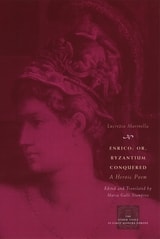
Enrico; or, Byzantium Conquered
A Heroic PoemLucrezia Marinella
University of Chicago Press, 2009
Lucrezia Marinella (1571–1653) is, by all accounts, a phenomenon in early modernity: a woman who wrote and published in many genres, whose fame shone brightly within and outside her native Venice, and whose voice is simultaneously original and reflective of her time and culture. In Enrico; or, Byzantium Conquered, one of the most ambitious and rewarding of her numerous narrative works, Marinella demonstrates her skill as an epic poet.
Now available for the first time in English translation, Enrico retells the story of the conquest of Byzantium in the Fourth Crusade (1202–04). Marinella intersperses historical events in her account of the invasion with numerous invented episodes, drawing on the rich imaginative legacy of the chivalric romance. Fast-moving, colorful, and narrated with the zest that characterizes Marinella’s other works, this poem is a great example of a woman engaging critically with a quintessentially masculine form and subject matter, writing in a genre in which the work of women poets was typically shunned.
Equal in Monastic Profession
Religious Women in Medieval FrancePenelope D. Johnson
University of Chicago Press, 1991
Johnson researched more than two dozen nunneries in northern France from the eleventh century through the thirteenth century, balancing a qualitative reading of medieval monastic documents with a quantitative analysis of a lengthy thirteenth-century visitation record which allows an important comparison of nuns and monks. A fascinating look at the world of medieval spirituality, this work enriches our understanding of women's role in premodern Europe and in church history.
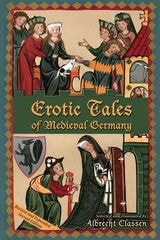
Erotic Tales of Medieval Germany
Translated by Albrecht Classen
Arizona Center for Medieval and Renaissance Studies, 2007
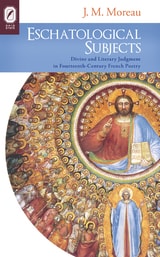
Eschatological Subjects
Divine and Literary Judgment in Fourteenth-Century French PoetryJ. M. Moreau
The Ohio State University Press, 2014
But Eschatological Subjects goes even further to demonstrate the largely unrecognized duality of this judge figure: not just God, the judge is also the imperious and imperfect human reader. The simultaneous divine and human judgments in (and of) French poetry reveal much about the ethical stakes of writing vernacular poetry in the later Middle Ages and, most importantly, about the relationships between authors and audiences.
Focusing on Guillaume de Deguileville, Guillaume de Machaut, and Jean Froissart (each of whom composed scenes in which they appear on trial before God), Moreau contributes important new insights on the complex “trial process” of later medieval literature, in which poetic authority and fame depended on the poet’s ability to defend himself before a fearful court of reader opinion.
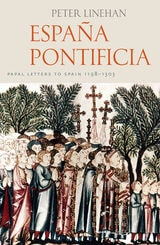
Espana Pontifica
Papal Letters to Spain 1198-1303Peter Linehan
Catholic University of America Press, 2022
Europe's Inner Demons
The Demonization of Christians in Medieval ChristendomNorman Cohn
University of Chicago Press, 2000
Explorations in Ottoman Prehistory
Rudi Paul Lindner
University of Michigan Press, 2007
The origins of the Ottomans, whose enterprise ruled much of the Near East for more than half a millennium, have long tantalized and eluded scholars, many of whom have thrown up their hands in exasperation. While the later fourteenth- and fifteenth-century history of the Ottomans has become better known, the earlier years have proved an alluring and recalcitrant puzzle. A reconsideration of the sources and a canvass of new ones has long been overdue. Rudi Paul Lindner’s Explorations in Ottoman Prehistory is the first book in over sixty years to reassess the overture to Ottoman history.
In addition to conducting a critical examination of the Ottoman chronicles and the Byzantine annals, Lindner develops hitherto unutilized geographic data and previously unknown numismatic evidence and also draws on travelers’ descriptions of the Anatolian landscape in an earlier epoch. By investigating who the Ottomans were, where they came from, and where they settled and why, as well as what sort of relationships they had with their neighbors in the late thirteenth and early fourteenth centuries, Lindner makes an engaging and lucid contribution to an otherwise very small store of knowledge of Ottoman history in the early stages of the empire.
Rudi Paul Lindner is Professor of History at the University of Michigan and author of Nomads and Ottomans in Medieval Anatolia,part of Indiana University’s Uralic and Altaic Series.