140 books match the query 'Mental Health' and 3 start with e

cover of Elizabeth Packard: A Noble Fight

Elizabeth Packard

A Noble Fight

Linda V. Carlisle

University of Illinois Press, 2010
Elizabeth Packard's story is one of courage and accomplishment in the face of injustice and heartbreak. In 1860, her husband, a strong-willed Calvinist minister, committed her to an Illinois insane asylum in an effort to protect their six children and his church from what he considered her heretical religious ideas. Upon her release three years later (as her husband sought to return her to an asylum), Packard obtained a jury trial and was declared sane. Before the trial ended, however, her husband sold their home and left for Massachusetts with their young children and her personal property. His actions were perfectly legal under Illinois and Massachusetts law; Packard had no legal recourse by which to recover her children and property. This experience in the legal system, along with her experience as an asylum patient, launched Packard into a career as an advocate for the civil rights of married women and the mentally ill. She wrote numerous books and lobbied legislatures literally from coast to coast advocating more stringent commitment laws, protections for the rights of asylum patients, and laws to give married women equal rights in matters of child custody, property, and earnings. Despite strong opposition from the psychiatric community, Packard's laws were passed in state after state, with lasting impact on commitment and care of the mentally ill in the United States. Packard's life demonstrates how dissonant streams of American social and intellectual history led to conflict between the freethinking Packard, her Calvinist husband, her asylum doctor, and America's fledgling psychiatric profession. It is this conflict--along with her personal battle to transcend the stigma of insanity and regain custody of her children--that makes Elizabeth Packard's story both forceful and compelling.
[more]
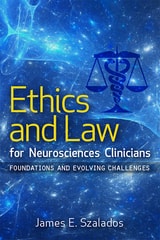
cover of Ethics and Law for Neurosciences Clinicians: Foundations and Evolving Challenges

Ethics and Law for Neurosciences Clinicians

Foundations and Evolving Challenges

James E. Szalados

Rutgers University Press, 2019
The brain represents the final frontier in medical sciences. Clinical neurosciences include the subspecialties of neurology, neurosurgery, neuro-imaging, cerebrovascular interventional specialties, neurocritical care, and the allied specialties in pharmacy and nursing. The first lens through which we see our patients is the clinical perspective; however, the complexity of neurosciences and the rapidity of the advances in these subspecialties require that clinicians not lose sight of the personhood of the patients, the professionalism required in the care of these complex patients, or the regulatory environment in which we practice. Science and technology are advancing more rapidly than regulations or the law can interpret and integrate them into a supportive or regulatory framework.  Thus, morality, ethics, and the law comprise the final lens through which we approach complex patient management issues, frame our communications with patients and families, and evaluate the risks and potential benefits of new technology. Ethics and Law for Neurosciences Clinicians is written for all clinicians in the neurosciences specialties to examine and re-examine the ethical and legal implications of advances in clinical neurosciences. 
[more]
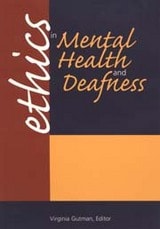
cover of Ethics in Mental Health and Deafness

Ethics in Mental Health and Deafness

Virginia Gutman

Gallaudet University Press, 2002

This volume explores ethical issues specific to working with deaf clients, particularly matters of confidentiality, managing multiple relationships, and the clinician’s competency to provide services, particularly in communicating with and understanding deaf people. Led by editor Virginia Gutman, a unique assembly of respected mental health professionals share their experiences and knowledge in working with deaf clients.

       Irene Leigh commences Ethics in Mental Health and Deafness with her varied experiences as a deaf mental health practitioner, and Gutman follows with insights on ethics in the “small world” of the Deaf community. William McCrone discusses the law and ethics, and Patrick Brice considers ethical issues regarding deaf children, adolescents, and their families. In contrast, Janet Pray addresses concerns about deaf and hard of hearing older clients.

       Minority deaf populations pose additional ethical aspects, which are detailed by Carolyn Corbett. Kathleen Peoples explores the challenges of training professionals in mental health services specifically for deaf clients. Closely related to these topics is the influence of interpreters with deaf clients in mental health settings, which Lynnette Taylor thoroughly treats. Ethics and Mental Health in Deafness also features a chapter on genetic counseling and testing for deafness by Kathleen Arnos. The final section, written by Robert Pollard, examines ethical conduct in research with deaf people, a fitting conclusion to a volume that will become required reading for all professionals and students in this discipline.

[more]