153 books match the query 'Metaphysics' and 4 start with e
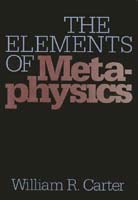
cover of Elements Of Metaphysics

Elements Of Metaphysics

William Carter

Temple University Press, 1989
"This is a work of the highest quality It is lucid, spells out each position with readily comprehensible arguments, and manages in the process to effortlessly integrate the most current views with classical, historical material.... It is without doubt the best general introduction to current treatments of metaphysics I have seen. A first-rate book." --Gerald Vision, Temple University This introduction to metaphysics provides a concise explanation and discussion of the branch of philosophy that concerns the nature of the world we inhabit. The approach is partly historical but focuses largely on recent arguments and lines of thought. William Carter addresses many issues, among them: the nature of mind, matter, ideas, and substance; the debate between those who believe human beings have free will and those who subscribe to determinism; fatalism, realism, and personal identity; and arguments for and against belief in the existence of God. He also explores the implications of such intellectual exercises for defining the boundaries of human knowledge and human responsibility. Woven into the authors discussion are the ideas of historical and contemporary figures who have made significant philosophical contributions in these areas. Carter tries to eliminate the intimidation that the term "metaphysics" can generate among students and general readers. Demonstrating how metaphysics overlaps extensively with nearly every branch of philosophical inquiry, he provides contemporary and often amusing examples to introduce the important topics of metaphysics and make current technical debates comprehensible for novices.
[more]
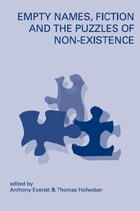
cover of Empty Names, Fiction and the Puzzles of Non-Existence

Empty Names, Fiction and the Puzzles of Non-Existence

Edited by Anthony Everett and Thomas Hofweber

CSLI, 2000
Philosophers and theorists have long been puzzled by humans' ability to talk about things that do not exist, or to talk about things that they think exist but, in fact, do not. Empty Names, Fiction, and the Puzzles of Non-Existence is a collection of 13 new works concerning the semantic and metaphysical issues arising from empty names, non-existence, and the nature of fiction. The contributors include some of the most important researchers working in these fields. Some of the papers develop and defend new positions on these matters, while others offer important new perspectives and criticisms of the existing approaches. The volume contains a comprehensive introductory essay by the editors, which provides a survey of the philosophical issues concerning empty names, the various responses to these issues, and the literature on the subject to date.
[more]
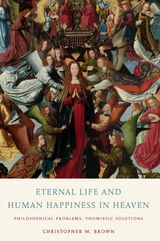
cover of Eternal Life and Human Happiness in Heaven: Philosophical Problems, Thomistic Solutions

Eternal Life and Human Happiness in Heaven

Philosophical Problems, Thomistic Solutions

Christopher M. Brown

Catholic University of America Press, 2021
Eternal Life and Human Happiness in Heaven treats four apparent problems concerning eternal life in order to clarify our thinking about perfect human happiness in heaven. The teachings of St. Thomas Aquinas provide the basis for solutions to these four problems about eternal life insofar as his teachings call into question common contemporary theological or philosophical presuppositions about God, human persons, and the nature of heaven itself. Indeed, these Thomistic solutions often require us to think very differently from our contemporaries. But thinking differently with St. Thomas is worth it: for the Thomistic solutions to these apparent problems are more satisfying, on both theological and philosophical grounds, than a number of contemporary theological and philosophical approaches. Christopher Brown deploys his argument in four sections. The first section lays out, in three chapters, four apparent problems concerning eternal life—Is heaven a mystical or social reality? Is heaven other-worldly or this-worldly? Is heaven static or dynamic? Won’t human persons eventually get bored in heaven? Brown then explains how and why some important contemporary Christian theologians and philosophers resolve these problems, and notes serious problems with each of these contemporary solutions. The second section explains, in five chapters, St. Thomas’ significant distinction between the essential reward of the saints in heaven and the accidental reward, and treats in detail his account of that in which the essential reward consists, namely, the beatific vision and the proper accidents of the vision (delight, joy, and charity). The third section treats, in five chapters, St. Thomas’ views on the multifaceted accidental reward in heaven, where the accidental reward includes, among other things, glorified human embodiment, participation in the communion of the saints, and the joy experienced by the saints in sensing God’s “new heavens and new earth.” Finally, section four argues, in four chapters, that St. Thomas’ views allow for powerful solutions to the four apparent problems about eternal life examined in the first section. These solutions are powerful because, not only are they consistent with authoritative, Catholic Christian Tradition, but they do not raise any of the significant theological or philosophical problems that attend the contemporary theological and philosophical solutions examined in the first section.
[more]
cover of Eternal Possibilities: A Neutral Ground for Meaning and Existence

Eternal Possibilities

A Neutral Ground for Meaning and Existence

David Weissman

Southern Illinois University Press, 1977

Eternal Possibilities: A Neutral Ground for Meaning and Existence builds on David Weissman's earlier Dispositional Properties and makes a signal contribution to the study of metaphysics. Here, broadening and enriching the point of view adopted in his earlier work, Weissman cites and criticizes a large number of theories proposed by authors from Plato to Wittgenstein and others exploring language theory and metaphysics.

Students of Wittgenstein will be especially interested in Mr. Weissman's critical examination of Wittgenstein's claim in the Tractatus that possibilities are the facts for logic. Weissman proposes a modal theory of properties: they exist in the first instance as possibilities. He argues that a sentence is meaningful if it signifies a property or complex of properties existing as a possible, and true if that possible is instantiated. The status of possibilities and their relation to actual states of affairs are considered in detail.

[more]