Results by title
479 books match the query 'Methodology' and 26 start with e

Early Modern Studies after the Digital Turn
Edited by Laura Estill, Diane K. Jakacki, Michael Ullyot
Iter Press, 2016
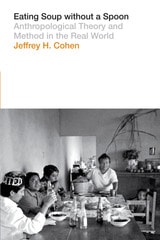
Eating Soup without a Spoon
Anthropological Theory and Method in the Real WorldBy Jeffrey H. Cohen
University of Texas Press, 2015
Significant scholarship exists on anthropological fieldwork and methodologies. Some anthropologists have also published memoirs of their research experiences. Renowned anthropologist Jeffrey Cohen’s Eating Soup without a Spoon is a first-of-its-kind hybrid of the two, expertly melding story with methodology to create a compelling narrative of fieldwork that is deeply grounded in anthropological theory.
Cohen’s first foray into fieldwork was in 1992, when he lived in Santa Anna del Valle in rural Oaxaca, Mexico. While recounting his experiences studying how rural folks adapted to far-reaching economic changes, Cohen is candid about the mistakes he made and the struggles in the village. From the pressures of gaining the trust of a population to the fear of making errors in data collection, Cohen explores the intellectual processes behind ethnographic research. He offers tips for collecting data, avoiding pitfalls, and embracing the chaos and shocks that come with working in an unfamiliar environment. Cohen’s own photographs enrich his vivid portrayals of daily life.
In this groundbreaking work, Cohen discusses the adventure, wonder, community, and friendships he encountered during his first year of work, but, first and foremost, he writes in service to the field as a place to do research: to test ideas, develop theories, and model how humans cope and react to the world.
Effective Social Science
Eight Cases in Economics, Political Science, and SociologyBernard Barber
Russell Sage Foundation, 1987
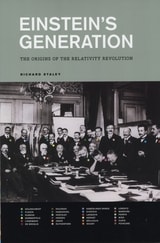
Einstein's Generation
The Origins of the Relativity RevolutionRichard Staley
University of Chicago Press, 2009
Why do we celebrate Einstein’s era above all other epochs in the history of physics? Much of the history of physics at the beginning of the twentieth century has been written with a sharp focus on a few key figures and a handful of notable events. Einstein’s Generation offers a distinctive new approach to the origins of modern physics by exploring both the material culture that stimulated relativity and the reaction of Einstein’s colleagues to his pioneering work.
Richard Staley weaves together the diverse strands of experimental and theoretical physics, commercial instrument making, and the sociology of physics around 1900 to present the collective efforts of a group whose work helped set the stage for Einstein’s revolutionary theories and the transition from classical to modern physics that followed. Collecting papers, talks, catalogues, conferences, and correspondence, Staley juxtaposes scientists’ views of relativity at the time to modern accounts of its history. Einstein’s Generation tells the story of a group of individuals which produced some of the most significant advances of the twentieth century; and challenges our celebration of Einstein’s era above all others.
Electromyography for Experimentalists
Gerald E. Loeb and Carl Gans
University of Chicago Press, 1986

Embedded Librarians
Moving Beyond One-Shot InstructionCassandra Kvenild
Assoc of College & Research Libraries, 2011
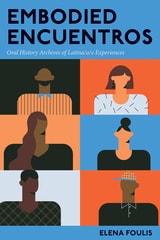
Embodied Encuentros
Oral History Archives of Latina/o/e ExperiencesElena Foulis
The Ohio State University Press, 2026
In Embodied Encuentros, Elena Foulis offers a practical guide for completing ethical fieldwork in Latina/o/e communities, emphasizing equitable and culturally sustaining practices for gathering oral histories. In her critical decolonial model, Foulis centers the agency of the people within these communities while considering the diversity and complexity of their experiences. In doing so, she advocates for the importance of building oral history archives that challenge our understandings of Latina/o/e peoples.
Foulis provides a conceptual framework for building on community knowledge that considers language, cultural practices, gender, and race. She suggests ways to involve students in ethical research; collect evolving oral histories; employ a language justice approach that acknowledges linguistic oppression, translanguaging, and bilingualism as essential aspects of this community; and consider the importance of digital archives for the creation of multimedia projects that foster community pláticas. Grounded in both theoretical approaches and a feminist ethics praxis, Embodied Encuentros ultimately outlines an important model for doing collaborative, ethical research—not only within Latina/o/e communities but within other minoritized communities as well.
Emile Durkheim on Institutional Analysis
Emile Durkheim
University of Chicago Press, 1978
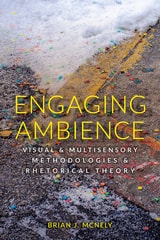
Engaging Ambience
Visual and Multisensory Methodologies and Rhetorical TheoryBrian McNely
Utah State University Press, 2024
By articulating theoretically sound methodologies and methods for the empirical study of rhetoric conceived as originary, immanent, and enveloping, Brian McNely contributes a methodological perspective that furthers new materialist theories of rhetoric. McNely demonstrates how scholars’ emergent theories of rhetoric call for new methodologies that can extend their reach, and in the process, he proposes a new conception of visual rhetoric. Engaging Ambience delineates methodologies and methods that help researchers in rhetoric and writing studies discover the ambient environments that condition and support everyday communication in all its forms.
Engaging Ambiencedetails and demonstrates visual and multisensory methodologies and methods for exploring the wondrous complexity of everyday communication. It will appeal to scholars and students of rhetorical theory, visual and multisensory rhetorics, and composition and writing studies.
Engaging the Intersection of Housing and Health
Volume ThreeEdited by Mina Silberberg
University of Minnesota Press, 2021
Researchers often hope that their work will inform social change. The questions that motivate them to pursue research careers in the first place often stem from observations about gaps between the world as we wish it to be and the world as it is, accompanied by a deep curiosity about how it might be made different. Researchers view their profession as providing important information about what is, what could be, and how to get there. However, if research is to inform social change, we must first change the way in which research is done.
Engaging the Intersection of Housing and Health offers case studies of research that is interdisciplinary, stakeholder-engaged and intentionally designed for “translation” into practice. There are numerous ways in which housing and health are intertwined. This intertwining—which is the focus of this volume—is lived daily by the children whose asthma is exacerbated by mold in their homes, the adults whose mental illness increases their risk for homelessness and whose homelessness worsens their mental and physical health, the seniors whose home environment enhances their risk of falls, and the families who must choose between paying for housing and paying for healthcare.

English in Today's Research World
A Writing GuideJohn M. Swales and Christine B. Feak
University of Michigan Press, 2000
In addition to instruction on writing for publication, English in Today's Research World provides needed advice on applications, recommendations, and requests--types of communications that are particularly vulnerable to influences from national cultural expectations and conventions and that, therefore, place the NNS writer at increased disadvantage.
The text is both a reference manual and a course book, so that researchers can continue to use the book after they have completed their formal education. New ESL/EFL teachers can use English in Today's Research World as a reference book for themselves or as a teaching aid in the classroom.
Essential Tensions in Archaeological Method and Theory
Todd L. Vanpool
University of Utah Press, 2003
In that spirit of plurality, contributors to this volume identify an important theoretical or methodological problem and present an argument regarding its solution. They also provide a critical evaluation of the current state of archaeological method and theory, illustrating that such recurrent issues as the role of agency and the importance of social considerations in the formation of archaeological research dominate current theoretical development.
By presenting both the range of important questions and a variety of answers, this volume contributes to the 'essential tension' that will further the growth of archaeological theory.
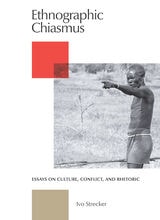
Ethnographic Chiasmus
Essays on Culture, Conflict and RhetoricIvo Strecker
Michigan State University Press, 2011
Ethnography and Human Development
Context and Meaning in Social InquiryEdited by Richard Jessor, Anne Colby, and Richard A. Shweder
University of Chicago Press, 1996
Part 1, informed by a post-positivist philosophy of science, argues for the validity of ethnographic knowledge. Part 2 examines a range of qualitative methods, from participant observation to the hermeneutic elaboration of texts. In Part 3, ethnographic methods are applied to issues of human development across the life span and to social problems including poverty, racial and ethnic marginality, and crime.
Restoring ethnographic methods to a central place in social inquiry, these twenty-two lively essays will interest everyone concerned with the epistemological problems of context, meaning, and subjectivity in the behavioral sciences.
Ethnological Imagination
A Cross-Cultural Critique Of ModernityFuyuki Kurasawa
University of Minnesota Press, 2004
A significant intervention in contemporary debates about cross-cultural understanding
Fuyuki Kurasawa unearths what he terms “the ethnological imagination,” a substantial countercurrent of thought that interprets and contests Western modernity’s existing social order through comparison and contrast to a non-Western other. Accordingly, Kurasawa traces and critiques, through this prism of cultural alterity, the writings of some of the key architects of this way of thinking: Jean-Jacques Rousseau, Karl Marx, Max Weber, Émile Durkheim, Claude Lévi-Strauss, and Michel Foucault.
In the work of these thinkers, Kurasawa finds little justification for two of the most prevalent claims about social theory: the wholesale “postmodern” dismissal of the social-theoretical enterprise because of its supposedly intractable ethnocentrism and imperialism, or, on the other hand, the traditionalist and historicist revival of a canon stripped of its intercultural foundations. Rather, Kurasawa’s book defends a cultural perspective that eschews both the false universalism of “end of history” scenarios and the radical particularism embodied in the vision of “the clash of civilizations.” It contends that the ethnological imagination can invigorate critical social theory by informing its response to an increasingly multicultural world—a response that calls for a reconsideration of the identity and boundaries of the West as well of modernity itself.
Evaluating Methodology in International Studies
Frank P. Harvey and Michael Brecher, Editors
University of Michigan Press, 2009
Evaluating Methodology in International Studies offers a unique collection of original essays by world-renowned political scientists. The essays address the state of the discipline in regard to the methodology of researching global politics, focusing in particular on formal modeling, quantitative methods, and qualitative approaches in International Studies.
The authors reflect on the strengths and weaknesses of current methodology and suggest ways to advance theory and research in International Studies. This volume is essential reading for methods courses and will be of interest to scholars and students alike.
See table of contents and excerpts.
Frank P. Harvey is Professor of Political Science and Director of the Centre for Foreign Policy Studies at Dalhousie University.
Michael Brecher is the R.B. Angus Professor of Political Science at McGill University and past president of the International Studies Association.
Millennial Reflections on International Studies
This volume is part of the Millennial Reflections on International Studies project in which forty-five prominent scholars engage in self-critical, state-of-the-art reflection on international studies to stimulate debates about successes and failures and to address the larger questions of progress in the discipline.
Other paperbacks from this project:
Realism and Institutionalism in International Studies
Conflict, Security, Foreign Policy, and International Political Economy: Past Paths and Future Directions in International Studies
Critical Perspectives in International Studies
The full collection of essays is available in the handbook Millennial Reflections on International Studies.
Evaluative Research
Principles and Practice in Public Service and Social Action ProgrEdward Suchman
Russell Sage Foundation, 1968
Evidence
Howard S. Becker
University of Chicago Press, 2017
Becker has for seventy years been mulling over the problem of evidence. He argues that social scientists don’t take questions about the usefulness of their data as evidence for their ideas seriously enough. For example, researchers have long used the occupation of a person’s father as evidence of the family’s social class, but studies have shown this to be a flawed measure—for one thing, a lot of people answer that question too vaguely to make the reasoning plausible. The book is filled with examples like this, and Becker uses them to expose a series of errors, suggesting ways to avoid them, or even to turn them into research topics in their own right. He argues strongly that because no data-gathering method produces totally reliable information, a big part of the research job consists of getting rid of error. Readers will find Becker’s newest guidebook a valuable tool, useful for social scientists of every variety.
Evolutionary Archaeology
Methodological IssuesPatrice A. Teltser
University of Arizona Press, 1994
Evolutionary archaeologists argue that Darwinian natural selection acts on human behavior, resulting in the persistence of alternative human behaviors and the material products of those behaviors. The contributors address the methodological requirements of evolutionary theory as it may apply to the nature of archaeological data. Several contributors evaluate the methodological implications of basic evolutionary principles, including the structure of explanations, the units of evolution and analysis, and the measurement of information transmission. Others explore the role of specific analytic approaches such as seriation, raw material sourcing, and comparative and engineering analyses. Still others confront the issue of reformulating archaeological problems from the point of view of evolutionary theory.
By focusing on the methodological requirements of evolutionary theory, these essays go far in meeting the challenge of building new archaeological method. The work contributes to a better understanding of cultural evolution and builds toward a new, logical framework to explain variation in the archaeological record.
Expanding Hermeneutics
Visualism in ScienceDon Ihde
Northwestern University Press, 1999
Experimental Economics
Theory and PracticeJohn A. List
University of Chicago Press, 2025
A landmark practical guide from the twenty-first-century pioneer in economics.
Experimental economics—generating and interpreting data to understand human decisions, motivations, and outcomes—is today all but synonymous with economics as a discipline. The advantages of the experimental method for understanding causal effects make it the gold standard for an increasingly empirical field. But until now the discipline has lacked comprehensive and definitive guidance for how to optimally design and conduct economic experiments.
For more than 30 years, John A. List has been at the forefront of using experiments to advance economic knowledge, expanding the domain of economic experiments from the lab to the real-world. Experimental Economics is his A-to-Z compendium for students and researchers on the ground floor of designing, conducting, analyzing, and interpreting data that they generate. List seeks not only to guide readers on how to develop and implement their experimental projects—everything from design to administrative and ethical considerations—but to help them avoid all the mistakes he’s made in his career, too. Experimental Economics codifies its author’s refined approach to the design, execution, and analysis of laboratory and field experiments. It is a milestone work poised to become the definitive reference for the next century of economics (and economists).
Experimental Foundations of Political Science
Donald R. Kinder and Thomas R. Palfrey, Editors
University of Michigan Press, 1993
Experimenting with Ethnography
A Companion to AnalysisAndrea Ballestero and Brit Ross Winthereik, editors
Duke University Press, 2021
Contributors. Patricia Alvarez Astacio, Andrea Ballestero, Ivan da Costa Marques, Steffen Dalsgaard, Endre Dányi, Marisol de la Cadena, Marianne de Laet, Carolina Domínguez Guzmán, Rachel Douglas-Jones, Clément Dréano, Joseph Dumit, Melanie Ford Lemus, Elaine Gan, Oliver Human, Alberto Corsín Jiménez, Graham M. Jones, Trine Mygind Korsby, Justine Laurent, James Maguire, George E. Marcus, Annemarie Mol, Sarah Pink, Els Roding, Markus Rudolfi, Ulrike Scholtes, Anthony Stavrianakis, Lucy Suchman, Katie Ulrich, Helen Verran, Else Vogel, Antonia Walford, Karen Waltorp, Laura Watts, Brit Ross Winthereik
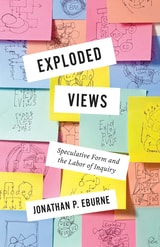
Exploded Views
Speculative Form and the Labor of InquiryJonathan Eburne
University of Minnesota Press, 2025
Idiosyncratic essays use their “exploded” forms to examine how inquiry functions
Insect galls, time, memory systems, orgone energy, and a bookstore that doesn’t yet exist. These disparate topics have persistently fascinated scholar Jonathan P. Eburne, yet each defied his previous efforts at classification through scholarly writing, resulting in five essays suspended in process. In Exploded Views, Eburne returns to these essays with the metaphorical tool of the exploded-view diagram, expanding them into entirely new, hybrid forms that unpack their inspirations and trace the wayward paths they followed.
An experiment into the nature of inquiry that spelunks, rather than shies from, the rabbit holes of scholarly curiosity, each essay gives way to sidelights and dilations to reveal the palimpsest of knowledge hiding beneath the surface of the academic form. A book about process—the process of turning ideas into things, and vice versa, as well as the particular tendency for research, scholarly inquiry, and critical writing to come apart and go awry—Exploded Views is a refreshing exploration of how the tools of creative critical thinking work at their most basic level.
Reflecting on the methods of scholarly knowledge production and the contextual factors that shape new ideas, Eburne boldly replaces the seamlessness of the finished manuscript with the friction and even messiness of the incomplete, inviting readers to think in new and invigorating ways.
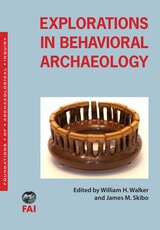
Explorations in Behavioral Archaeology
William H. Walker and James M. Skibo
University of Utah Press, 2015
Behavioral archaeology, defined as the study of people-object interactions in all times and places, emerged in the 1970s, in large part because of the innovative work of Michael Schiffer and colleagues. This volume provides an overview of how behavioral archaeology has evolved and how it has affected the field of archaeology at large.
The contributors to this volume are Schiffer’s former students, from his first doctoral student to his most recent. This generational span has allowed for chapters that reflect Schiffer’s research from the 1970s to 2012. They are iconoclastic and creative and approach behavioral archaeology from varied perspectives, including archaeological inference and chronology, site formation processes, prehistoric cultures and migration, modern material culture variability, the study of technology, object agency, and art and cultural resources. Broader questions addressed include models of inference and definitions of behavior, study of technology and the causal performances of artifacts, and the implications of artifact causality in human communication and the flow of behavioral history.
Exploring the Scientific Method
Cases and QuestionsEdited by Steven Gimbel
University of Chicago Press, 2011
From their grade school classrooms forward, students of science are encouraged to memorize and adhere to the “scientific method”—a model of inquiry consisting of five to seven neatly laid-out steps, often in the form of a flowchart. But walk into the office of a theoretical physicist or the laboratory of a biochemist and ask “Which step are you on?” and you will likely receive a blank stare. This is not how science works. But science does work, and here award-winning teacher and scholar Steven Gimbel provides students the tools to answer for themselves this question: What actually is the scientific method?
Exploring the Scientific Method pairs classic and contemporary readings in the philosophy of science with milestones in scientific discovery to illustrate the foundational issues underlying scientific methodology. Students are asked to select one of nine possible fields—astronomy, physics, chemistry, genetics, evolutionary biology, psychology, sociology, economics, or geology—and through carefully crafted case studies trace its historical progression, all while evaluating whether scientific practice in each case reflects the methodological claims of the philosophers. This approach allows students to see the philosophy of science in action and to determine for themselves what scientists do and how they ought to do it.
Exploring the Scientific Method will be a welcome resource to introductory science courses and all courses in the history and philosophy of science.