Results by title
89 books match the query 'Mind & Body' and 2 start with e
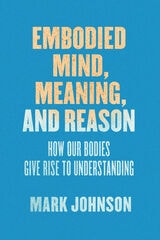
Embodied Mind, Meaning, and Reason
How Our Bodies Give Rise to UnderstandingMark Johnson
University of Chicago Press, 2017
Mark Johnson is one of the great thinkers of our time on how the body shapes the mind. This book brings together a selection of essays from the past two decades that build a powerful argument that any scientifically and philosophically satisfactory view of mind and thought must ultimately explain how bodily perception and action give rise to cognition, meaning, language, action, and values.
A brief account of Johnson’s own intellectual journey, through which we track some of the most important discoveries in the field over the past forty years, sets the stage. Subsequent chapters set out Johnson’s important role in embodied cognition theory, including his cofounding (with George Lakoff) of conceptual metaphor theory and, later, their theory of bodily structures and processes that underlie all meaning, conceptualization, and reasoning. A detailed account of how meaning arises from our physical engagement with our environments provides the basis for a nondualistic, nonreductive view of mind that he sees as most congruous with the latest cognitive science. A concluding section explores the implications of our embodiment for our understanding of knowledge, reason, and truth. The resulting book will be essential for all philosophers dealing with mind, thought, and language.
A brief account of Johnson’s own intellectual journey, through which we track some of the most important discoveries in the field over the past forty years, sets the stage. Subsequent chapters set out Johnson’s important role in embodied cognition theory, including his cofounding (with George Lakoff) of conceptual metaphor theory and, later, their theory of bodily structures and processes that underlie all meaning, conceptualization, and reasoning. A detailed account of how meaning arises from our physical engagement with our environments provides the basis for a nondualistic, nonreductive view of mind that he sees as most congruous with the latest cognitive science. A concluding section explores the implications of our embodiment for our understanding of knowledge, reason, and truth. The resulting book will be essential for all philosophers dealing with mind, thought, and language.
[more]

Externalism and Self-Knowledge
Edited by Peter Ludlow and Norah Martin
CSLI, 1998
One of the most provocative projects in recent analytic philosophy has been the development of the doctrine of externalism, or, as it is often called, anti-individualism. While there is no agreement as to whether externalism is true or not, a number of recent investigations have begun to explore the question of what follows if it is true. One of the most interesting of these investigations thus far has been the question of whether externalism has consequences for the doctrine that we have authoritative, a priori self-knowledge of our mental states.
The selected works presented in this volume, some previously published, some new, are representative of this debate and open up new questions and issues for philosophical investigation, including the connection between externalism, self-knowledge, epistemic warrant, and memory.
The selected works presented in this volume, some previously published, some new, are representative of this debate and open up new questions and issues for philosophical investigation, including the connection between externalism, self-knowledge, epistemic warrant, and memory.
[more]