Results by title
187 books match the query 'Minorities' and 6 start with e
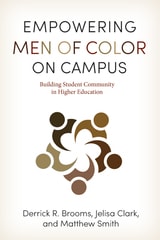
Empowering Men of Color on Campus
Building Student Community in Higher EducationBrooms, Derrick R.
Rutgers University Press, 2018
Encounters with American Ethnic Cultures
Edited by Philip L. Kilbride, Jane C. Goodale, and Elizabeth R. Ameisen
University of Alabama Press, 1990
Encounters with American Ethnic Cultures represents a cultural approach to understanding ethnic diversity in the Philadelphia metropolitan area.
Thirteen chapters, each using an ethnographic field methodology, explore such ethnic experience as the "invisible" (WASPS and African-Americans); "self-chosen" (Welsh-American, Irish-American, and Ukrainian-American); "gender-related" (the Lubovitcher); "religious" (Jewish, Native American, Greek-American, and Puerto Rican); and "dislocated" (Cambodians and the homeless). Ethnographic fieldwork focuses an insider's view on the meaning of ethnic experience in the lives of participants in the research. This volume examines the role and function of various ethnic endeavors in the preservation and maintenance of ethnic identity by contemporary Americans.
This five part volume includes:
Introduction: Ethnic Culture Analysis—A Course of Study, Jane C. Goodale and Philip L. Kilbride
Methodology, Elizabeth R. Ameisen and Carolyn G. Friedman
Part I. Black and WASP in American Cultural Experience: The Invisible Ones
Exclusivity in an Ethnic Elite: Racial Prejudice as Boundary Maintenance, Elizabeth R. Ameisen
Africans and African-Americans: An Ethnohistorical View and Symbolic Analysis of Food Habits, Carolyn G. Friedman
Part II. Self-Chosen Ethnicity
Unique Americans: The Welsh-American Ethnic Group in the Philadelphia Area, Lorraine Murray
Irish-Americans and Irish Dance: Self-Chosen Ethnicity, Erin McGauley Hebard
Art and Identity: Ukrainian-American Ethnicity, Jennifer Krier
Part III. Interpretations of Gender and Ethnicity: The Lubavitcher Experience
Equality Does Not Mean Sameness: The Role of Women within the Lubavitcher Marriage, Philip Baldinger
Strategies for Strength: Women and Personal Empowerment in Lubavitcher Hasidism, Gita Srinivasan
Part IV. Ethnicity and Religion: The Persistence of Collective Representations
Our Lives Revolve around the Holidays: Holidays in the Transmission of Jewish Ethnicity, Anna Dahlem
Fayetteville or Raleigh? An Analysis of an American Indian Baptist Church, Beth Batten
Issues in Greek Orthodoxy That Define and Maintain Greek-American Ethnicity, Karen L. Belsley
Es como si fuera la casa de uno: The Role of the Community Church in Maintaining Puerto Rican Ethnicity, Monica Schoch-Spana
Part V. Dislocation and Ethnicity
Cambodian Marriage: Marriage and How it is Changing among Cambodian Refugees in Philadelphia, Rebecca C. Popenoe
Ethnic Expression in a Jewish Street Person, Andrew Millstein
Conclusion, Philip L. Kilbride and Jane C. Goodale
Ethnic Federalism
The Ethiopian Experience in Comparative PerspectiveDavid Turton
Ohio University Press, 2006
Since 1991, Ethiopia has gone further than any other country in using ethnicity as the fundamental organizing principle of a federal system of government. And yet this pioneering experiment in “ethnic federalism” has been largely ignored in the growing literature on democratization and ethnicity in Africa and on the accommodation of ethnic diversity in democratic states. Ethnic Federalism brings a much-needed comparative dimension to the discussion of this experiment in Ethiopia.
Ethnic Federalism closely examines aspects of the Ethiopean case and asks why the use of territorial decentralism to accommodate ethnic differences has been generally unpopular in Africa, while it is growing in popularity in the West.
The book includes case studies of Nigerian and Indian federalism and suggests how Ethiopia might learn from both the failures and successes of these older federations. In the light of these broader issues and cases, it identifies the main challenges facing Ethiopia in the next few years, as it struggles to bring political practice into line with constitutional theory and thereby achieve a genuinely federal division of powers.
Ethnicity and Inequality in Hawai'i
Jonathan Y. Okamura
Temple University Press, 2008
Challenging the dominant view of Hawai’i as a “melting pot paradise”—a place of ethnic tolerance and equality—Jonathan Okamura examines how ethnic inequality is structured and maintained in island society. He finds that ethnicity, not race or class, signifies difference for Hawaii’s people and therefore structures their social relations. In Hawai’i, residents attribute greater social significance to the presumed cultural differences between ethnicities than to more obvious physical differences, such as skin color.
According to Okamura, ethnicity regulates disparities in access to resources, rewards, and privileges among ethnic groups, as he demonstrates in his analysis of socioeconomic and educational inequalities in the state. He shows that socially and economically dominant ethnic groups—Chinese Americans, Japanese Americans, and Whites—have stigmatized and subjugated the islands’ other ethnic groups—especially Native Hawaiians, Filipino Americans, and Samoans. He demonstrates how ethnic stereotypes have been deployed against ethnic minorities and how these groups have contested their subordinate political and economic status by articulating new identities for themselves.
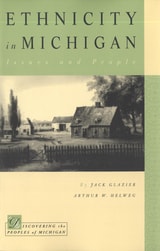
Ethnicity in Michigan
Issues and PeopleJack Glazier
Michigan State University Press, 2001
As the introductory volume in the series Discovering the Peoples of Michigan, Ethnicity in Michigan outlines the processes of migration, as well as the rich relationship between ethnic groups and the trajectories of historical and social change in Michigan. On both state and local levels, issues of identity, race, politics, and shared history inform community development. Jack Glazier and Arthur Helweg provide a substantive general and theoretical overview of the various ethnic groups in Michigan, and of the ways in which immigrants both respond to and shape Michigan's particular regional character.
Exploring Ethnic Diversity in Burma
Edited by Mikael Gravers
National University of Singapore Press, 2007