Results by title
210 books match the query 'Missouri' and 2 start with e

Earthquake Fears, Predictions, and Preparations in Mid-America
John E. Farley
Southern Illinois University Press, 1998
The New Madrid Seismic Zone (NMSZ) generated the strongest earthquakes ever observed in the lower forty-eight states in 1811 and 1812. And the region is overdue for another damaging quake. When self-proclaimed climatologist lben Browning predicted that a major earthquake would shatter the Heartland on 2 or 3 December 1990, many living within reach of the New Madrid fault zone reacted with varying combinations of preparation and panic.
John Farley’s study reports the results of four surveys conducted in the NMSZ both before and after the quake prediction. Thus, Farley notes the level of awareness and preparation at the height of the Browning-induced scare and shows to what extent earthquake awareness and preparedness were sustained in this region after the most widely publicized prediction in recent history proved baseless. All four surveys offer important insights into what people believe about earthquake risk in the NMSZ, what they know about earthquakes, what specific actions they have—and have not—taken in preparation for earthquakes, and what they think a severe quake would do to their neighborhoods.
Farley is the first researcher to study the response to an earthquake prediction while the prediction remained in effect and to continue the inquiry after the date covered by the prediction had passed. He is also the first researcher to look at earthquake awareness and preparedness in the NMSZ over an extended period of time.
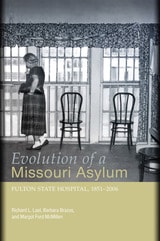
Evolution of a Missouri Asylum
Fulton State Hospital, 1851-2006Richard L. Lael, Barbara Brazos, and Margot Ford McMillen
University of Missouri Press, 2007
This institutional history of the hospital traces the debates surrounding its creation (as the State Lunatic Asylum) in a time when mental illness was barely understood. Although the Fulton hospital was initially conceived as a treatment facility, it quickly transformed into a primarily custodial institution. It existed as a self-sufficient establishment until the mid-twentieth century, dependent on patient labor and even producing its own food. But for the most socially disadvantaged and for the severely delusional, life at Fulton was anything but therapeutic.
The book describes not only the lofty goals of professionals dedicated to treating the mentally ill but also an institution once clouded by overcrowding, financial mismanagement, political cronyism, and wrongful confinement. It considers segregation within the hospital, where the first black doctor was hired in 1960 and where racism nevertheless continued to flourish, and it describes how, even after the 1921 Eleemosynary Act, the patronage system continued to plague Fulton for two more decades.
The authors reveal changing attitudes toward new treatments in the mid-twentieth century as psychotherapy and drugs became common, and decisions at Fulton regarding patient care are described within the context of progress in Europe and the eastern United States. The book addresses the complexities facing the physician-superintendents who supervised both medical therapies and administrative matters, depicting ongoing tension between hospital finances and state support and showing the difficulties state institutions faced in a “low tax/low public service” environment.
As Fulton State Hospital enters the twenty-first century, clients have become active in the development of institutional policies—a far cry from the warehousing of patients a hundred years ago. In tracing these seismic shifts in mental health care, this book offers an eye-opening exploration of how one state has sought to care for its citizens.