Results by title
193 books match the query 'Modernism (Literature)' and 7 start with e
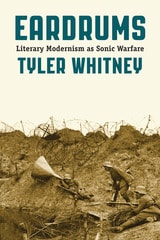
Eardrums
Literary Modernism as Sonic WarfareTyler Whitney
Northwestern University Press, 2019
Eardrums is the first book-length study to explore the relationship between acoustical modernity and German modernism, charting a literary and cultural history written in and around the eardrum. The result is not only a new way of understanding the sonic impulses behind key literary texts from the period. It also outlines an entirely new approach to the study of literature as as the interaction of text and sonic practice, voice and noise, which will be of interest to scholars across literary studies, media theory, sound studies, and the history of science.

Echo Chambers
Figuring Voice In NarrativePatrick O'Donnell
University of Iowa Press, 1992
Echo Chambers provides an illuminating discussion of the representation of “voice” in novels by Dickens, Joyce, Faulkner, Lowry, and Gaddis. Focusing on the paradoxes of “voice” as an indication of how different authors understand the contradictions of “identity,” O'Donnell charts the recent history of subjectivity as reflected in the development of modern fiction. With strong theoretical underpinning—O'Donnell skillfully utilizes the theories formulated by Bakhtin, Derrida, Bersani, De Man, Deleuze, and Guattari, among others, and the semiotics of voice put forth by Julia Kristeva—Echo Chambers shows how identity is inherently contradictory, conflicted, and multiple.
This insightful volume compellingly demonstrates that “voice” is a revealing (because contradictory and heterogeneous) site where language, the body, culture, and subjectivity meet. Echo Chambers makes an important contribution to the study of modern literature, the semiotics of identity, and cultural poetics as they are informed by the projections of voice in modern narrativ
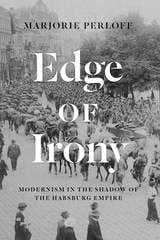
Edge of Irony
Modernism in the Shadow of the Habsburg EmpireMarjorie Perloff
University of Chicago Press, 2016
Perloff explores works ranging from Karl Kraus’s drama The Last Days of Mankind and Elias Canetti’s memoir The Tongue Set Free to Ludwig Wittgenstein’s notebooks and Paul Celan’s lyric poetry. Throughout, she shows that Austro-Modernist literature is characterized less by the formal and technical inventions of a modernism familiar to us in the work of Joyce and Pound, Dada and Futurism, than by a radical irony beneath a seemingly conventional surface, an acute sense of exile, and a sensibility more erotic and quixotic than that of its German contemporaries. Skeptical and disillusioned, Austro-Modernism prefers to ask questions rather than formulate answers.
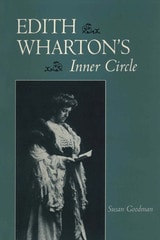
Edith Wharton's Inner Circle
By Susan Goodman
University of Texas Press, 1994
When Edith Wharton became friends with Henry James, she joined a group of men who became her "inner circle." This group included both well-known figures, such as James, Percy Lubbock, and Bernard Berenson, and several now forgotten, including John Hugh Smith, Walter Berry, Gaillard Lapsley, Robert Norton, and Howard Sturgis.
Drawing on unpublished archival material by and about members of the circle, Susan Goodman here presents an intimate view of this American expatriate community, as well as the larger transatlantic culture it mirrored. She explores how the group, which began forming around 1904 and lasted until Wharton's death in 1937, defined itself against the society its founders had left in the United States, while simultaneously criticizing and accommodating the one it found in Europe. Tracing Wharton's individual relationships with these men and their relationships with one another, she examines literary kinships and movements in the biographical and feminist context of gender, exile, and aesthetics. She also relates the group to other literary circles, such as the Bloomsbury group and Gertrude Stein's salon.
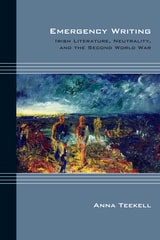
Emergency Writing
Irish Literature, Neutrality, and the Second World WarAnna Teekell
Northwestern University Press, 2018
Taking seriously Ireland’s euphemism for World War II, “the Emergency,” Anna Teekell’s Emergency Writing asks both what happens to literature written during a state of emergency and what it means for writing to be a response to an emergency.
Anchored in close textual analysis of works by Samuel Beckett, Elizabeth Bowen, Flann O’Brien, Louis MacNeice, Denis Devlin, and Patrick Kavanagh, and supported by archival material and historical research, Emergency Writing shows how Irish late modernism was a response to the sociopolitical conditions of a newly independent Irish Free State and to a fully emerged modernism in literature and art. What emerges in Irish writing in the wake of Independence, of the Gaelic Revival, of Yeats and of Joyce, is a body of work that invokes modernism as a set of discursive practices with which to counter the Free State’s political pieties.
Emergency Writing provides a new approach to literary modernism and to the literature of conflict, considering the ethical dilemma of performing neutrality—emotionally, politically, and rhetorically—in a world at war.
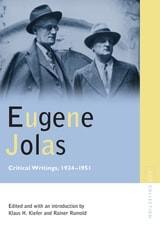
Eugene Jolas
Critical Writings, 1924-1951Eugene Jolas
Northwestern University Press, 2009
Dividing his youth between the United States and the bilingual Alsace-Lorraine, Eugene Jolas (1894–1952) flourished in three languages. As an editor and poet, he came to know the major writers and artists of his time and enjoyed a pivotal position between the Anglo-American and Continental avant-garde. His editorship of transition, the leading avant-garde journal of Paris in the twenties and early thirties, provided a major impetus to writers from James Joyce (whose Finnegans Wake was serialized in transition) to Gertrude Stein, and Samuel Beckett, with first translations of André Breton, and Franz Kafka, among others. Jolas’s critical work, collected in this volume, includes introductions to anthologies, manifestoes like the famous Vertical, essays, some published here for the first time, on writers as various as Novalis, Trakl, the major Surrealists, Heidegger, and other philosophers. An acute observer of the literary scene as well as of the roiling politics of the time, Jolas emerges here in his role at the very center of avant-garde activity between the wars. Accordingly, this book is of signal importance to anyone with an interest in modernism, avant-garde, multilingualism, and the culture of Western Europe in the first half of the twentieth century.
Extraordinary Measures
Afrocentric Modernism and 20th-Century American PoetryLorenzo Thomas
University of Alabama Press, 2000
From early 20th-century writings to present-day poetry slams, African American poetry exhibits an impressive range of style and substance. Lorenzo Thomas has written an important new history of the genre that offers a critical reassessment of its development in the 20th century within the contexts of modernism and the troubled racial history of the United States.
Basing his study on literary history, cultural criticism, and close readings, Thomas revives and appraises the writings of a number of this century's most important African American poets, including Margaret Walker, Amiri Baraka, Askia M. Toure, Harryette Mullen, and Kalamu ya Salaam. Thomas analyzes the work of Fenton Johnson within the context of emerging race consciousness in Chicago, contributes to critical appraisals of William Stanley Braithwaite and Melvin B. Tolson, and examines the Black Arts Movement of the 1960s and 1970s. Throughout the book, Thomas demonstrates the continuity within the Afrocentric tradition while acknowledging the wide range of stylistic approaches and ideological stances that the tradition embraces.
By reassessing the African American poetry tradition, Thomas effectively reassesses the history of all 20th-century American literature by exploring avenues of debate that have not yet received sufficient attention. Written with intelligence and humor, his book is itself an extraordinary measure that reflects years of scholarship and opens up African American poetry to a wider audience.